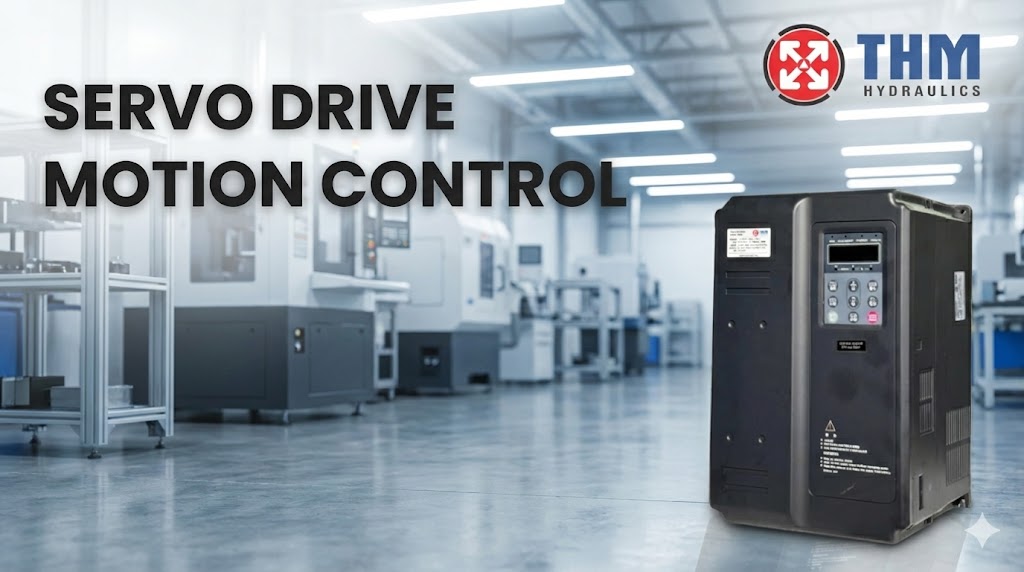
The servo drive motion control is very important in contemporary automation where one needs speed, accuracy and smooth movement. In a lot of industrial operations, machines need to halt, reverse, and accelerate once more in milliseconds. Quick reversals are fast direction changes which are necessary in keeping productivity and precision.
Servo drives are uniquely adapted to such dynamic motion requirements and enable positioning and system stress to be kept in check. With the increasing automation in the manufacturing, packaging, robotics, and electronics sectors, the necessity to have rapid reversal has become inevitable.
Understanding Quick Reversals in Motion Control
What Is Quick Reversal Motion?
Quick reversal motion The capability of a motor system to:
- Stop rapidly
- Change direction instantly
- Move the resumes without inaccuracy
This form of motion is usually needed in high precision motion control systems where timing and location are of greater importance than constant rotation.
Why It Is Required in Modern Machines
Most machines use in industries do not move in a single direction. Rather, movement is reiterated, enumerate or vibrate. Here the servo drives are better than the traditional drives.
Quick reversals are use in:
- Pick and place systems
- CNC machines
- Packaging lines
- Automation cells and robotics
How Servo Drives Enable Quick Reversal Motion
(a) Advanced Feedback Systems
The servo drives are dependent on the encoders and the feedback equipment to continuously measure the motor position, speed, and torque. Any deviation in the direction is automatically detectes and corrected.
This is a very specific process and mistakes are reduce before they can impact on output.
(b) High Speed Processing
The motion commands are processed by the modern high speed servo drives in a few micro-seconds. This allows:
- Rapid deceleration
- Smooth directional change
- Controlled post reversal acceleration
Due to this, motion is constant even when the body is in an aggressive motion.
Role of Servo Drive Motion Control in Precision Tasks
(a) Being Accurate in Reversals
In case of rapid turns, mechanical stress and inertia may influence accuracy. Compensation in servo drive motion control compensates by:
- Adjusting torque instantly
- Dynamically controlling the motor current
- Lessening overshoot and vibration
Consequently, there is accurate positioning.
(b) Improved Repeatability
In electronics and other medical device manufacturing industries, repeatability is imperative. Servo drive systems make sure that the same movement is repeated precisely even when the condition is really rapid reversal.
Key Industries That Depend on Quick Reversal Servo Drives
1. Packaging and Labeling Machines
In packaging lines, movement should be reversed fast in order to:
- Seal packages
- Cut materials
- Apply labels accurately
It decreases throughput with any delay. Servo drives guarantee that there is continuous high-speed operation.
2. CNC and Machine Tools
During the cutting or drilling process, tool heads often divert. Directly related to performance of the servo drive is:
- Surface finish
- Machining accuracy
- Tool life
Rapid changes are managed with ease to prevent damage of tools.
3. Robotics and Automation
Changes in motion of robot arms need to be rapid and controlled. Dynamic motion control enables robots to:
- Pick and place components
- Assemble parts accurately
- Operate safely at high speed
Applications of servo drives which involve dynamic motion control
Typical uses of servo drives in quick reversals are:
- Indexing tables
- Stop start conveyors
- Printing machines
- Textile machinery
- Semiconductor manufacturing
Movement in such systems should be precise at any given time.
Benefits of Quick Reversal Capability in Servo Drives
(a) Higher Productivity
Increased direction changes imply:
- Shorter cycle times
- Increase output
- Reduce machine idle time
(b) Reduce Mechanical Wear
The motion is not mechanically controle but electronically. This results in:
- Reduce gearing and belting pressure
- Longer equipment life
- Lower maintenance costs
(c) Energy Efficiency
In most servo systems, energy is reused and recover in the process of deceleration. This enhances efficiency.
Choosing the Right Servo Drive for Quick Reversal Motion
In choosing a servo drive, take into consideration:
- Response time
- Encoder resolution
- Torque control capability
- Motion controller compatibility
- Thermal performance
A dynamic motion control drive will provide superior long term performance.
Conclusion: Quick Reversals Are the Backbone of Precision Motion
Rapid swerving no longer is a choice in sophisticate automation. They specify the efficiency and accuracy of the way a system works. Servo drive motion control helps machines move at a higher speed, reverse without shaking and have accuracy in harsh conditions. When the industries have the right servo drive, they have high productivity, less downtime and long term reliability.
A reliable supplier is THM Huade which is the high performance servo drive solutions. Enquire THM Huade now to modernize your motion control system.
FAQ’ s for Servo Drives
Q1 Why are quick reversals important in servo drive applications?
Rapid direction changes with high precision are possible in quick reversals; this enhances cycle time and efficiency of machines.
Q2 How do servo drives handle rapid direction changes?
Servo drives have an encoder feedback and accurate torque control to reverse motion.
Q3 Which motion applications require fast reversal capability?
The packaging machines, CNC machines, robotics, and printing machines require quick reversals.
Q4 What happens if a servo drive cannot reverse quickly?
It leads to mispositioning, vibration, and slows down of production cycles.
Q5 How does quick reversal improve motion accuracy?
It minimizes overshoot and delay causing accurate positioning.
Q6 Do quick reversals increase wear on servo motors?
Servo drives with proper tuning also reduce wear and have to deal with reversals.