Selecting the right pump is among the most significant choices in case of dealing with a hydraulic power pack. The controversy of Gear pump vs piston pump is highly prevalent due to the fact that both of the types of pumps play important albeit different roles. Although they might appear to be like beginners, their design, performance and applications vary largely. Knowing such differences can assist you to save on expensive mistakes, minimize downtimes, and enhance efficiency of the systems.
The pump is regarded as the core of the hydraulic power pack in the context of industrial settings. When incorrect pump is chosen, the performance of the system may be impaired, energy may be wasted, and parts may be damaged too soon.
The guide will ensure that you are able to distinguish a Hydraulic gear pump and a Hydraulic piston pump with minimal and practical observations.
Why Pump Identification Matters in a Hydraulic Power Pack
Every hydraulic power packs depend on pump to produce flow and this produces pressure when opposition is experienced. But this is not true with all pumps.
The proper identification of pumps assists you:
- Identify performance issues in a short time.
- Choose appropriate substitutes.
- Avoid pressure related failures.
- Enhance machine stability.
- Increase efficiency in energy use.
Repeated system failures have in most cases been caused by misidentification of pumps.
Understanding Hydraulic Power Pack Pump Types
To make a comparison on designs, it is good to know the two most common types of Hydraulic power pack pumps used:
- Gear Pump – The most common one is used in standard-duty.
- Piston pump – This is applied where greater pressure and efficiency is needed.
They both are of the type of Industrial hydraulic pumps but the way their inner mechanism works is very different.
What is a Gear Pump?
A Gear pump is a positive displacement pump, which operates with meshing gears to pump hydraulic fluid. It is popular due to its simplicity, durability and reduced price.
The Major features of a Hydraulic Gear Pump:
- Basic in-house building
- Fixed displacement design
- Continuous fluid delivery
- Appropriate to low to medium pressures.
- Cost-effective solution
Between rotating gears and the pump housing, fluid is confined and is forced to the outlet.
What is a Piston Pump?
A Piston pump involves the use of reciprocating pistons that are fitted within a cylinder block. It is precise, high pressure and high efficiency.
The principal Features of a Hydraulic Piston Pump:
- Complex internal mechanism
- High-pressure capability
- Displacement options that are variable.
- Greater efficiency
- Used in favor of demanding systems.
These pumps are normally applicable in cases where a High pressure hydraulic pump is needed.
Gear Pump vs Piston Pump – Core Differences
Although both hydraulic fluid is driven by the pumps, its actions within a Hydraulic power pack are highly dissimilar.
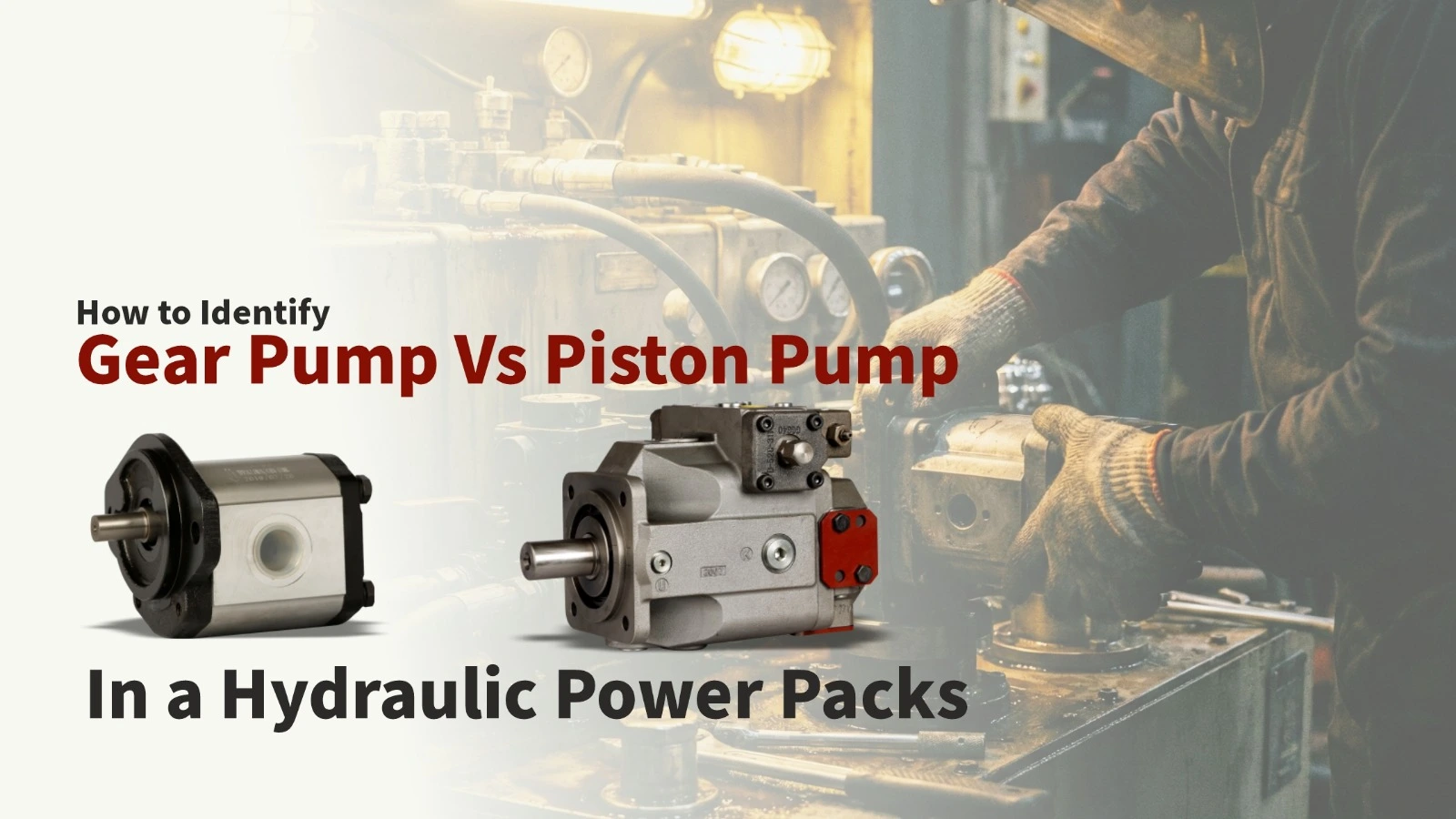
1. Visual Identification
External features can be used to identify a pump.
Gear Pump Appearance:
- Compact, box-like housing
- Fewer external components
- Direct inlet/outlet ports.
- Lighter overall structure
Piston Pump Appearance:
- Bulkier body
- Frequently contains control mechanisms.
- May have adjustment screws
- More complex design
Piston pumps are in most cases larger to the eye.
2. Noise and Operating Sound
Sound may give useful hints.
Hydraulic Gear Pump:
- Generally gives a continuous whine.
- Wear increases the noise level.
- Vibration may be felt
Hydraulic Piston Pump:
- Typically runs smoother
- When healthy, less audible noise.
- Operation feels refined
One should never underestimate excessive noise as there may be internal damage that is underway.
3. Pressure Capability
One of the key differentiators is pressure handling.
Gear Pumps:
- Constructed to operate at low- to -moderate pressures.
- There is a performance degradation at high loads.
- Stress reduces efficiency.
Piston Pumps:
- Made to work under high pressure.
- onstant performance at heavy loads.
- Favorite in application demanding.
In case of high pressure that is extremely high, a piston pump is usually employed.
4. Hydraulic Pump Working Principle
Knowledge of the Hydraulic pump principle of working makes it easy to identify.
- Gear Pump Principle: Gear rotation forms fluid movement. The flow is fixed and the displacement is fixed.
- Piston Pump Principle: The movement of fluid is produced by the reciprocation of pistons. Flow and displacement can be varied.
The piston mechanism is more easily controlled and effective.
5. Efficiency and Performance
Piston pumps are normally used to enhance their energy efficiency.
Gear Pump Performance:
- Adequate for basic systems
- Reduced efficiency at high pressure.
- More heat may be generated
Piston Pump Performance:
- Increased volumetric efficiency.
- More appropriate towards fine tasks.
- Reduced operating cost over the long-term.
Piston pumps are widely recognized to work well in developed systems.
Practical Tips to Identify the Pump
In case you do not know what type of pump is in place, do the following simple tests:
- Notice pump size and construction.
- Hear noise attributes.
- Check rated pressure specifications
- Examine labels on manufacturers.
- View system design requirements.
In case of doubt, one should consult the experts.
Common Application
System needs determine the choice of a pump.
Use of Hydraulic Gear Pump is Desired When:
- Budget is limited
- Pressure specifications are average.
- System design is simple
- Ease of maintenance is a consideration.
Hydraulic Piston Pump is Preferred when:
- High pressure is required
- Efficiency is critical
- The changes in loads are substantial.
- Precision control is needed
Maintenance Considerations
With proper care, pump lifespan can be increased.
Gear Pumps:
- Easier to maintain
- Less susceptible to contaminant.
- Components wear gradually
Piston Pumps:
- Require cleaner fluid
- Averse to inadequate lubrication.
- More precise maintenance required.
The contamination is believed to be one of the top reasons of damages to the pump.
Conclusion
The right choice among a gear pump, a piston pump is not only a technicality, but a choice which directly affects the performance, efficiency and reliability. Although a Hydraulic gear pump is simple and cheap, a Hydraulic piston pump is precise and can provide a high pressure. The correct option is solely based on the demands of the system.
Whenever you are considering your hydraulic power pack or upgrading it, you should always make informed decisions.
To have professional support and high quality hydraulic components, get in touch with THM Huade team to ensure that you have a system that works at its best.
FAQ’s
Q1. What is the main difference between a gear pump and a piston pump?
Gear pump involves rotating gears to transport fluid whereas the piston pump involves reciprocating pistons which enables high pressure and efficiency.
Q2. What are the common applications of gear pumps?
The gear pumps are widely applied in the low to medium pressure hydraulic systems, lubrication systems, and general industrial machines.
Q3. How do piston pumps work in hydraulic systems?
Piston pumps produce flow by pushing back and forth the pistons within the cylinder block to allow high-pressure and accurate operation.
Q4. Which pump is better for high-pressure applications?
The design and high efficiency of the piston pumps are advantageous in the high pressure application, as they are better suited.
Q5. Are gear pumps fixed displacement or variable displacement?
Majority of the gearing pumps are fixed displacement and therefore the volume of fluid released per turn remains constant.
Q6. Why are piston pumps more expensive than gear pumps?
Piston pumps are more expensive to manufacture with a more complex design, more precise components and more sophisticated control mechanisms.