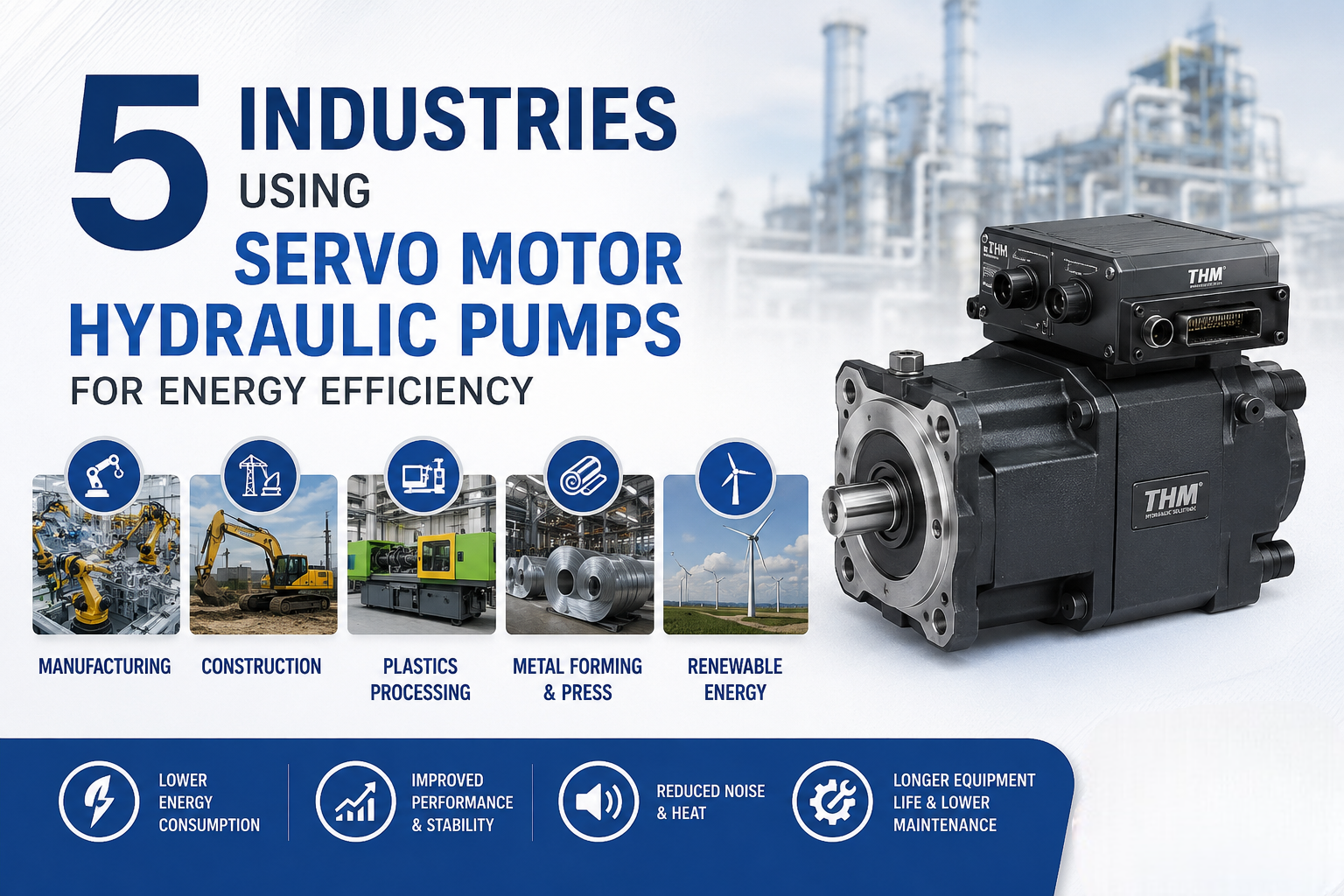
Across factory floors in India and abroad, one pattern keeps appearing: engineers who switched from fixed-speed hydraulic systems to servo motor hydraulic pumps rarely go back. The reason is straightforward. A conventional hydraulic pump runs at full speed regardless of demand. A servo-driven system matches pump speed to actual load in real time, drawing power only when the work requires it. The energy gap between those two approaches is not marginal.
Compared to traditional fixed-speed pump systems, servo-driven pumps can achieve energy savings of up to 80%, depending on the duty cycle, because the pump operates only when needed, eliminating idle losses, and energy recuperation during deceleration offsets input power demands. That figure shifts the economics of entire production lines. The industries below have moved furthest in adopting this technology, and the operational data from each tells a consistent story.
The Core Advantage Before the Industry Examples
Understanding why a servo motor hydraulic pump performs differently from a standard pump makes the application data easier to interpret.
If you have a hydraulic cylinder run by a servo motor driven pump, there is no energy being consumed when the cylinder is not moving. As soon as the cylinder starts to move, the motor spins to drive the pump at the speed required to get the necessary velocity. The speed of the motor is exactly matched to the speed of the hydraulic device it is connected to, going from zero to maximum speed as needed, perfectly matched to the amount of energy required to do the work.
A standard AC motor cannot behave this way. It spins continuously, even when nothing needs moving. That idle consumption is waste by definition. The industrial servo drive that governs the pump eliminates it.
1. Plastics and Injection Molding
This was the first industry to adopt variable-speed hydraulic pump technology at scale, and the adoption happened for a direct commercial reason: plastics processing is cost-sensitive, and energy is a major input.
Traditional hydraulic injection molding machines use a constant-speed motor to drive the hydraulic pump even when the machine is idle, such as during part cooling or demolding, and this always-on design wastes up to 60% of energy. A servo-hydraulic machine removes that waste by shutting off the motor during non-productive phases of the cycle.
Research on injection molding machines driven by different electro-hydraulic power unit configurations shows that a fixed displacement pump driven by a servo motor can reduce energy consumption by up to 87% compared to a fixed displacement pump driven by a standard asynchronous motor.
For THM Huade customers running plastics processing lines, the IGP internal gear pump series paired with a servo motor drive offers the pulse-free, smooth flow these machines require.
2. Die Casting
Die casting shares the same on-demand hydraulic demand profile as injection molding: intense pressure during injection and clamping, near-zero demand during cooling and ejection. A fixed-speed pump cannot adapt to that cycle. A servo motor hydraulic pump is purpose-suited to it.
Variable pump speed technology adjusts the pump speed based on real-time requirements. When less hydraulic volume is needed, the motor slows down, conserving energy. When demand increases, the motor speeds up, optimizing flow and pressure. This dynamic system reduces energy consumption by approximately 40% compared to constant-speed motor systems, with a measurable return on investment achieved in a short timeframe.
The secondary benefit in die casting environments is heat reduction. Servo-driven systems generate less heat during operation because they are not continuously churning fluid under pressure. That reduction in thermal load lowers oil cooling requirements and extends fluid life, both of which reduce operating costs beyond the direct energy saving.
3. Metal Forming and Hydraulic Press Operations
Metal forming presses, stamping, deep drawing, forging, and hydroforming, operate with highly variable load profiles. The press demands maximum force at the forming point of each stroke and minimal force during return travel. Conventional hydraulic systems size the pump for peak demand and waste energy across every other phase.
An industrial servo drive governing the hydraulic pump changes that equation. In a hydraulic press for deep die operation, electro-hydraulic actuators with closed-loop servo control were used at four separate cushions of the machine, and during deep drawing operation, energy was recovered from the die cushion machine to the ram actuator, demonstrating the energy recovery potential of these systems.
Servo-driven pressing systems deliver energy savings of 30 to 50% versus conventional hydraulic systems, while lower scrap rates result from closed-loop control ensuring consistent quality and reducing material waste by 5 to 20%.
4. Aerospace and Defense Testing
Aerospace applications demand something different from the industries above: not just energy efficiency, but control precision under dynamic, high-frequency load cycles. Flight control actuation, landing gear systems, and structural fatigue test rigs all require hydraulic systems that respond within milliseconds and hold position with sub-millimeter accuracy.
Servo motor pumps play a decisive role as central power and control elements in electro-hydrostatic actuators, and internationally recognised hydraulic companies have introduced them for aerospace and high-value industrial applications.
Unlike traditional centralized hydraulic systems, electro-hydrostatic actuators integrate the electric motor and hydraulic pump into a compact unit, eliminating long hoses and reducing energy losses, leakage, and maintenance. They generate pressure only when needed, minimizing idle losses, and with closed-loop servo control offer precise positioning and fast dynamic response, with natural frequency in the range of 30 to 50 Hz sufficient for many industrial applications.
5. Automotive Manufacturing
Automotive body shops, press lines, and assembly fixtures represent one of the largest installed bases for hydraulic equipment anywhere in manufacturing. The transition to servo motor hydraulic pumps in this sector is being driven by two converging pressures: tightening energy efficiency targets and the increased use of high-strength steels that demand precise force control.
In the automotive sector, electro-hydraulics are being used to power electric and hybrid vehicle systems while reducing energy consumption and emissions, and these systems have become increasingly popular in industries requiring fine control over movements including automotive manufacturing and robotics.
Servo-hydraulic systems also support the shift to mixed-material vehicle platforms. Forming aluminium alloys and advanced high-strength steels in the same press line requires the ability to vary force profiles across part families without mechanical retooling. A servo motor drive on the hydraulic pump enables that variation through software parameter changes, not mechanical adjustments.
Choosing the Right System Configuration
Not every application needs the same servo-hydraulic architecture. The table below outlines typical selection criteria across the five industries covered.
| Industry | Key Demand Profile | Typical Savings vs Fixed Speed | Primary Benefit |
| Plastics/Injection Molding | Cyclic, long idle phases | 50–87% | Energy and part consistency |
| Die Casting | High-pressure short cycles | ~40% | Energy and oil cooling |
| Metal Forming | Variable load, recoverable energy | 30–50% | Press force control and energy recovery |
| Aerospace Testing | High-frequency, precision-critical | Varies by duty cycle | Positional accuracy and dynamic response |
| Automotive Manufacturing | Mixed-material, high-volume | 40–70% | Cycle time and force profile flexibility |
The common thread across all five is the industrial servo drive governing the pump. Without precise speed and torque control at the motor, the hydraulic system cannot respond to demand fast enough to eliminate idle and throttling losses.
Conclusion
The shift to servo motor hydraulic pumps is not a future transition for these industries. It is already the dominant architecture in new equipment specifications across plastics, die casting, metal forming, aerospace, and automotive. The energy savings are verified, the control benefits are documented, and the payback periods across most applications are measured in months rather than years.
For engineers and procurement teams specifying hydraulic power units, the question is no longer whether to move to servo-hydraulic systems. It is which configuration, which pump family, and which industrial servo drive combination fits the specific duty cycle and pressure requirements of the application. Contact THM Huade’s engineering team to discuss the right servo pump specification for your process.
Frequently Asked Questions
What is a servo motor hydraulic pump and how does it differ from a standard hydraulic pump?
A servo motor hydraulic pump pairs a variable-speed servo motor with a hydraulic pump, adjusting output in real time based on system demand. Unlike a standard fixed-speed pump that runs continuously at full load, a servo-driven pump consumes power only when the hydraulic circuit requires flow or pressure, eliminating idle losses entirely.
How much energy can a servo motor hydraulic pump save in industrial applications?
Energy savings depend on the duty cycle of the application. In injection molding, verified reductions of 50 to 87% have been documented. Die casting and metal forming typically show 30 to 50% savings.
What role does an industrial servo drive play in a hydraulic system?
An industrial servo drive is the electronic controller that governs the servo motor’s speed and torque in real time. It interprets demand signals from the hydraulic circuit, pressure, flow, or position sensors, and adjusts motor output accordingly.
Are servo motor hydraulic pumps suitable for high-pressure applications?
Yes. Modern servo-driven axial piston and internal gear pumps are rated for continuous operating pressures up to 350 bar. The servo motor drive governs speed and flow, while the pump’s mechanical design handles pressure capacity.
How does a servo motor drive improve part quality in injection molding?
By regulating pump speed precisely, a servo motor drive holds hydraulic pressure within very tight tolerances, in some systems, within ±0.5 bar of the set value. That pressure stability translates directly to consistent fill rates and holding pressures during the molding cycle, reducing dimensional variation and defect rates in precision parts.
Can existing hydraulic systems be retrofitted with servo motor drives?
Many existing fixed-speed hydraulic power units can be retrofitted by replacing the induction motor with a permanent magnet servo motor and adding a servo drive controller. Feasibility depends on the mechanical coupling configuration, pump type, and control system compatibility.