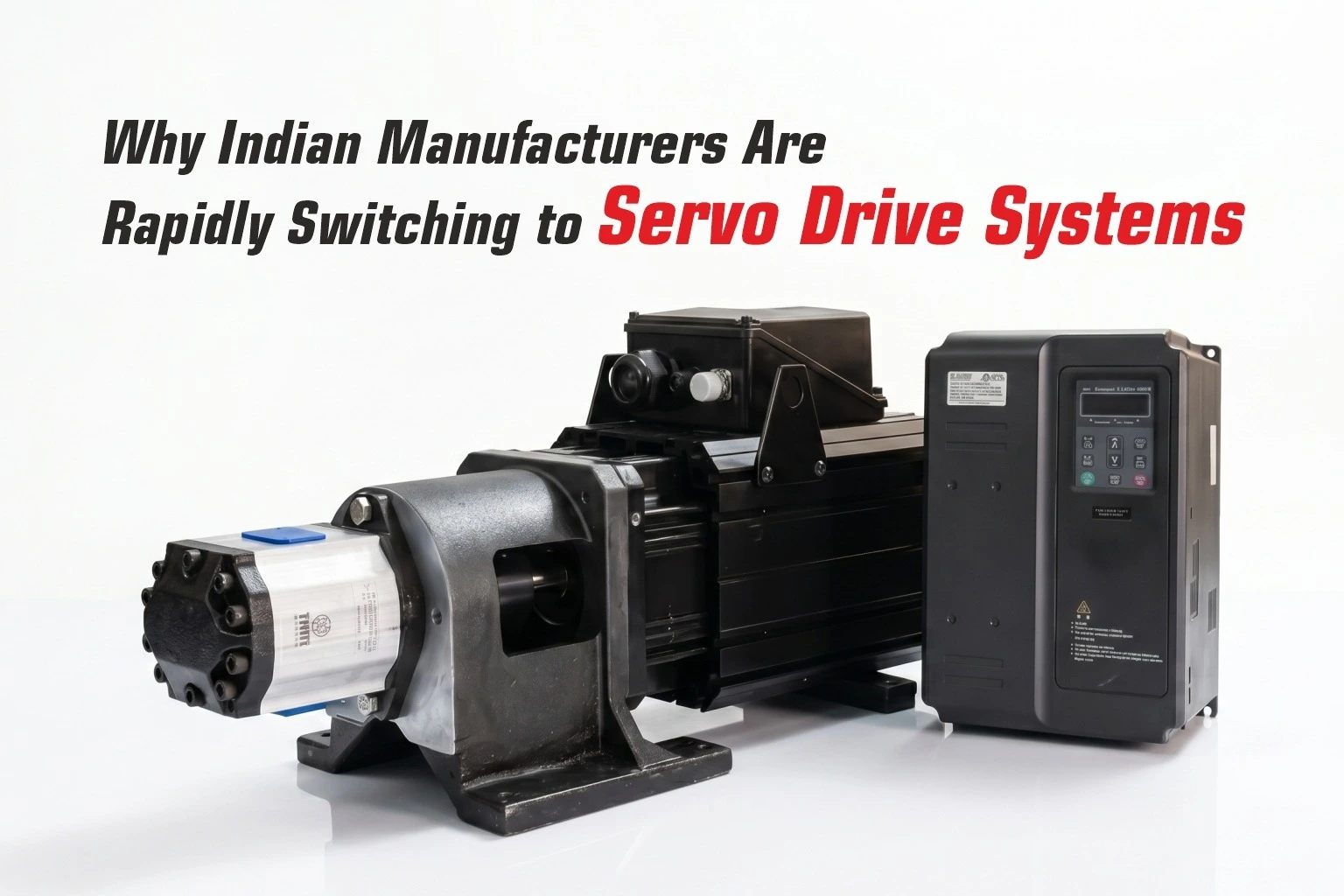
A Servo drive system is turning out to be one of the most significant technologies in contemporary manufacturing. The Indian industries are constantly under pressure to increase the speed of production, lowering the cost of energy and increasing its precision. Due to these dynamic needs, a large number of manufacturers are shifting their focus away more traditional motor control systems, and are investing in more advanced servo drive systems.
Starting with plastic machinery and moving on to the packaging lines and CNC equipment, the transformation is occurring at a very rapid pace. An appropriately paired servo motor and drive can provide precision in motion control, improved response, and even greater efficiency. The servo technology is no longer a choice anymore to Indian manufacturers who are keen on quality and productivity, the servo technology is slowly becoming a smart competitive edge.
Why the Shift is Happening Faster in India
Rapid change is taking place in Indian manufacturing. Companies desire enhanced production, reduced wastage, and enhanced machine work.
Main reasons behind the transition:
- Increase in electricity and operating costs
- Request to increase the accuracy of production
- Increase in automation in factories
- Require increased production cycles
- Pressure to reduce downtime
Due to these issues, automation in manufacturing India is becoming increasingly popular, and servo technology is being implemented in a variety of industries.
Better Precision Means Better Product Quality
Motion accuracy is one of the largest reasons why manufactures prefer servo systems.
A conventional motor can exist, but is not always capable of giving the same amount of accurate speed, torque, and position control. A servo drive system is capable of making minor adjustments on the spot, and this allows the machines to be consistent in their output.
Why this matters:
- Better dimensional accuracy
- Consistent product quality
- Reduced rejection rates
- Less material waste
This is particularly significant in servo motor applications like packaging, injection molding, printing and CNC machining.
Lower Energy Consumption Is Driving Adoption
One of the concerns of Indian factories is the power bill.
One of the key benefits of servo drives is energy efficiency. Servo systems just consume the energy required to carry out the precise task. Conventional motor systems are easy to waste power than necessary.
Energy-saving advantages:
- The use of power is done when necessary
- Less heat generation
- Lower operating costs
- Increased efficiency of the machine as a whole
According to this, in the long run, these savings render the investment worth, to most manufacturers.
Faster Response Improves Production Speed
The more the machine runs the more it produces.
An industrial servo drive is fast to react to variations in load, velocity or motion need. Such rapid reaction enhances cycle time and assists manufacturers become more productive.
Production benefits:
- Quick acceleration and deceleration
- Smooth speed control
- Reduced machine vibration
- Better cycle consistency
These are the enhancements that are making Indian industries remain competitive in international markets.
Servo Drive vs VFD: Why Manufacturers Compare Both
Most companies compare servo drive vs VFD before modernizing the systems.
A VFD can be used to control the speed of a simple device, but the precision and dynamic range of servo systems are much more precise.
Simple comparison:
| Feature | Servo Drive System | VFD |
| Position control | Excellent | Limited |
| Torque control | Highly accurate | Moderate |
| Speed response | Very fast | Slower |
| Best for | Precision automation | Basic motor control |
Servo systems are becoming the choice of high-accuracy applications.
Industries in India That Are Adopting Servo Systems
This change can be observed in various industries.
Industries that are using the technology of servo.
- Plastic injection molding
- Packaging machinery
- Textile equipment
- CNC machines
- Printing machines
- Material handling systems
Such industries are highly dependent on industrial automation solutions to enhance performance and minimise waste.
Common Servo Motor Applications in Manufacturing
Servo systems find extensive application in areas where a controlled motion is important.
Popular applications:
- Positioning systems
- Indexing tables
- Robotic arms
- Conveyor synchronization
- Accurate cutting and shaping
These applications of servo motors are in need of accuracy, speed and repeatability.
What Indian Manufacturers Should Check Before Upgrading
There are a couple of things that ought to be considered before the change to servo systems.
Important selection tips:
- Understand your load requirement
Calculations should be made on torque and speed requirements.
- Test available compatibility with machines
The servo motor and drive must blend well into the system.
- Check operating environment
They should be temperature, dust and vibration.
- Everything revolves around long-term value
The initial investment is often justified by the lower downtime and energy savings.
Why the Future of Indian Manufacturing Looks Automated
India is headed towards smarter factories.
Manufacturers desire systems which provide:
- Higher efficiency
- Better process control
- Lower production costs
- Faster production cycles
- Improved product consistency
Due to this, automation in manufacturing India is not decelerating. Servo technology is getting into that long term industrial transformation.
Conclusion
A Servo drive system is no longer an advanced option, but a practical need of Indian manufacturers wishing to have precision, efficiency and long term productivity. The increasing energy prices, stiff competition and the demand to maintain quality are all driving industries towards smarter control systems.
The manufacturers that currently adopt servo technology will be creating faster, cleaner, and efficient production levels tomorrow.
To have the best and high functioning servo solutions, THM Huade offers technology that is designed to work in the modern manufacturing.
Upgrade your machines to THM Huade servo drive systems and improve your production efficiency to the next level time to upgrade your machines with THM servo drive systems and to put your production efficiency on steroids.
FAQ’s
Q. What is a servo drive system and how does it work?
Servo Drive Systems regulate the speed, position and torque of the servo motors as per the instruction given by the controller and optimize the operation of the motor as needed.
Q. Why are Indian manufacturers adopting servo drive systems rapidly?
Currently, the Indian manufacturing companies have started using servo drive systems to improve their production accuracy, use lesser energy, increase automation and gain working efficiency.
Q. How do servo drives improve efficiency in industrial automation?
Through accurate motion control, faster response, and energy-efficient operations, servo drives assist in reducing the energy waste and improving the productivity of machines.
Q. What is the difference between a servo drive and a VFD?
The reason for the fast adoption of servo systems among Indian manufacturers is that it helps them gain efficiency and automation during the production process.
Q. Are servo drive systems cost-effective for small and medium industries in India?
The servo drive system is used to provide accurate motion control, respond fast, and save energy so as to save on energy consumption.