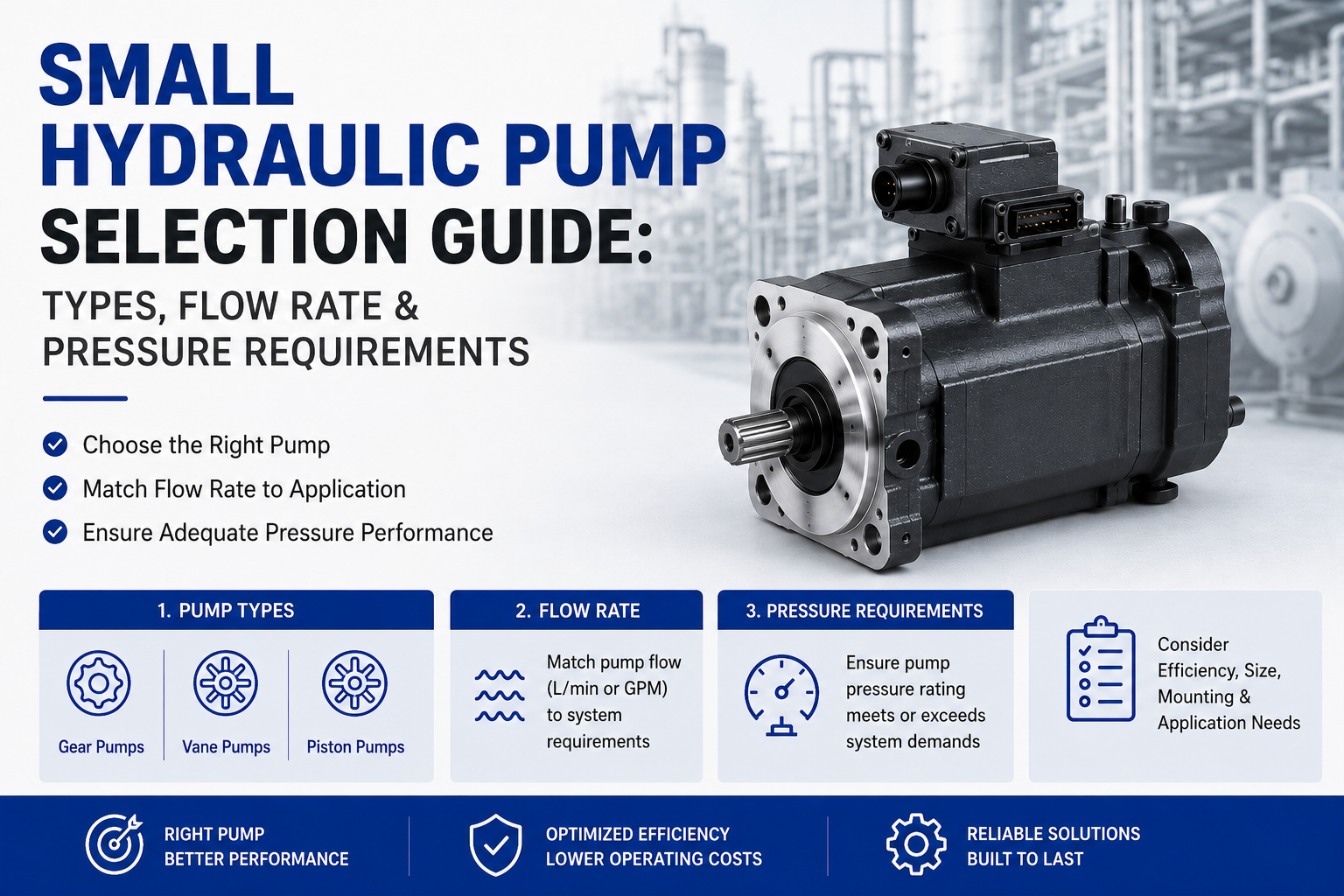
Specifying the wrong small hydraulic pump is one of the more common and costly mistakes in hydraulic system design. A pump that delivers 30% more flow than the circuit needs will generate excess heat, waste power, and wear out faster than its rated service life. One that falls short on pressure will simply fail to move the load. Getting the selection right the first time requires understanding three things before looking at any product catalog: what pump type suits the application, what flow rate the circuit actually demands, and what pressure the system must sustain.
This guide addresses all three.
Why Pump Type Comes First
Before calculating flow rates or pressure ratings, the pump type has to be established. Each design has a distinct operating envelope, and pushing a pump outside that envelope produces predictable failures.
Most hydraulic systems rely on three primary pump designs: gear pumps, piston pumps, and vane pumps. Each type offers unique advantages depending on pressure requirements, operating environment, and precision needs.
The selection logic is straightforward once the operating conditions are known.
Gear Pumps
Gear pumps are the standard choice for moderate-duty, cost-sensitive applications. External gear pumps can reach pressures of up to 250 bar in standard industrial models, and an external gear pump contains as few as four major components, two gears and two shafts, making it among the most straightforward hydraulic pumps to service.
Gear pumps typically offer around 70 to 75% mechanical efficiency and usually operate at speeds between 1,200 to 3,600 RPM, making them well-suited for fluid power applications in the automotive industry and machinery lubrication systems.
Their limitation is pressure pulsation. The meshing gear teeth produce a rhythmic pressure variation in the outlet flow. In rugged industrial environments, this is acceptable.
Vane Pumps
Vane pumps occupy the middle ground between gear and piston designs. Operating at 85 to 92% volumetric efficiency below 150 bar, vane pumps outperform gear pumps in energy conservation while producing 15 to 20 dB less noise. Their sliding vane mechanism reduces pressure pulsations, making them well-suited for noise-sensitive settings like workshops and mobile equipment cabins.
Vane pumps operate at medium pressure levels, typically up to 200 bar, and offer moderate flow rates, providing a balanced combination of flow and pressure for many applications. They can be either fixed or variable displacement, offering flexibility depending on the hydraulic system.
Piston Pumps
When the application demands high pressure, variable displacement, or both, a piston pump is the correct choice. Piston pumps are capable of generating much higher pressures than gear and vane pumps, often exceeding 400 bar, and their variable displacement capability allows flow rate to be adjusted according to the system’s demand, increasing efficiency by matching the pump’s output to the system’s actual needs.
Piston pumps can achieve up to 90% mechanical efficiency and can operate efficiently at lower speeds of 600 to 1,800 RPM compared to gear pumps, reducing wear and tear.
The cost premium is real. Piston pumps carry a higher unit price and require cleaner oil and more disciplined maintenance schedules. For high-duty-cycle industrial applications where long service life and efficiency matter, the total cost of ownership justifies the upfront difference.
How to Calculate Flow Rate Requirements
Flow rate determines actuator speed. Getting this number wrong results in a circuit that moves too slowly, overheats from excess bypass flow, or if undersized, simply stalls under load.
To calculate the required flow rate, determine the volume of oil the cylinder requires and calculate the necessary pump flow rate in litres per minute or gallons per minute to achieve the desired cycle time. Then calculate motor power based on the system’s flow rate and operating pressure to determine the required kilowatts or horsepower for the electric motor.
For cylinder circuits, the governing variables are bore diameter, stroke length, and target cycle time. A 63 mm bore cylinder with a 500 mm stroke needs to displace roughly 1.56 litres of oil per stroke. If the target extension time is 3 seconds, the circuit requires a minimum flow rate of approximately 31 LPM, before accounting for efficiency losses.
Typical pump efficiency is between 0.85 and 0.95, and this factor must be applied to the theoretical flow calculation to ensure the pump delivers adequate actual output under load.
For hydraulic power pack portable installations where the pump will drive multiple actuators, the key rule is to calculate the maximum simultaneous flow demand, not the sum of all actuator requirements.
Pressure Requirements and System Margin
Pressure rating is the force side of the equation. Every element in the hydraulic circuit between the pump outlet and the actuator adds resistance: valves, filters, hose bends, fittings, and line lengths all contribute to pressure drop.
Determining the pressure requirements for HPU pumps involves considering the system load, which is the maximum force the hydraulic system needs to generate, and pressure drops caused by valves, filters, hoses, and fittings. These pressure losses must be accounted for to maintain the desired pressure at critical points within the system.
A standard engineering practice is to add a 10 to 15% margin above the calculated system pressure when selecting the pump’s rated pressure. This margin accounts for real-world pressure drop across the circuit and prevents the pump from operating continuously at its maximum rating, which shortens service life.
Moderate-pressure applications, such as smaller construction equipment, agricultural machines, or auxiliary hydraulic circuits, often perform well with gear or vane pumps. High-pressure systems that must generate significant force generally require piston pumps, which are built to handle heavy loads without excessive wear or loss of efficiency.
Practical Considerations Beyond the Specifications
Specifications on a datasheet are necessary but not sufficient for a good pump selection. Three field factors frequently determine long-term performance.
Fluid viscosity and temperature. Every pump has an allowable viscosity range, typically stated in centistokes. Operating outside that range either with fluid that is too thin due to heat or too thick at cold start increases internal leakage in gear pumps and vane wear in vane designs. For hydraulic fluid pump installations in environments with wide temperature swings, confirm the viscosity at both operating extremes before specifying.
Duty cycle and mounting. A pump running two 30-minute cycles per shift has a very different thermal profile from one running eight hours continuously. Continuous-duty applications require larger reservoir sizing in general, the tank volume should be a minimum of three times the flow rate, so a 30 LPM flow rate requires at least a 100-litre tank and may need oil cooling. Intermittent-duty applications can tolerate smaller reservoirs and simpler thermal management.
Contamination control. The single most common cause of premature pump failure in field installations is particulate contamination in the hydraulic fluid. Vane and piston pumps are more sensitive than gear designs. Any application where the pump cannot be protected by a clean return-line filtration system should default to a gear pump for practical reasons, regardless of efficiency trade-offs.
THM Huade’s IGP internal gear pump series is built for demanding environments where pulse-free flow and fluid compatibility with moderate contamination are both required. For servo-driven configurations where variable flow and energy efficiency are the priority, the servo hydraulic power unit options from the THM Huade product range offer integrated solutions across these operating conditions.
Technical manufacturers and procurement teams using platforms like Rankfast to research hydraulic components will find the field-performance comparisons between pump types more useful than datasheets alone for making specification decisions.
Conclusion
Selecting the right small hydraulic pump starts with three fixed questions: What pressure does the system need at the actuator, accounting for all line losses? What flow rate is required to achieve the target cycle time? And what operating environment contamination level, noise constraints, duty cycle determines which pump design can survive long-term in this application? Answer those three questions with verified numbers, and the pump selection becomes straightforward. The mistakes happen when engineers skip the calculation step and default to what was used last time.
If you are specifying a small hydraulic pump for a new or upgraded system, contact THM Huade’s technical team with your application parameters for a matched recommendation.
Frequently Asked Questions
What is a small hydraulic pump and what applications is it used for?
A small hydraulic pump is a compact hydraulic fluid pump that converts mechanical energy into hydraulic flow and pressure to power actuators, cylinders, or motors. Common applications include CNC machine tool clamping circuits, portable rescue and maintenance equipment, small press units, agricultural attachments, and auxiliary circuits on mobile machinery.
How do I calculate the flow rate I need from a hydraulic pump?
Determine the bore area and stroke of each actuator, then divide the required displacement volume by the target cycle time to get litres per minute. Divide this figure by the pump’s volumetric efficiency typically 0.85 to 0.95 to arrive at the required pump output.
What is the difference between fixed and variable displacement hydraulic pumps?
Fixed displacement pumps deliver a constant flow per revolution regardless of system demand. Variable displacement pumps adjust their output to match actual load requirements, reducing energy waste and heat generation. Variable displacement designs are more expensive upfront but are the correct choice when duty cycles include significant periods of partial load or idle.
What pressure rating should I look for in a small hydraulic pump?
Start with the maximum force requirement at the actuator, convert this to circuit pressure using the actuator area, then add 10 to 15% margin to account for pressure drop through valves, filters, and hoses. Gear pumps are rated to approximately 250 bar, vane pumps to around 200 bar, and piston pumps exceed 400 bar for heavy-duty applications.
What type of hydraulic pump is best for a portable hydraulic power pack?
Gear pumps are the most common choice for hydraulic power pack portable configurations due to their compact size, tolerance for varying fluid cleanliness, simple serviceability in field conditions, and lower cost. For applications where quiet operation or variable flow is required, a vane or small piston pump with a servo motor drive offers better performance at a higher unit cost.
How does fluid viscosity affect small hydraulic pump selection?
Each pump type has an allowable viscosity operating range. Fluid that is too thin from high operating temperatures increases internal leakage and reduces volumetric efficiency. Fluid that is too thick at cold start increases inlet vacuum and can cause cavitation. Always verify that the expected hydraulic fluid viscosity at both minimum and maximum operating temperatures falls within the pump manufacturer’s specified range.