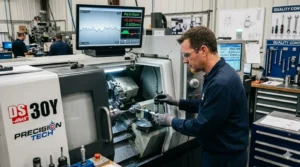
Modern industrial automation is being revolutionized by advanced servo drives that provide the highest level of control, precision and efficiency. These systems are used in applications where accurate motion is needed, they allow machines to move in a smooth manner even at low speed with the high level of torque. Robotics, CNC machines among others, industries depend on the precision servo drive technology to bring consistent performance and minimize errors in operations.
Servo systems are the intelligent control that is combined with real-time feedback as opposed to conventional motors. This enables more accurate motion control and they are best suited to the high performance industrial servo systems where precision is important.
How Servo Drives Control Motion
A servo drive controller is highly central in controlling motor movement. It takes instructions at a control system and changes the motor speed, position, and torque.
Working Process:
- Signals are sent by the controller to the motor.
- Position and speed is monitored by feedback sensors.
- It makes instant adjustments to be accurate.
- Real time motion control.
Due to this closed-loop system, it is possible to make smooth movements even when the load conditions change. To ensure accuracy, the system is constantly checked.
Low Speed, High Torque Explained
Among the largest benefits of advanced servo drives is the fact that they provide high torque at low speeds.
What Does It Mean?
- Low speed motor operates with low RPM.
- A high torque motor is one that generates high rotational force.
- Both together are used to move heavy loads accurately.
In most industrial processes the machines are required to move slowly yet with high force. This is the area where servo drives are better than the traditional systems.
As an illustration, in lifting or positioning, it needs constant torque without any abrupt action. Modern digital servo drive systems offer this ability.
Why Precision Matters in Industry
Accuracy is also crucial in those industries where a little mistake can lead to huge losses.
Importance of Precision:
- Ensures product quality
- Reduces material waste
- Enhances efficiency of machines.
- Increases safety in operations.
Precise positioning is needed in the servo motor applications like CNC machining or robotics. The slightest variance can have an impact on the end product. Thus, accuracy motion control is deemed important in the present automation-oriented world.
Inside a Servo Drive System
A full servo drive system consists of a number of components that operate in conjunction with each other to provide precise motion.
Main Components:
- Servo drive controller
- Servo motor
- Feedback device (encoder)
- Power supply
The system will be able to react fast to load and command signal variations. Maintaining stability and performance is done through continuous feedback.
Due to such a design, it is more accurate even in complex industrial servo systems.
Key Features of Servo Drives
The advanced servo drives that are used today have a number of features that enhance the performance and reliability.
Important Features:
- High Precision Control: Precision positioning and control of speed is also ensured during the operation.
- Fast Response Time: Fast response to input signals guarantees a good operation.
- Energy Efficiency: Optimal power consumption is achieved.
- Compact Design: These are systems which are usually set up to conserve space in industrial systems.
- Digital Integration: A digital servo drive enables easy connection with automation systems and controllers.
Performance Benefits in Automation
Servo drives are very popular in automation since they provide uniform and dependable functionality.
Key Benefits:
- Improved machine accuracy
- Reduced downtime
- Increased efficiency of production.
- Peasy and fluid movement.
- Capacity to cope with changing loads.
Due to these strengths, most industries are inclined to use the precision servo drive systems instead of the conventional motor solutions.
Choosing the Right Servo Drive
The choice of the right servo drive system will give the best performance.
Important Selection Tips:
Know Application Requirement
Applications of various types of servo motors need varying amounts of torque and speed.
Check Load Capacity
Select a system which is capable of supporting the needed load without loss in performance.
Evaluate Control Features
Make sure the servo drive controller will suit your automation requirements.
Take into Account System Compatibility.
The drive must fit into your current installation.
Focus on Reliability
Select reputable suppliers of industrial servo systems that are durable.
Conclusion
Precision and efficiency are more of a priority than ever in the present competitive industrial environment. State-of-the-art servo drives offer the optimal combination of low-speed operation with high torque operation and are optimal in the modern automation system. They have been important in most industrial servo systems due to their capability to provide precise and stable motion.
Servo drives are also important in enhanced manufacturing and automation processes that are done to improve productivity to product quality. Companies investing in sound precision servo drive solutions are able to perform better and have long run operational advantages.
THM Huade is a provider of hi tech systems capable of addressing the needs of the modern industry to provide trusted and high quality servo solutions. Call today to modernize your machines with the effective and strong servo drive technology.
FAQ’s
Q1. Why are servo drives used in industrial automation?
The reason why servo drives are employed is that they have accurate movement control, smooth functioning, and high precision, which is very critical in automated machines.
Q2. What are the main components of a servo drive system?
A servo drive system is composed of a servo drive controller, a motor, a feedback device (encoder), and power supply.
Q3. How do servo drives control speed and torque?
They feed back on controlling motor input to enable speed and torque to be controlled in real time.
Q4. What are the advantages of using servo drives?
They are very precise, respond quickly, consume low energy and can be controlled well as opposed to conventional motors.
Q5.How do you choose the right servo drive?
When choosing a servo drive, you must take into account the requirements by the loads, speed, torque, compatibility, and the application needs.
Q6. Are servo drives energy efficient?
Yes, servo drives are energy efficient in industrial systems because they regulate the output depending on the demand.