Precision engineering reaches its most demanding form when working with a small hydraulic cylinder. In industries where compact motion control defines performance, even a few microns of error can compromise an entire Hydraulic Cylinder system. From hydraulic cylinder piston alignment to hydraulic cylinder seals integrity and long-term hydraulic cylinder repair, dimensional accuracy becomes both a technical necessity and a strategic advantage.
According to standards from the National Institute of Standards and Technology (NIST.gov), maintaining micro-level dimensional consistency is critical in high-precision manufacturing.
When applied to a small hydraulic cylinder, this discipline determines pressure stability, fluid efficiency, and service life. Users seeking to overcome machining limitations must understand where tolerance failure begins and how to prevent it.
Why Is Micro-Tolerance Critical in a Small Hydraulic Cylinder?
A small hydraulic cylinder operates under high pressure within minimal spatial margins. Unlike large-bore systems that allow slight deviation, compact cylinders amplify error. Surface finish, concentricity, bore roundness, and piston alignment must meet exceptionally tight standards.
1. Bore Geometry and Surface Finish Limitations
The internal bore of a small hydraulic cylinder must maintain roundness within microns. Any deviation increases friction and accelerates wear on hydraulic cylinder seals.
The U.S. Department of Energy highlights that energy loss in hydraulic systems often stems from mechanical inefficiencies and internal leakage, which is frequently caused by tolerance deviations.
Precision honing becomes challenging as the diameter decreases. Tool chatter, heat distortion, and vibration introduce micro-variations. These issues directly impact:
- Seal compression uniformity
- Piston glide smoothness
- Pressure retention
If machining tolerances exceed limits, the entire hydraulic cylinder loses efficiency.
2. Hydraulic Cylinder Piston Alignment Constraints
The hydraulic cylinder piston must maintain perfect axial alignment. In a small hydraulic cylinder, even slight misalignment increases side loading. This creates uneven wear patterns, particularly on hydraulic cylinder seals.
Key machining challenges include:
- Maintaining piston rod concentricity
- Ensuring uniform chrome plating thickness
- Preventing thermal distortion during finishing
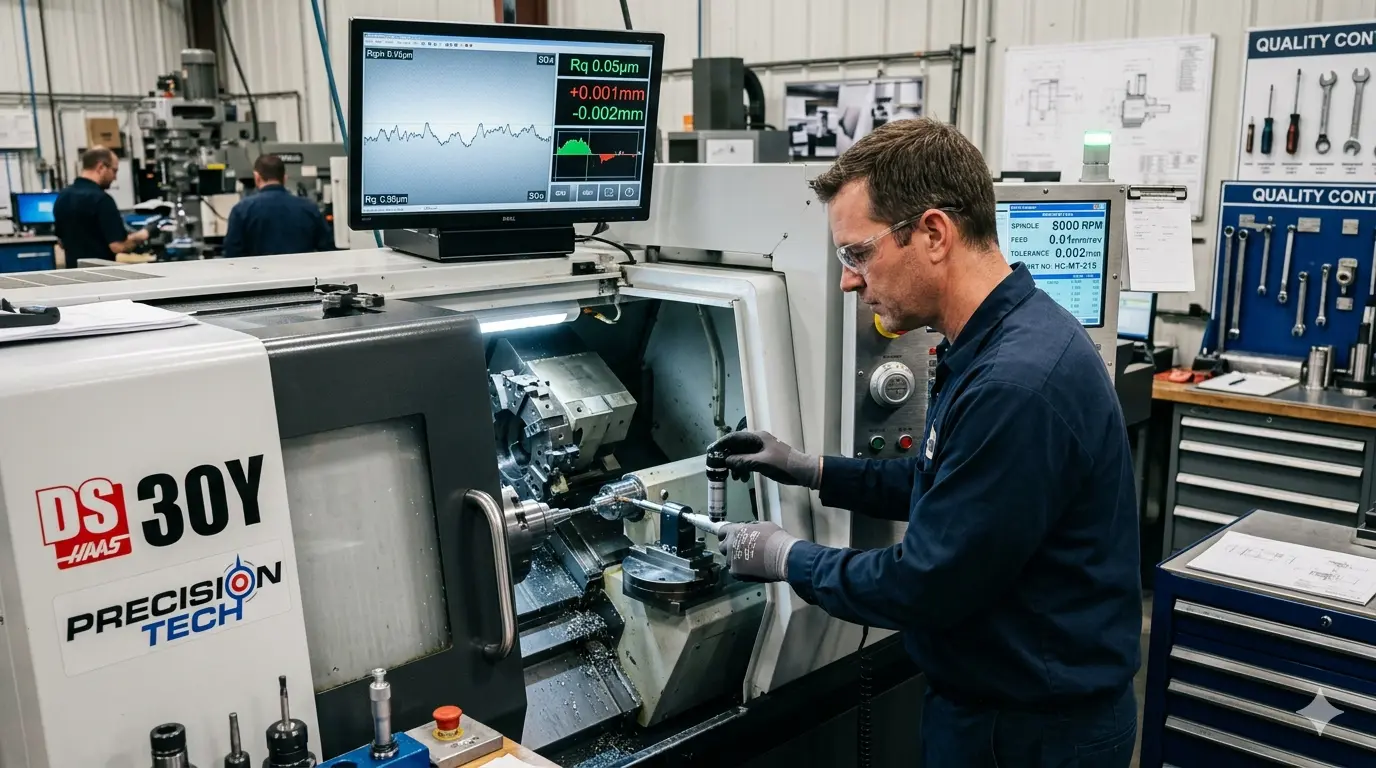
Advanced CNC turning with in-process metrology helps reduce these risks. However, compact components leave a minimal correction margin.
3. Seal Groove Machining Precision
Groove dimensions for hydraulic cylinder seals must be exact. Overcutting results in leakage. Undercutting increases compression, accelerating seal degradation.
Seal groove tolerance is often measured within ±0.01 mm in precision applications. Any deviation compromises long-term reliability and increases the need for hydraulic cylinder repair.
What Machining Limitations Affect Hydraulic Cylinder Accuracy?
Manufacturing a small hydraulic cylinder requires balancing machine capability, material behavior, and environmental control.
Material Expansion and Thermal Variation
Metal expands with heat. During micro-machining, tool friction increases localized temperatures. In a small hydraulic cylinder bore, thermal expansion can temporarily distort dimensions, leading to post-cooling contraction errors.
NIST research confirms that temperature variation remains a primary contributor to machining inaccuracies. Climate-controlled machining environments significantly improve dimensional repeatability.
Tool Deflection and Vibration
Small-diameter boring tools are prone to deflection. In a compact hydraulic cylinder, this results in tapering or ovality.
Mitigation strategies include:
- Reduced cutting speeds
- High-rigidity tool holders
- Multi-pass finishing techniques
Without strict control, tolerance stacking occurs, multiplying error across piston, bore, and seal groove interfaces.
Surface Roughness Constraints
Surface roughness must remain low enough to prevent seal abrasion but textured enough to retain lubrication. Achieving this balance inside a small hydraulic cylinder is one of the most delicate aspects of precision machining.
A roughness average (Ra) between 0.2 and 0.4 µm is often required. Deviations increase friction and shorten seal lifespan, leading to premature hydraulic cylinder repair.
How Can You Improve Dimensional Accuracy in Small Hydraulic Cylinder Production?
Precision is not accidental. It is engineered. It comes from controlled machining environments, advanced CNC equipment, and strict quality inspections at every stage. In a small hydraulic cylinder, every micron is measured, verified, and refined to ensure flawless performance.
Implement In-Process Measurement Systems
Laser micrometers and probe-based measurement systems allow real-time dimensional correction. For a small hydraulic cylinder, continuous monitoring prevents compounding errors.
Statistical process control (SPC), recommended by manufacturing guidelines from NIST, ensures repeatable tolerance maintenance.
Optimize Hydraulic Cylinder Seals Compatibility
Selecting the right hydraulic cylinder seals reduces sensitivity to minor machining variation. Advanced polymer seals accommodate micro-imperfections while maintaining pressure containment.
However, seal selection should never compensate for poor machining. Instead, it complements precision engineering.
Enhance Hydraulic Cylinder Piston Manufacturing
The hydraulic cylinder piston must be manufactured with precision-ground surfaces and verified concentricity. Hard chrome plating must be evenly distributed to prevent imbalance.
Improvements include:
- CNC precision grinding
- Controlled electroplating thickness
- Final-stage polishing
When piston geometry is optimized, overall small hydraulic cylinder performance improves dramatically.
Develop Preventive Hydraulic Cylinder Repair Protocols
Even with precision machining, wear occurs. Structured inspection intervals reduce downtime and prevent catastrophic failure.
Effective hydraulic cylinder repair includes:
- Bore inspection for scoring
- Seal replacement before leakage onset
- Rod straightness verification
Proactive maintenance extends the operational lifespan of a small hydraulic cylinder while maintaining efficiency.
What Is The Role of Quality Standards in Hydraulic Cylinder Manufacturing
Industry quality benchmarks, such as ISO 9001 and precision engineering guidance from NIST, reinforce the importance of dimensional control. In a hydraulic cylinder, especially a small hydraulic cylinder, certification-driven processes reduce variability.
Micro-tolerance machining is not merely about equipment sophistication. It requires:
- Skilled operators
- Data-driven inspection systems
- Controlled environmental conditions
When these factors align, manufacturing consistency increases significantly.
Conclusion
A small hydraulic cylinder is a masterpiece of compact power. Yet its performance depends entirely on micro-tolerance accuracy. From the alignment of the hydraulic cylinder piston to the integrity of hydraulic cylinder seals and the prevention of frequent hydraulic cylinder repair, precision machining dictates longevity and efficiency.
Understanding machining limitations, thermal distortion, tool deflection, and surface roughness constraints empowers engineers and manufacturers to improve dimensional accuracy. By combining advanced metrology, controlled machining environments, and strict quality standards, the modern Hydraulic Cylinder achieves remarkable reliability.
For industries demanding flawless motion in confined spaces, mastering micro-tolerance machining is not optional; it is essential.
For uncompromising precision in every small hydraulic cylinder, trust THM Huade. With advanced machining expertise, strict quality control, and proven Hydraulic Cylinder solutions, THM Huade delivers performance, durability, and reliability engineered to exceed industry standards.
FAQs
How do hydraulic cylinder seals affect machining accuracy?
Hydraulic cylinder seals require precisely machined grooves. Incorrect dimensions cause leakage or excessive compression, reducing lifespan and increasing maintenance needs in a small hydraulic cylinder system.
What causes frequent hydraulic cylinder repair in compact systems?
Common causes include bore scoring, piston misalignment, poor surface finish, and seal failure. Micro-tolerance machining errors in a small hydraulic cylinder often lead to repeated hydraulic cylinder repair cycles.
How can manufacturers improve small hydraulic cylinder machining accuracy?
Manufacturers can improve small hydraulic cylinder accuracy by using climate-controlled facilities, in-process measurement systems, precision honing techniques, and strict quality inspections to maintain tight tolerances and reduce dimensional variation during production.
What role does the hydraulic cylinder piston play in performance?
The hydraulic cylinder piston ensures smooth motion and pressure balance inside a small hydraulic cylinder. Proper alignment, surface finish, and concentricity reduce friction, protect hydraulic cylinder seals, and minimize unexpected hydraulic cylinder repair.