Modern industrial automation depends on accuracy, responsiveness, and reliability. Among the technologies enabling this precision, the hydraulic servo control system plays a critical role in motion control and power management.
Industries such as aerospace, manufacturing, robotics, and heavy equipment rely on these systems to regulate force, position, and velocity with exceptional accuracy. However, not every configuration serves the same purpose. Different environments require different system designs.
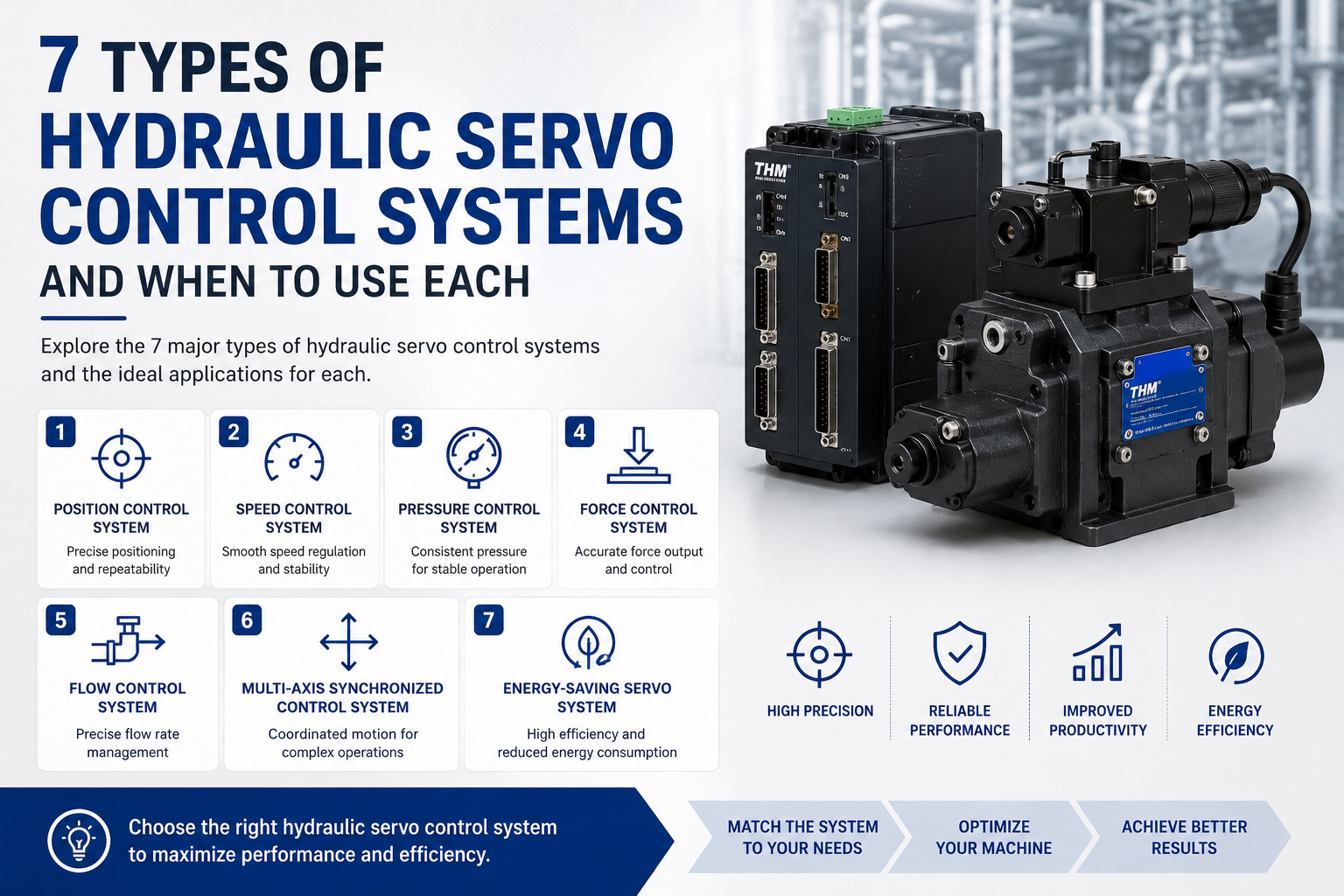
So, how do you determine the right hydraulic servo system for your application? This guide explains seven essential configurations and when each one delivers the best performance.
What Is a Hydraulic Servo Control System and Why Does It Matter?
A hydraulic servo control system is a closed-loop control mechanism that uses hydraulic power to control motion or force. Sensors monitor performance and continuously adjust the system through feedback.
This design enables extremely precise control of position, velocity, and torque. Because hydraulic power can generate significant force in compact systems, it is often preferred in demanding industrial environments.
Most systems combine several components:
- A hydraulic flow control valve to regulate fluid movement
- Sensors that provide real-time feedback
- A controller that processes signals
- A servo motor drive or actuator that converts commands into motion
Together, these elements allow machines to respond instantly to changing loads or commands.
Why Are Different Types of Hydraulic Servo Systems Used?
No single configuration works for every application. Industrial machines vary widely in terms of speed, load capacity, environmental conditions, and required precision.
For example, aircraft control surfaces require extremely fast response times. Meanwhile, heavy presses demand massive force with stable positioning.
Because of these differences, engineers design several variations of the hydraulic servo system. Each configuration optimizes a specific performance characteristic such as speed, torque, stability, or efficiency.
Understanding these types helps engineers select the most effective solution for their equipment.
1. Position Control Servo Systems
Position control systems focus on moving a component to an exact location and maintaining that position. Sensors constantly measure displacement and send feedback to the controller.
When Do You Need Precise Positioning?
The controller adjusts the hydraulic flow control valve to correct any deviation. As a result, the actuator precisely follows the commanded position.
This type of hydraulic servo control system is common in applications where accuracy is essential.
Typical uses include:
- CNC machinery
- Aerospace control surfaces
- Robotics and automation systems
- Injection molding equipment
Position control designs work best when the machine must repeatedly reach the same location with minimal error.
2. Velocity Control Servo Systems
Velocity control systems regulate the speed of motion rather than the position. Sensors monitor the actuator’s movement rate and feed the information back to the controller.
When Is Speed the Most Important Factor?
If the speed changes due to load variations, the system instantly adjusts hydraulic flow to compensate.
This configuration of a hydraulic servo system is valuable in operations where consistent movement speed is essential.
Industries often use it for:
- Conveyor systems
- Rolling mills
- Industrial cutting machines
- Automated production lines
These systems ensure smooth and stable motion even when mechanical loads fluctuate.
3. Force or Pressure Control Systems
Some industrial processes require constant force instead of position or speed accuracy. In these situations, force or pressure control systems are ideal.
These systems measure hydraulic pressure to determine the force being applied. The controller adjusts the hydraulic flow control valve to maintain the desired pressure level.
A hydraulic servo control system configured for force control is commonly used in heavy manufacturing environments.
Typical applications include:
- Hydraulic presses
- Metal forming equipment
- Testing machines
- Material compression systems
Because hydraulic power can generate immense force, this configuration offers exceptional performance for demanding industrial tasks.
4. Electro-Hydraulic Servo Systems
Electro-hydraulic systems integrate electronic control technology with hydraulic actuation. Electronic controllers interpret sensor feedback and regulate hydraulic flow with high precision.
In many designs, an industrial servo drive manages signals and communicates with the actuator or servo motor drive.
The combination of electronics and hydraulics provides several advantages:
- Faster response times
- Highly accurate feedback control
- Improved automation compatibility
- Advanced diagnostic capabilities
Electro-hydraulic configurations are widely used in modern industrial automation and aerospace systems where precision and responsiveness are critical.
5. Proportional Valve Servo Systems
Proportional valve systems offer a practical alternative to high-end servo valves. While they may not deliver the same level of ultra-precision, they provide reliable control at a lower cost.
In these systems, the hydraulic flow control valve adjusts fluid flow proportionally to the input signal.
This type of hydraulic servo system works well for applications that require controlled motion but not extreme precision.
Common uses include:
- Construction machinery
- Agricultural equipment
- Industrial lifting systems
- Material handling machines
Proportional valve systems strike a balance between affordability and performance.
6. Torque Control Servo Systems
Torque control systems regulate rotational force rather than position or speed. Sensors measure torque output and provide feedback to the controller.
The controller then adjusts hydraulic pressure or flow to maintain the desired torque level.
A hydraulic servo control system configured for torque control is particularly valuable in applications where rotational loads change frequently.
Industries often rely on these systems for:
- Drilling equipment
- Industrial mixers
- Wind turbine pitch control
- Heavy rotating machinery
Maintaining stable torque ensures efficient performance and protects equipment from excessive stress.
7. Load-Sensing Hydraulic Servo Systems
Load-sensing servo systems automatically adjust hydraulic pressure based on the current load demand.
Instead of maintaining constant high pressure, the system increases or decreases pressure as needed. This approach improves efficiency and reduces energy consumption.
A hydraulic servo system with load sensing provides several advantages:
- Lower energy use
- Reduced heat generation
- Longer equipment lifespan
- Improved system responsiveness
These systems are increasingly common in modern industrial machines where energy efficiency is a major priority.
How Do You Choose the Right Hydraulic Servo Control System?
Selecting the right hydraulic servo control system requires a careful evaluation of your machine’s operational needs and performance expectations. Engineers must consider several technical factors to ensure the system delivers reliable and efficient control in demanding industrial environments.
Key considerations include:
- Required precision and accuracy
- Load capacity and force requirements
- Response speed
- Energy efficiency goals
- Integration with automation systems
For example, aerospace equipment often relies on electro-hydraulic systems because they provide extremely precise control and rapid response. In contrast, construction machinery typically benefits from proportional valve systems, which balance performance and cost effectively. Choosing the right industrial servo drive and control architecture helps ensure the hydraulic servo control system operates smoothly, efficiently, and reliably over time.
What Does the Future Hold for Hydraulic Servo Systems?
Industrial automation continues to evolve rapidly. As a result, hydraulic servo systems are becoming smarter and more efficient.
Modern designs increasingly incorporate:
- Digital control systems
- Real-time data monitoring
- Smart diagnostics
- Integration with Industrial IoT platforms
These innovations allow engineers to monitor system performance continuously and detect potential issues before they affect operations.
In the coming years, the integration of advanced servo motor drive technologies with hydraulic control systems will likely deliver even greater precision, reliability, and energy efficiency.
Conclusion
Choosing the right hydraulic servo control system can significantly improve the performance, efficiency, and reliability of your industrial equipment. From position and velocity control to advanced electro-hydraulic configurations, each hydraulic servo system serves a unique purpose depending on the application’s precision, force, and speed requirements. By understanding these system types, engineers and manufacturers can make more informed decisions and achieve optimal operational results.
If you are looking for high-quality hydraulic components such as a hydraulic flow control valve, reliable servo motor drive, or advanced industrial servo drive solutions, partnering with a trusted manufacturer is essential. THM Huade offers dependable hydraulic technologies designed to support modern industrial applications with precision and durability. Contact THM Huade today to explore hydraulic solutions tailored to your operational needs.
Frequently Asked Questions
1. What is a hydraulic servo control system?
A hydraulic servo control system is a closed-loop mechanism that uses hydraulic power and feedback sensors to control motion, force, or speed. It provides precise control for industrial machinery, aerospace systems, and automation equipment requiring accurate performance.
2. How does a hydraulic servo system work?
A hydraulic servo system operates by comparing the desired output with the actual output using sensors. The controller then adjusts hydraulic flow through valves to correct any difference, ensuring precise motion, speed, or pressure control.
3. What industries use hydraulic servo systems?
Industries such as aerospace, automotive manufacturing, robotics, construction equipment, and heavy industrial machinery rely on hydraulic servo systems for precise motion control, high-force operations, and reliable performance in demanding environments.
4. What is the role of a hydraulic flow control valve?
A hydraulic flow control valve regulates the rate of hydraulic fluid moving through the system. By adjusting flow, it controls actuator speed, stability, and responsiveness within a hydraulic servo control system.
5. How is an industrial servo drive used in hydraulic systems?
An industrial servo drive processes control signals and communicates with actuators or servo motors. It ensures accurate movement, stable feedback control, and seamless integration between electronic controllers and hydraulic components.