Hydraulic technology powers countless industrial processes, from injection molding to metal forming and automated manufacturing. At the center of these systems are hydraulic pumps and motors, which convert mechanical energy into hydraulic power. However, choosing the right pump configuration can significantly influence energy consumption, performance, and long-term operational costs.
In modern industrial systems, the comparison often comes down to two major technologies: the servo-driven hydraulic pump and the traditional fixed-speed pump. Both approaches have distinct advantages, yet they serve different operational needs.
So how do you decide which option best suits your application?
This guide explores the differences between these systems, examining performance, energy efficiency, operational flexibility, and long-term cost considerations. By the end, you will have a clear understanding of whether a servo motor hydraulic pump system or a conventional setup is the right investment for your operation.
What Is a Servo-Driven Hydraulic Pump?
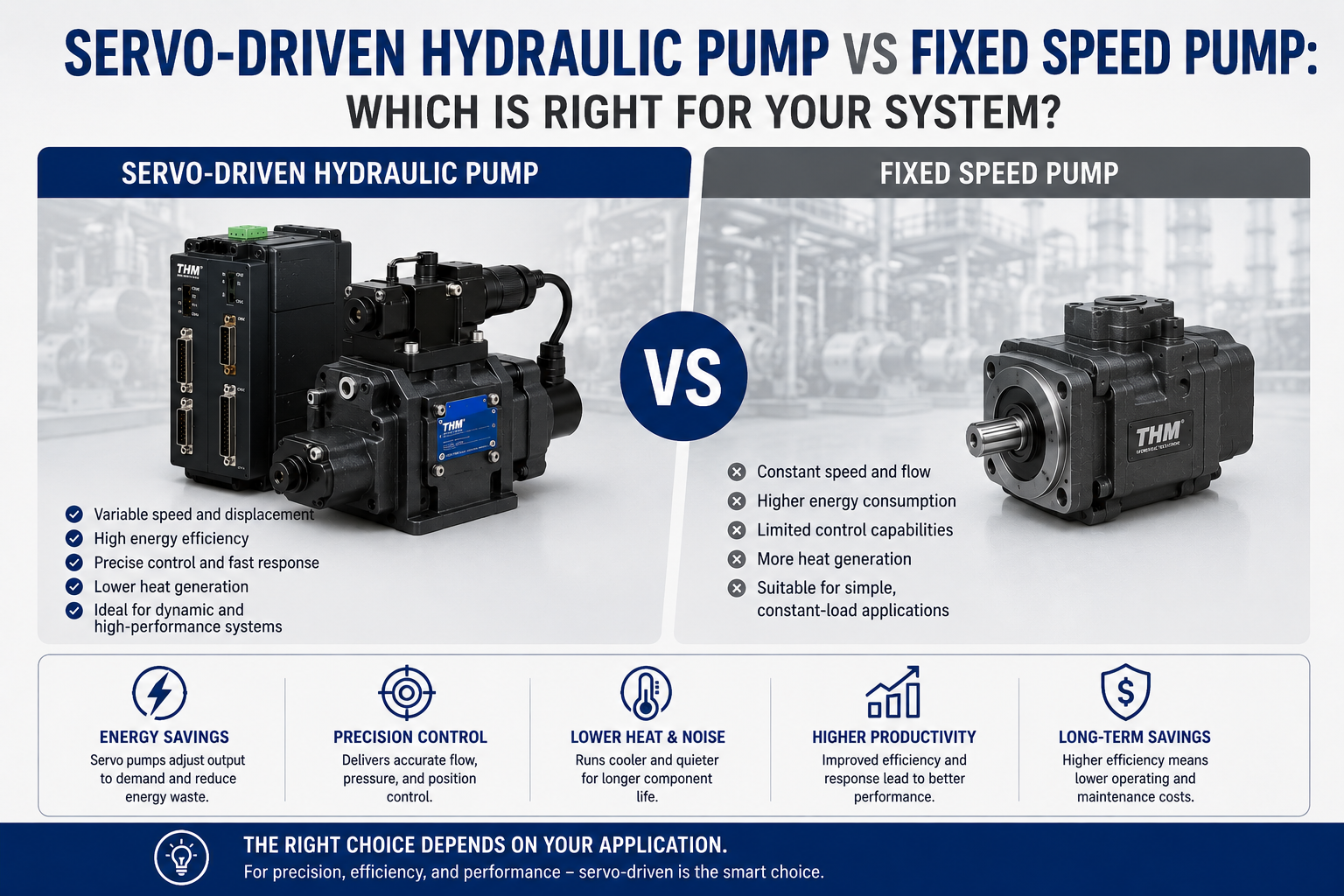
A servo driven hydraulic pump uses a servo motor and drive system to precisely control pump speed and output based on real-time demand. Instead of running continuously at full speed, the system adjusts dynamically to match the exact hydraulic requirements of the machine.
This design combines three core components:
- A servo motor-driven hydraulic pump
- A high-precision servo controller
- Integrated sensors for feedback and control
Because the motor speed varies according to demand, a servo drive hydraulic pump system can significantly reduce energy consumption and heat generation.
In many advanced manufacturing environments, these systems are replacing traditional pumps due to their intelligent control capabilities. The ability to match output with real-time load conditions makes servo systems especially valuable in precision industries such as plastic injection molding, die casting, and robotics.
How Does a Fixed-Speed Hydraulic Pump Work?
Unlike servo-driven systems, a fixed-speed hydraulic pump operates at a constant motor speed whenever it is turned on. The pump continuously circulates hydraulic fluid, even when the system does not require full power.
In a typical setup:
- An electric motor runs at a constant speed.
- The pump delivers a steady flow rate.
- Pressure is regulated through valves rather than motor speed.
While this approach has been widely used for decades, it often results in excess energy consumption. When the system does not need maximum output, the excess flow is redirected through pressure control valves, which leads to heat buildup and energy loss.
Despite these limitations, fixed-speed pumps remain popular due to their simplicity and relatively low initial cost.
Why Are Servo Motor Hydraulic Pumps Becoming More Popular?
Modern industries are increasingly prioritizing energy efficiency and precision control. This is where the servo motor hydraulic pump offers a significant advantage.
A servo motor-driven hydraulic pump adjusts speed instantly according to system demand. This responsiveness enables machines to operate more efficiently and with greater accuracy.
Several factors contribute to the growing adoption of servo-based systems:
Key Advantages
- Energy Efficiency
Servo systems only use energy when hydraulic flow is required. This can reduce electricity consumption by 30–70 percent in many applications. - Lower Heat Generation
Since the motor does not run continuously at full speed, less heat is generated. This reduces cooling requirements and improves component lifespan. - Improved Precision
Servo control enables accurate pressure and flow adjustments, which is essential for high-precision manufacturing. - Reduced Noise Levels
A servo drive hydraulic pump operates more quietly than traditional fixed-speed systems because the motor does not run continuously at full power. - Extended Equipment Life
Reducing mechanical stress on pumps, motors, and valves can improve overall system longevity.
These benefits have made servo-driven solutions increasingly attractive in energy-conscious industries.
Are Fixed-Speed Pumps Still Relevant?
Although servo technology offers compelling advantages, fixed-speed pumps remain a practical solution in certain scenarios.
Some operations prioritize simplicity and reliability over advanced control. Fixed-speed systems contain fewer electronic components, which can make them easier to maintain in environments where technical resources are limited.
They are commonly used in:
- Small-scale industrial machinery
- Basic hydraulic presses
- Equipment with consistent load requirements
In systems where hydraulic demand rarely changes, a fixed-speed pump may still deliver satisfactory performance without the complexity of a servo control system.
However, when production processes involve varying loads or intermittent operation, the energy inefficiency of fixed-speed pumps becomes more apparent.
How Do Servo Drive Hydraulic Pumps Improve Energy Efficiency?
Energy consumption is one of the most critical factors when evaluating hydraulic pumps and motors.
A fixed-speed pump operates continuously, even when the machine is idle. As a result, significant energy is wasted circulating fluid unnecessarily.
A servo-driven hydraulic pump, however, works differently.
Intelligent Energy Management
Instead of running at full capacity, the system adjusts motor speed according to demand. When the machine requires minimal hydraulic power, the motor slows down or stops entirely.
This dynamic control provides several measurable benefits:
- Reduced electricity consumption
- Lower operational costs
- Less heat generation
- Smaller cooling requirements
According to energy studies published by the U.S. Department of Energy, variable-speed motor systems can dramatically improve efficiency in industrial applications.
Over time, these energy savings can offset the higher initial investment associated with servo technology.
What About Performance and Control?
When comparing performance, the servo motor-driven hydraulic pump delivers a level of precision that traditional pumps cannot easily match.
Because servo motors respond quickly to control signals, the system can adjust flow and pressure almost instantly.
Performance Advantages of Servo Systems
- Rapid response to load changes
- Precise pressure control
- Improved repeatability in manufacturing processes
- Smoother machine operation
These characteristics make servo systems ideal for industries that demand high accuracy, such as:
- Injection molding
- Precision machining
- Automated assembly systems
- Advanced robotics
By contrast, fixed-speed pumps rely on mechanical valves to regulate pressure and flow, which can introduce inefficiencies and slower response times.
How Do Costs Compare Between the Two Systems?
Cost is often the deciding factor when choosing between a servo-driven hydraulic pump and a fixed-speed pump.
While servo systems typically require a higher upfront investment, their operational efficiency can deliver long-term savings.
Fixed-Speed Pump Costs
Advantages include:
- Lower initial equipment cost
- Simple installation
- Minimal electronic components
However, long-term expenses may increase due to:
- Higher electricity consumption
- Increased cooling requirements
- Faster component wear
Servo Hydraulic Pump Costs
A servo motor hydraulic pump system involves:
- Higher initial purchase cost
- Additional electronic components
- More advanced installation
But these systems often provide:
- Significant energy savings
- Reduced maintenance
- Longer system lifespan
In many industrial facilities, the energy savings alone can recover the additional investment within a few years.
Which Hydraulic Pump Is Best for Your System?
The right solution depends largely on your operational priorities.
A servo drive hydraulic pump is ideal if your facility prioritizes:
- Energy efficiency
- Precision control
- Reduced operational noise
- Advanced automation
On the other hand, a fixed-speed pump may still be suitable for:
- Basic hydraulic machinery
- Systems with consistent workloads
- Operations with limited automation requirements
Ultimately, evaluating your system’s energy consumption, load variability, and production demands will guide the best decision.
Modern facilities increasingly favor servo-driven hydraulic pumps because they align with sustainability goals and long-term cost optimization.
The Future of Hydraulic Pump Technology
Industrial equipment continues to evolve toward smarter, more efficient systems. Innovations in hydraulic pumps and motors are helping manufacturers reduce energy usage while improving machine performance.
Servo technology represents a major step in this evolution. With precise digital control, these systems enable machines to operate more intelligently and adapt to real-time conditions.
As industries move toward automation, data-driven operations, and energy-conscious manufacturing, servo motor-driven hydraulic pump systems are likely to become the preferred solution across many sectors.
Conclusion
Choosing between a servo-driven hydraulic pump and a fixed-speed pump depends on your system’s performance needs, energy goals, and long-term operational strategy. While fixed-speed systems remain suitable for simple applications with stable loads, modern industries increasingly benefit from the efficiency and precision offered by a servo motor hydraulic pump. With its ability to adjust speed based on real-time demand, a servo motor-driven hydraulic pump can reduce energy consumption, improve machine responsiveness, and extend the lifespan of hydraulic pumps and motors.
If your facility is looking to upgrade efficiency and control, a servo drive hydraulic pump can be a valuable investment. THM Huade provides reliable hydraulic solutions engineered to support advanced industrial systems. Contact THM Huade today to explore high-performance hydraulic technologies tailored to your operational needs.
FAQs
1. What is a servo-driven hydraulic pump?
A servo-driven hydraulic pump uses a servo motor to control pump speed based on real-time demand. This allows precise adjustment of hydraulic flow and pressure, improving energy efficiency and system performance compared to traditional fixed-speed pumps.
2. How does a servo motor hydraulic pump save energy?
A servo motor hydraulic pump adjusts motor speed according to hydraulic demand instead of running continuously. This reduces unnecessary power consumption, lowers heat generation, and improves overall system efficiency in industrial operations.
3. What industries benefit most from servo motor-driven hydraulic pumps?
Industries such as injection molding, robotics, metal forming, and automated manufacturing benefit greatly from servo motor-driven hydraulic pump systems due to their precision control, energy efficiency, and ability to handle variable loads.
4. Are fixed-speed hydraulic pumps outdated?
Fixed-speed pumps are not outdated, but they are less energy efficient. They remain useful in applications with constant load requirements where the simplicity and lower upfront cost of traditional hydraulic pumps and motors are preferred.
5. Is a servo drive hydraulic pump expensive to install?
A servo drive hydraulic pump generally requires a higher initial investment due to advanced control components. However, energy savings, reduced maintenance, and improved performance often make it more cost-effective over time.