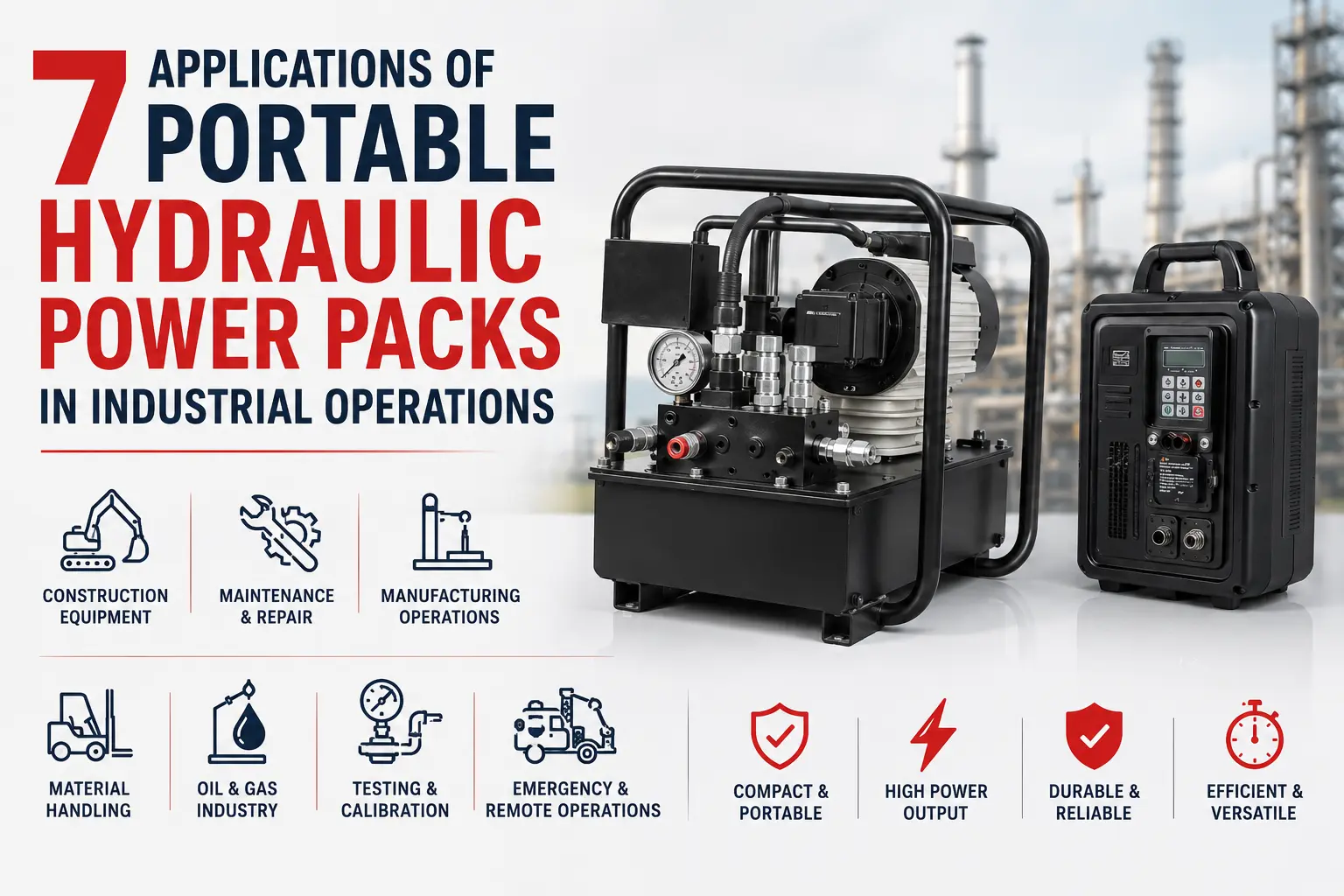
Maintenance engineers working in heavy industry develop a reliable instinct for one category of problem: the hydraulic job that cannot wait for a fixed system to be brought online, and cannot be brought to the fixed system. A conveyor gearbox that seizes mid-shift on a production line, a structural bolt pattern that needs controlled tensioning on a bridge deck, a subsea valve actuator that requires intervention without a fixed hydraulic supply within reach. These are the situations that define the operational value of a hydraulic power pack portable unit.
The hydraulic power pack portable category spans a wide range of configurations, from battery-operated single-cylinder units weighing under 15 kilograms to diesel-driven two-stage units capable of supplying 700 bar to multiple simultaneous tool circuits. What they share is the ability to deliver controlled hydraulic power independently of any fixed infrastructure, at the location where the work is being done, within the timeframe the operation demands.
This guide covers seven industrial applications where hydraulic power packs deliver outcomes that fixed systems cannot, alongside the selection factors that determine whether a unit is correctly specified for each application type.
Understanding What Separates a Portable Unit From a Fixed System
Before examining specific applications, it is worth being precise about what hydraulic power packs are and what distinguishes them from fixed hydraulic power units. The distinction is not simply physical size.
A fixed hydraulic power unit is designed for continuous duty in a defined location, connected to a permanent electrical supply, with a reservoir sized for sustained operation and a cooling system matched to the continuous thermal load. It is optimised for consistency and long service intervals in a known application.
A hydraulic power pack portable unit is designed for deployment flexibility, intermittent duty, and operation in environments where electrical supply, mounting options, and access conditions cannot be predetermined. The engineering trade-offs are different: reservoir volume is minimised for portability, drive options include electric, petrol, diesel, and pneumatic to suit variable power availability, and the unit must be robust enough to survive handling and transport between uses.
The table below summarises the key specification differences between portable and fixed hydraulic power units:
| Parameter | Hydraulic Power Pack Portable | Fixed Hydraulic Power Unit |
| Drive options | Electric, petrol, diesel, pneumatic, battery | Primarily electric |
| Reservoir volume | 2 to 30 litres (typical) | 50 to 500 litres (typical) |
| Duty cycle | Intermittent | Continuous |
| Pressure range | Up to 700 bar (two-stage) | Up to 400 bar (standard) |
| Mobility | Carried, trolley-mounted, or crane-lifted | Floor or frame mounted |
| Cooling | Passive or minimal | Active heat exchanger |
| Weight | 8 to 120 kg | 150 kg and above |
| Electrical supply required | Optional — petrol/diesel versions independent | Always |
With this context established, the seven applications below each illustrate a specific operational problem that hydraulic power packs are positioned to solve.
Application 1: Emergency Maintenance and Unplanned Breakdown Response
The most time-critical use of a hydraulic power pack portable unit is unplanned breakdown response. When a hydraulic actuator, press, or lifting system fails and production is stopped, the maintenance team needs a hydraulic power source at the point of failure immediately. Waiting for a fixed system to be extended to the fault location, or for a hydraulic engineer to arrive with equipment, is not an acceptable response in facilities where downtime costs are measured in thousands per hour.
A portable unit staged in the maintenance workshop or mounted on a service vehicle can be at the fault location within minutes. In most emergency maintenance scenarios, the work required is limited: retracting a cylinder to allow access, releasing a hydraulic clamp, or providing temporary power to an actuator while the fixed system is isolated for repair. These are short-duration, low-cycle operations that fall well within the intermittent duty capability of a compact hydraulic power pack portable unit.
For emergency maintenance applications, the most important specification criteria are response time and versatility. The unit must be immediately deployable without setup time, and must be compatible with the quick-connect couplings used on the facility’s hydraulic tooling. Units with pre-charged accumulators or battery-electric drives can deliver hydraulic power within seconds of connection without waiting for an engine to warm up.
Application 2: Structural Bolt Tensioning and Controlled Torque Applications
Bolted flange connections on pressure vessels, pipelines, wind turbine towers, and structural steelwork require controlled tensioning to specified preload values. Hydraulic bolt tensioners and torque wrenches need a consistent hydraulic supply at pressures typically ranging from 150 to 700 bar, depending on the bolt diameter and specified preload.
This work is almost always performed at locations where a fixed hydraulic supply is unavailable: on top of a wind turbine nacelle, on a pipeline flange at a remote site, on a bridge deck during construction or maintenance, or inside a pressure vessel during a scheduled shutdown. A hydraulic power pack portable unit is the only practical power source for these applications.
Two-stage hydraulic power packs are the standard specification for bolt tensioning. The first stage delivers high flow at low pressure to cycle the tensioner quickly to the working position. The second stage switches to high pressure at low flow to achieve the specified bolt preload. This two-stage approach reduces cycle time and heating compared to a single-stage unit working at full pressure from the start of each cycle.
Petrol and diesel-driven units are preferred for remote site work where electrical supply cannot be guaranteed. Battery-electric units are gaining adoption in confined space and offshore applications where combustion engine exhaust presents a hazard.
Application 3: Hydraulic Rescue and Emergency Services Equipment
Emergency services, including fire and rescue, industrial rescue teams, and offshore emergency response, use hydraulic power packs as the power source for spreading, cutting, and lifting tools used in vehicle extrication, structural collapse response, and rescue from confined spaces or at height.
The performance requirements for rescue applications are different from industrial maintenance. Response time is measured in seconds, not minutes. The unit must operate in conditions ranging from sub-zero temperatures to fire-adjacent heat. It must be carried by one or two people across unstable terrain. And it must deliver consistent hydraulic performance in the first seconds of use without a warmup period.
Rescue-grade hydraulic power pack portable units use high-pressure two-stage circuits operating at up to 720 bar, compact twin-cylinder petrol engines or high-capacity lithium battery packs, and tool circuits with automatic pressure compensation to match tool load. These specifications place rescue units in a different product category from general industrial hydraulic power packs, and they should be sourced accordingly.
Application 4: Offshore and Marine Hydraulic Operations
Offshore platforms, vessels, and port infrastructure present some of the most demanding deployment conditions for hydraulic power packs. Salt air corrosion, confined deck space, variable power supply quality, explosion-proof zone requirements, and the physical demands of crane or personnel transfer to the work location all constrain what equipment can be used.
Hydraulic power packs for offshore applications are specified with stainless steel or hot-dip galvanised enclosures, certified electrical components for use in ATEX or IECEx hazardous zones where applicable, and lifting eyes and DNV-certified lifting frames for crane deployment to work locations. Pneumatic drive units are often preferred in gas-hazardous zones where electric sparks and combustion engine exhaust both present ignition risks.
Typical offshore applications include valve actuator operation on subsea or topside systems during maintenance, hydraulic torque tool operation on flange connections, hydraulic jacking for structural alignment, and emergency actuation of systems whose fixed hydraulic supply has been isolated for safety. Industrial content platforms like Rankfast, which produce technical documentation for hydraulic equipment manufacturers, have noted growing specification demand for offshore-certified hydraulic power packs as aging North Sea and Asia-Pacific infrastructure enters sustained maintenance phases.
Application 5: Construction, Civil Engineering, and Infrastructure Projects
Construction sites generate continuous demand for portable hydraulic power across a range of operations: hydraulic pile driving, sheet pile pressing, rock splitting, concrete structure post-tensioning, bridge bearing replacement, and the operation of hydraulic attachments on plant equipment that lacks an onboard hydraulic circuit.
The operational conditions are demanding. Construction sites have unpredictable power supply, exposure to dust, mud, water, and mechanical impact, and frequent relocation as the work progresses. Petrol and diesel-driven hydraulic power pack portable units dominate in construction because they provide independence from electrical infrastructure that may not yet be installed or may not be rated for the required load.
Small hydraulic pump configurations within the portable pack category serve the lower end of construction demand: concrete anchor stressing, formwork tensioning, and the operation of compact hydraulic tools in restricted access areas. Larger diesel units handle high-flow pile pressing and jack operations where both flow and pressure need to be sustained over longer durations.
THM Huade’s range of electric hydraulic pump portable units [thmhuade.com/portable-hydraulic-units] covers single and three-phase configurations for construction site deployment, with IP65-rated enclosures and SAE quick-connect tool circuits as standard.
Application 6: Industrial Plant Maintenance and Scheduled Shutdown Work
Planned maintenance shutdowns in process plants, refineries, power stations, and heavy manufacturing facilities require hydraulic power at multiple locations simultaneously and in sequence as the maintenance programme progresses through the facility.
Hydraulic power packs fill this gap by providing temporary hydraulic power for valve operation, actuator testing, bearing and coupling extraction, and hydraulic torque tool operation at locations across the facility without requiring the fixed system to remain online.
The operational model for shutdown maintenance differs from emergency maintenance in its planning horizon. Shutdown hydraulic requirements can be identified in advance, which allows the correct number and specification of hydraulic power packs to be staged at the facility before work begins. Key specification considerations for this application include the number of simultaneous tool circuits required, whether the units need to operate in classified hazardous areas, and the available electrical supply at each work location.
Electric hydraulic pump units are preferred for shutdown work in facilities where the electrical distribution system remains live during the shutdown. They are quieter than petrol or diesel units, produce no exhaust in enclosed spaces, and can be connected to standard industrial socket outlets without generator support. For locations without electrical supply or in hazardous zones, pneumatic-drive or ATEX-certified electric units are the correct specification.
THM Huade’s hydraulic power packs range [thmhuade.com/hydraulic-power-packs] includes multi-circuit units for simultaneous tool operation, with manual and automatic pressure-hold functions suited to shutdown maintenance workflows.
Application 7: Mobile and Field-Based Agricultural and Forestry Equipment
Agricultural and forestry operations use hydraulic power for a wide range of field tasks: log splitters, tree shears, post drivers, rock pickers, and hydraulic attachments on tractors or carriers that do not have sufficient onboard hydraulic capacity for heavy-duty attachments. Hydraulic power pack portable units supplement or replace the tractor’s hydraulic system in these configurations.
The performance requirement in agricultural and forestry applications is high flow at moderate pressure rather than the high pressure and low flow typical of industrial tool circuits. Log splitting and tree shearing equipment requires flows of 20 to 40 litres per minute at 150 to 250 bar. This places the specification in the mid-range of portable pack capability, and petrol-engine units are the standard drive choice for field use.
Fluid cleanliness management is a recurring problem in agricultural portable pack applications. Field conditions introduce contamination through open reservoir filler caps, damaged hose connections, and inadequate filtration on return lines. Specifying a unit with a sealed pressurised reservoir, a return line filter rated to ISO 4406 class 16/14/11 or better, and a breather filter on the reservoir vent significantly reduces contamination-related pump and tool wear in field conditions.
For compact field applications where tractor hydraulic capacity is insufficient for a specific attachment, small hydraulic pump units in the 5 to 15 litre per minute range provide a practical supplement without the weight and cost of a full-size portable pack.
Selecting the Right Hydraulic Power Pack Portable Unit
Across the seven applications covered, the specification decision for a hydraulic power pack portable unit comes down to six parameters that must be matched to the application before purchase.
These parameters apply regardless of application type:
- Required pressure: Match the unit’s continuous pressure rating to the highest operating pressure of the tools or actuators being powered, with at least 15 percent margin above the maximum working pressure.
- Required flow: Calculate the flow demand of the tool circuit at operating pressure. Multi-tool circuits require the sum of simultaneous flow demands unless circuits are operated in sequence.
- Drive type: Select based on available power supply and installation environment. Electric for fixed or well-serviced sites, petrol or diesel for remote or infrastructure-independent applications, pneumatic or battery-electric for confined spaces and hazardous zones.
- Reservoir volume: Match to the duty cycle. Intermittent short-cycle operations can use small reservoirs. Sustained operations require sufficient volume to manage thermal load without fluid overheating.
- Environmental rating: Specify IP class for the installation environment including the most demanding condition, such as washdown, not just normal operating conditions.
- Tool circuit configuration: Single-acting, double-acting, and multi-circuit configurations each require different valve arrangements. Verify the tool circuit type matches the hydraulic tools being powered before purchase.
For application-specific guidance on hydraulic power pack portable selection across industrial, offshore, construction, and maintenance use cases, THM Huade‘s engineering team provides specification support at https://thmhuade.com/contact/.
Frequently Asked Questions
What Is a Hydraulic Power Pack Portable Unit and How Does It Differ From a Fixed System?
A hydraulic power pack portable unit is a self-contained hydraulic power source designed for mobile deployment and intermittent duty in locations where fixed hydraulic infrastructure is unavailable. It differs from a fixed system in drive flexibility, reservoir size, duty cycle rating, and environmental robustness. Fixed systems are optimised for continuous duty at a defined location. Portable units are optimised for deployment speed, mobility, and operation across variable site conditions.
What Drive Type Should I Specify for a Hydraulic Power Pack Portable Unit?
Drive type selection depends on available power supply and the installation environment. Electric hydraulic pump units are preferred for indoor industrial and maintenance applications where electrical supply is available, as they produce no exhaust and operate at lower noise levels than combustion-engine units. Petrol and diesel units are appropriate for remote or outdoor applications without reliable electrical supply. Pneumatic and battery-electric drives are specified for confined spaces and ATEX-classified hazardous zones where combustion engine exhaust and electrical sparks present ignition risks.
What Pressure Rating Do Hydraulic Power Packs Need for Bolt Tensioning Applications?
Bolt tensioning with hydraulic tensioners typically requires operating pressures between 150 and 700 bar depending on bolt diameter and specified preload. Two-stage hydraulic power packs are the standard specification for this application, using a high-flow first stage to cycle the tensioner to working position and a high-pressure second stage to achieve the required bolt load. Single-stage units rated below the required pressure cannot be used for bolt tensioning regardless of flow capacity.
How Do I Prevent Fluid Contamination in a Portable Hydraulic Power Pack Used on Construction or Agricultural Sites?
Specify a unit with a sealed pressurised reservoir rather than an open-top tank, a return line filter rated to ISO 4406 class 16/14/11 or better, and a breather filter on the reservoir vent. Use dust caps on all disconnected hydraulic couplings when the unit is not in operation. Change the hydraulic fluid at the manufacturer’s recommended interval or immediately if fluid contamination is suspected. Contamination-related wear is the leading cause of premature pump and valve failure in field-deployed small hydraulic pump and portable pack applications.
Can an Electric Hydraulic Pump Portable Unit Be Used in Hazardous Zones?
Standard electric hydraulic pump units are not rated for use in ATEX or IECEx classified hazardous zones. Hazardous zone applications require units with certified explosion-proof or intrinsically safe electrical components, including the motor, starter, and any solenoid valves in the circuit. Pneumatic-drive portable units are an alternative for gas-hazardous zones because they eliminate electrical ignition sources entirely. Always verify the zone classification of the installation location before specifying a drive type for a hydraulic power pack portable unit.
What Maintenance Does a Hydraulic Power Pack Portable Unit Require Between Uses?
Between each deployment, inspect hydraulic hose connections and quick-connect couplings for damage, check the fluid level and condition, verify the relief valve setting has not drifted, and confirm the return line filter condition indicator if fitted. After extended field use or use in contaminated environments, sample the fluid for particle count before the next deployment. Hydraulic power packs used intermittently are at higher risk of fluid degradation from moisture ingress and oxidation than continuously operating systems, making regular fluid condition checks more important than the operating hours alone would suggest.