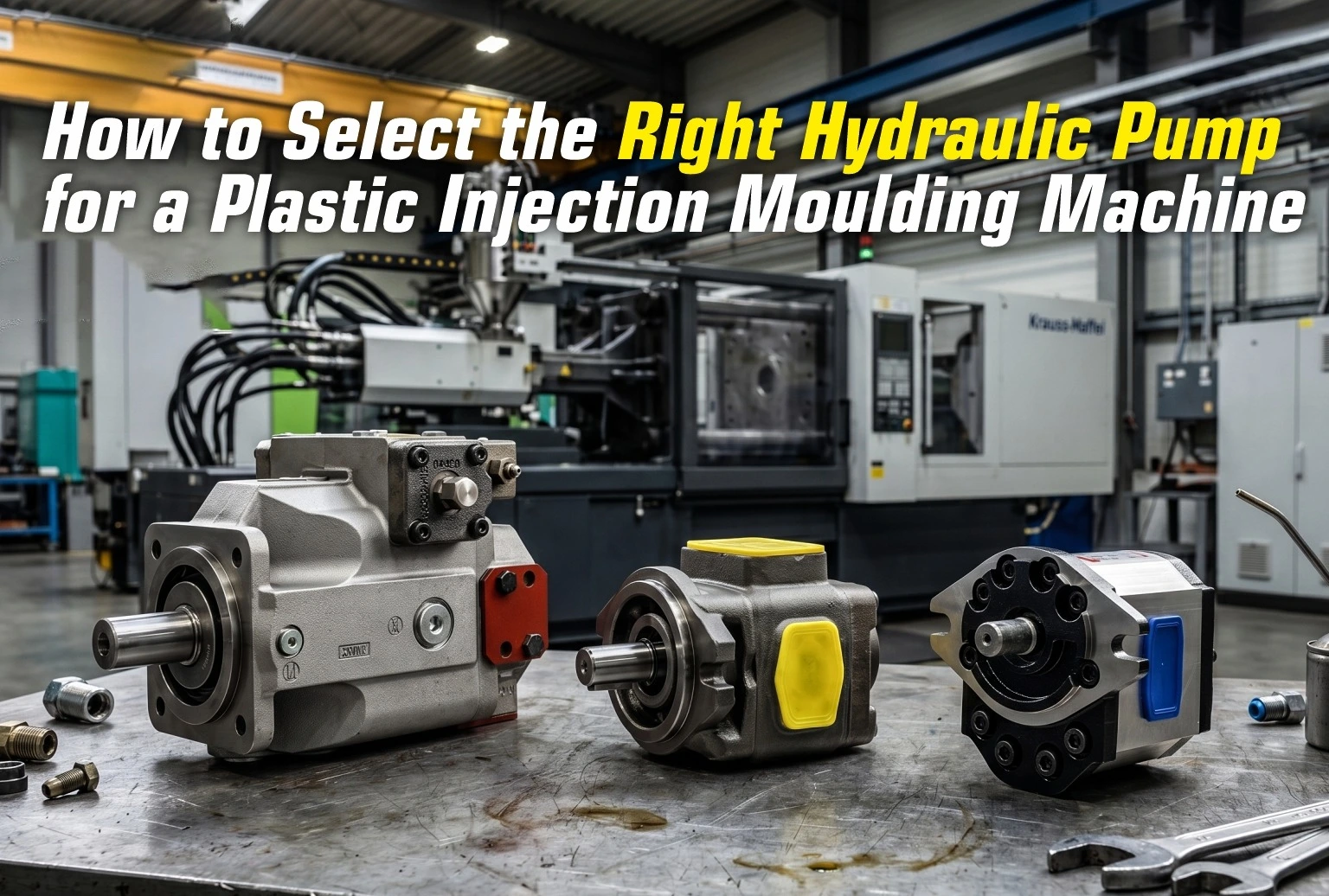
Selecting the right hydraulic pump for injection moulding machine is one of the highest-leverage decisions an OEM or plant engineer makes. Get it right and you have a machine that runs precise cycles, consumes less energy, and lasts a decade. Get it wrong and you face inconsistent shot weights, hot oil, premature pump failure, and an electricity bill that quietly eats into margins for years.
In our 20 years of supplying hydraulic components to plastic machinery manufacturers across India, from Daman to Vapi to Faridabad, we’ve seen the same pump selection mistakes repeated. This guide walks through what actually matters: how injection moulding hydraulics work, which pump types fit which applications, the sizing logic, and the trade-offs nobody warns you about until it’s too late.
Why pump selection matters more in injection moulding than in most hydraulic applications
Most hydraulic machines operate at relatively constant load. Injection moulding is the opposite. A single moulding cycle has at least five distinct hydraulic load phases:
- Mould close — moderate flow, low to medium pressure
- Clamping — very high pressure, near-zero flow
- Injection — high flow, high pressure, very short duration
- Holding (packing) — moderate pressure, low flow
- Cooling and ejection — low flow, low pressure for long durations
This means an injection moulding pump spends most of its life at low load, with brief but punishing high-load demands. A pump sized only for peak flow wastes huge amounts of energy in idle periods. A pump sized for average flow can’t deliver injection speed when needed. The right answer is a pump (or pump system) that adapts to the cycle.
The four pump types that get used in injection moulding
1. Fixed-displacement gear pumps
The cheapest option, found in older or low-tonnage machines (typically below 80 tons). Internal gear pumps like the THM IGP series run quietly and reliably for low-pressure work. The fundamental limitation: they pump the same volume per revolution regardless of whether the machine needs flow. During the long cooling phase, that flow gets dumped over a relief valve as heat, which means high oil temperatures, oversized coolers, and wasted electricity.
Best for: low-tonnage machines, budget-driven OEMs, applications where total operating hours per year are limited.
2. Variable-displacement axial piston pumps
The workhorse of mid-tonnage injection moulding machines globally. The pump’s swashplate angle changes based on system demand, high flow during injection, near-zero flow during clamping and cooling. The A10VO Series 52/53 and the A4VSO are two of the most widely used variable-displacement pumps in plastic machinery. Energy savings versus a fixed-displacement gear pump typically run 25–40%.
Best for: machines from 80 tons to 800 tons, plants where electricity cost is a meaningful operating expense, OEMs targeting mid-market quality.
3. Servo pumps (servo motor + fixed-displacement pump)
The current state of the art. A servo motor with closed-loop speed control drives a fixed-displacement pump (often an internal gear pump for quiet operation). The motor speed varies with cycle demand, running at high RPM during injection and dropping to near-zero during cooling. Energy savings of 40–60% versus a fixed-displacement system are routine, and we have customers reporting 65% in optimized installations. The other benefit nobody talks about: oil temperatures stay much lower, which extends seal life and reduces cooler load.
Best for: plants running 16-24 hours per day, plants paying ₹8+ per unit for industrial electricity, OEMs differentiating on energy efficiency.
The trade-off: higher upfront cost. Payback typically lands at 14-22 months for two-shift operations and under 12 months for three-shift plants.
4. Pump combinations (load-sensing systems)
Larger machines (1,000+ tons) often use a combination, for example, a high-flow fixed pump plus a smaller variable pump, with an unloading valve that routes flow based on demand. These are application-specific and typically engineered by the OEM with the pump supplier’s support. We design these systems on request.
Sizing the pump: the basic calculations
Three numbers determine pump sizing for injection moulding.
Required flow during injection
Flow (L/min) = Injection volume (cm³) × 60 / Injection time (seconds) / 1000
For a machine injecting 200 cm³ of melt in 2 seconds, that’s 200 × 60 / 2 / 1000 = 6 L/min of melt flow. Multiplied by the screw-to-cylinder ratio (typically 1.2–1.5), the hydraulic flow demand at peak injection is roughly 7-9 L/min. This number sets the minimum pump displacement at injection RPM.
Required pressure
Most injection moulding machines are designed around 140-175 bar working pressure. Specify the pump for at least 175 bar continuous and 210 bar intermittent. Going under-spec is one of the most common failure modes, engineers size the pump for nominal pressure and the relief valve cycles every shot, killing the pump within 18 months.
Duty cycle profile
Estimate hours per year, shifts per day, and the percentage of cycle time at full load versus idle. This dictates whether energy savings will pay back a more efficient pump. As a rule of thumb: anything running more than 4,000 hours per year benefits from variable displacement, and anything running more than 6,000 hours per year benefits from a servo pump system.
Quick reference: which pump for which machine size
| Machine size | Recommended pump type | THM model to consider | Typical energy saving vs fixed gear |
| Below 80 tons | Fixed gear / internal gear | THM IGP, Q-IGPE | Baseline |
| 80–250 tons | Variable axial piston | A10VO Series 52/53 | 25–35% |
| 250–800 tons | Variable axial piston (larger) | A4VSO | 30–40% |
| Any size, high-utilization plant | Servo pump system | TDDG servo motor + IGP | 40–60% |
| 1,000+ tons | Pump combination / engineered | Custom system design | 30–50% |
The five mistakes we see most often
- Sizing only for peak flow. A pump that delivers 80 L/min when the machine needs 80 L/min for 2 seconds out of a 30-second cycle is a pump that wastes 28 seconds of flow over a relief valve every shot. Use a variable or servo pump.
- Ignoring oil cleanliness specifications. Modern axial piston and servo pumps require ISO 4406 cleanliness of 18/16/13 or better. Many Indian plants run at 21/19/16 because the OEM didn’t specify the right filter. Pumps then fail at 4,000 hours instead of 25,000 hours and the OEM blames the pump.
- Under-specifying pressure rating. If your relief valve is set at 175 bar, the pump should be rated for 210 bar continuous, not 175 bar. Continuous operation at maximum rated pressure is what kills bearings.
- Treating the pump as a commodity. Two pumps with the same nominal displacement and pressure rating can have wildly different volumetric efficiency, noise levels, and bearing life. Spec sheets only tell part of the story. Ask the supplier for actual test data on a comparable machine.
- Forgetting about the rest of the system. A premium pump driving a leaky cylinder, undersized accumulator, or wrong-size relief valve gives you premium-pump cost with mediocre-system performance. Match the pump to the surrounding components.
Energy efficiency: the business case in numbers
Take a 250-ton injection moulding machine running two shifts (4,800 hours per year) with a 22 kW main motor.
- Fixed gear pump (baseline): 22 kW × 4,800 h = 105,600 kWh/year. At ₹8/unit, that’s ₹8.45 lakh/year in electricity.
- Variable displacement pump (35% saving): saves around 37,000 kWh/year, or ₹2.95 lakh/year.
- Servo pump system (55% saving): saves around 58,000 kWh/year, or ₹4.65 lakh/year.
Upfront cost premium for a servo pump system over a fixed gear setup is typically ₹6–8 lakh on a machine of this size. Payback under 18 months, then ₹4.65 lakh of savings every year for the next 8–10 years. This is the conversation OEMs should be having with their plastics customers, and most aren’t.
How to evaluate a pump supplier (not just a pump)
Specifications matter, but the supplier matters as much. Ask:
- Do they have technical support engineers in India who can visit your plant within 48 hours of a problem?
- Do they stock spares locally, or does every replacement have a 6-week lead time from China or Germany?
- Will they provide application engineering support during machine design, or only after the order is placed?
- Can they share reference customers running similar machines for at least 3 years?
- What’s their warranty policy when something fails — do they replace fast, or do they argue?
Conclusion
Pump selection for injection moulding is not about finding the cheapest pump that meets the spec sheet. It’s about matching the pump’s behaviour to the cycle, the duty hours, and the cost of electricity at your plant. For most modern injection moulding machines in India today, a variable-displacement axial piston pump or a servo pump system pays back its cost premium within two years and saves money every year afterward.
If you’re designing a new machine or planning to upgrade an existing one, our application engineers can help size the pump for your specific cycle, calculate energy savings, and recommend the right component combination from our THM Huade, and STF ranges.