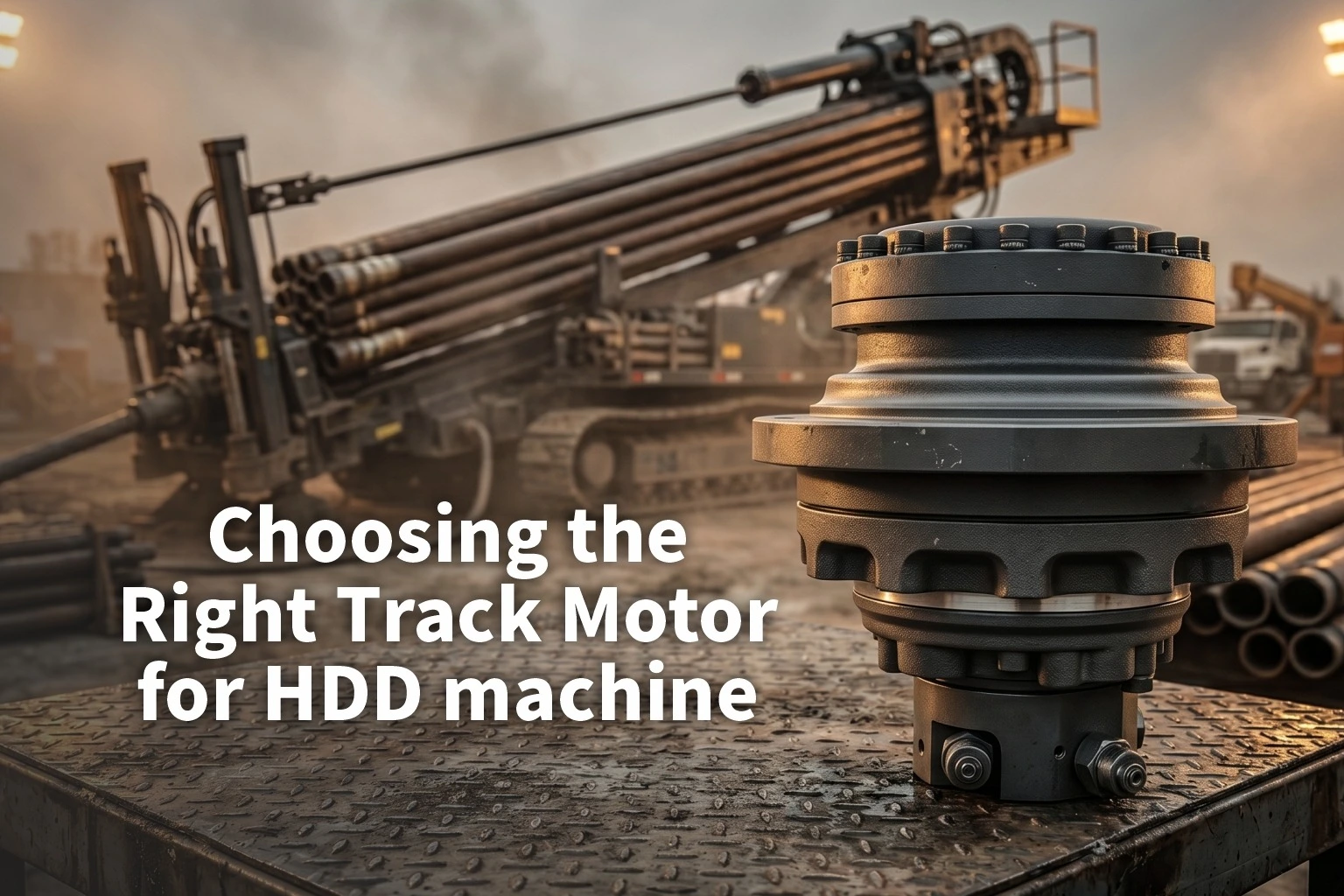
If you work in trenchless technology or horizontal directional drilling, you already know that not every machine is built the same and neither is every track motor. Picking the wrong combination can lead to costly downtime, hydraulic failure, or worse, a stalled project in the middle of a tight deadline.
Choosing the right track motor for HDD machine does not have to be complicated. You just need to know what to look for, what to avoid, and how to match the motor to your actual working conditions not just the spec sheet. Let’s through everything you need to know before making that decision.
What Does a Track Motor Actually Do in an HDD Machine?
Understanding the role of a track motor first can help you in the selection process. The track motor is the unit used to transform the hydraulic energy into mechanical action in simple terms. It is what enables your HDD machine to go forward, backward and turn in various kinds of terrain.
The track motor is the most expensive component on the most expensive HDD rig that will not move an inch if it’s not working properly. The motor operates in tandem with the machine pump of the HDD machine and the HDD gear pump to control the speed and direction of the machine. The three parts collectively make up the mobility and drilling accuracy of your machine.
Think of it like this: the HDD pump generates the hydraulic pressure, the gear pump controls how that pressure is delivered, and the track motor turns all of that energy into actual ground movement. A weak link in any one of these means your whole operation suffers.
Key Factors to Consider When Choosing an Track Motor for HDD Machine
1: Torque Output – Match It to Your Ground Conditions
This is probably the most important factor, and yet it is the one most often overlooked. Every HDD project is different. Rocky terrain, clay-heavy soil, sandy ground each one demands a different torque output from your track motor.
A track motor with insufficient torque will stall under pressure. On the flip side, an oversized motor can overwhelm your hydraulic system and cause pressure spikes that damage other components. The goal is balance.
When reviewing machine specs, look at both breakaway torque (the force needed to start moving from a standstill) and running torque (what keeps the machine moving under continuous load). For HDD operations in dense or hard ground, you need a motor that delivers strong torque consistently not just in bursts.
A good rule of thumb: always size your track motor based on your worst-case terrain, not your average conditions.
2: Hydraulic Compatibility – Do Not Skip This Step
Your track motor and your HDD machine’s hydraulic system must be a match. This means checking flow rate requirements, operating pressure ratings, and the type of hydraulic fluid the motor is designed for.
If the motor’s pressure rating is lower than what your HDD pump delivers, you will burn out the motor faster than expected. If the flow rate does not align, you will get sluggish movement or erratic speed control neither of which is acceptable on an active drill site.
Always cross-reference the motor’s displacement (measured in cubic centimeters per revolution) with the pump’s flow output. The larger the displacement, the more torque you get but also the slower the travel speed. Finding the right balance between torque and speed depends entirely on your project type.
3: Terrain and Ground Conditions
Not all HDD machines are built for the same environments. If you are drilling through open, flat land, your requirements are very different from someone running a bore under a riverbed or through urban rock formations.
For soft, loose ground, a moderate torque motor with good speed control works well. For hard, compacted ground or mixed terrain, you need a high-torque motor with a robust build that can handle sustained pressure without overheating.
Pay attention to what the machine encounters not just below the surface. HDD rigs are frequently required to move from one drilling entry to another, and sometimes over uneven, sloped or muddy surfaces. These movements are performed by a track motor that has high traction and load-bearing capacity, and which will not slip or stall.
4: Build Quality and Sealing
Here is something a lot of buyers underestimate: sealing quality matters enormously on a job site. HDD drilling involves mud, water, debris, and pressure constantly. A track motor with poor sealing will let contaminants into the internal components, which leads to premature wear and expensive repairs.
Look for motors that use high-grade seals designed for dust, moisture, and hydraulic fluid resistance. The internal components pistons, bearings, gear sets should be made from wear-resistant materials that hold up under repeated high-pressure cycles.
A well-built track motor costs more upfront, but the reduction in downtime and repair costs more than makes up for it over the life of the machine.
5: Speed Control and Precision
Accurate drilling requires more than just power it requires control. Your track motor should offer smooth and precise speed range adjustments, so the operator can control the machine’s operation without disruptions in speeds that may mangle the bore path.
An advanced hydraulic control system, sometimes coupled with the HDD machine pump and gear pump, enables operators to adjust travel speed as needed in real time. This is particularly significant during the pilot bore stage as any minor misalignment could be costly in the field.
When you’re in a tight urban environment or working on sensitive infrastructure crossings, make the smooth, responsive a track motor a priority over one with the highest torque number.
6: Serviceability and Spare Parts Availability
Serviceability is a practical concern that directly affects your project schedule. Choose a track motor and by extension, an HDD machine where replacement parts are easy to source and the motor itself is designed for straightforward maintenance access.
Some motors require specialized tools or factory-level service for even basic repairs. Others are designed so that a skilled technician on-site can handle most maintenance tasks in a few hours. For active operations, the second option is almost always the smarter choice.
Common Mistakes to Avoid
Choosing based on price alone. A cheaper track motor might save you money today but cost you three times as much in repairs within the first year. Balance upfront cost against long-term reliability.
Ignoring hydraulic system compatibility. Putting the wrong motor into an existing hydraulic setup is one of the fastest ways to damage both the motor and the pump. Always verify specifications before installation.
Prioritizing speed over torque. Faster is not always better in HDD operations. A high-speed, low-torque motor will leave you stuck the moment ground conditions get tough.
Skipping manufacturer data. Always read the technical documentation. Manufacturer specs exist for a reason, and ignoring them leads to mismatched components and reduced machine life.
Conclusion
The selection of the appropriate track motor for the HDD machine is not only a technical consideration, it is a decision that should be made based on the working conditions, hydraulic configuration, terrain conditions, and long-term operational requirements. Choosing the right track motor will increase drilling accuracy, machine control, fuel efficiency and life of the equipment.
Conversely, the improper selection of motors can result in higher maintenance expenses, lower performance and unnecessary downtime on essential projects. This is why it is crucial to know the right track motor for your HDD machine specifications before you begin your next drilling process.
THM Huade supply high quality track motors for HDD applications with reliable performance and durable hydraulic solution.
Contact now to find the right track motor solution for your next project and improve machine efficiency with THM Huade.
FAQ’s
Q1: What is a track motor in an HDD machine?
Track motor is a hydraulic component which transforms hydraulic pressure into a mechanical motion so that the HDD machine can be driven on various terrains during drilling.
Q1: What is a track motor in an HDD machine?
Review the pressure rating, flow rate needs and displacement of the motor with the output specs of your HDD machine pump. Numbers should match in order to effectively run the system.
Q3: What torque rating do I need for my HDD track motor?</h4
This will vary depending on the soil in which you plant. Hard and compacted soil, and rocks, require more torque. Always size for the worst working environment and not the “average” environment.
Q4: How often should I service a track motor on an HDD machine?
Adhere to manufacturer’s recommended service intervals. Regularly check hydraulic oil quality; check for, and replace worn or leaking seals and replace filters as per schedule to prevent oil contamination.
Q5: Can I use the same track motor for different HDD machine models?
Some track motors fit a wide range of different machine designs but it is important to ensure that the hydraulic specifications & mounting arrangement of the machine are correct before installation.