If you are involved in hydraulic systems, you recognize how important precise feedback on position is. If you manage the hydraulic servo control system, or try to track stroke length, selecting the correct digital position sensor designed for use in hydraulic cylinders could determine your system’s performance. With the many options available it is often down to the accuracy needs, budget, as well as the environment in which you operate.
Let’s take a look at five of the most popular linear position sensor for hydraulic cylinder types: What makes each valuable, and the areas where they fall short.
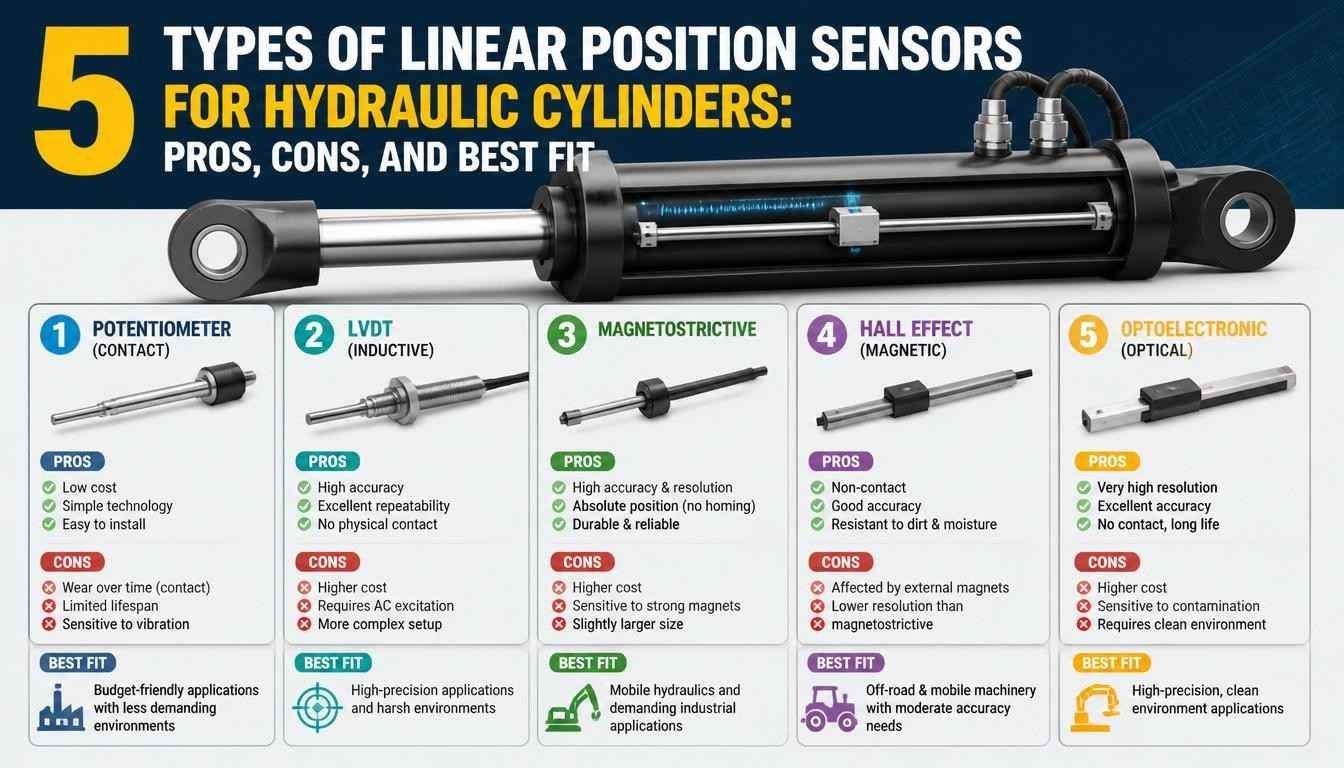
1. Magnetostrictive Linear Position Sensors
Sensors that use magnetostrictive are accepted as the gold standard in positioning sensing for hydraulic cylinders. They function by sending a sound pulse through a magnetostrictive cable and determining the amount of length of time that it requires for an appropriate return signal to come from a floating magnetic element attached on the piston. This non-contact technique provides high precision and an extended service life.
Pros: Superior resolution as well as repeatability, usually up to 1 micron. Non-contact design means no wear over time. It is suitable for direct integration into the piston rod of the hydraulic cylinder. It is reliable across the length of stroke.
Cons: Higher price point when compared with other options. Installation requires careful attention to avoid the magnet from misaligning. Not always the ideal choice for low-budget projects.
The best fit: Precision manufacturing, injection molding machines, as well as every hydraulic control device where precision and reliability are not a matter of debate.
2. Linear Variable Differential Transformer (LVDT)
The LVDT is among the most trusted and longest-running sensor technologies used in industrial measurement. It operates by using electromagnetic induction principles creating an output voltage proportional the movement of a moveable central part of the coil assembly. As an inductive linear position sensor, it performs extremely well in the harsh industrial environment.
Pros:Solid construction, with zero electrical contacts between the moving components. Good linearity and high resolution. It is resistant to vibration, shock and contaminants. A well-established technology that has gained wide industry acceptance.
Cons: Typically requires signal conditioning electronics. The length of the stroke is governed by the coil’s design. More bulky than contemporary sensors, this could limit the installation options.
The best fit: Aerospace, defense heavy industrial equipment and hydraulic systems in which durability and vibration resistance are essential.
3. Potentiometric (Resistive) Linear Position Sensors
Potentiometric sensors employ an element of resistance and an abrasive that moves with it as the cylinder expands and retracts. The position is determined by observing the variation in voltage or resistance. This is among the simplest technologies that are accessible and is a favorite option for those looking for an inexpensive linear sensor with no complicated electronic components.
Pros: Easy to connect and connect. This is a low cost linear position sensor compared to optical or magnetostrictive sensors. A wide operating range and easy output of signal.
Cons: Mechanical contact between the wiper’s track and the resistive one results in wear and tear over time, particularly when used in high-cycle applications. Highly susceptible to contamination if not sealed properly. Limited lifespan in demanding environments.
The best fit: Agriculture equipment, mobile machinery and industrial light hydraulic cylinders, with moderate duty cycles and strict budgets.
4. Optical Linear Encoders
Optical encoders determine the position of objects by registering light pulses as they pass through a precise scale. They offer exceptional resolution and are often used in precision machines. However, their use in hydraulic cylinders is limited because of their sensitivity to contamination.
Pros: Excellent resolution as well as precision. Rapid response time, ideal for high-speed tasks. Digital output makes communication with modern controllers easy.
Cons: Highly sensitive to dust, oil, or moisture. All of these are all common within hydraulic settings. Costlier than resistive alternatives. Mechanical fragility could be an issue in environments with high demands.
The best fit: Clean-room environments, precision machine tools, and other applications in which the sensor can be separated from direct exposure of fluids.
5. Inductive Position Sensors (Eddy Current and Proximity-Based)
Inductive sensors sense the position of objects by measuring the changes in the electromagnetic field that is caused by a target made of metal. As an inductive position sensor it encompasses both proximity-type sensors of short-range and eddy current models with longer ranges. They are completely non-contact, giving them a lasting advantage in wet or dirty conditions.
Pros: The system is non-moving and has no contact with the physical which means that it has a long life. This product is great for non-metallic barriers such as walls of cylinders. Excellent resistance to water, oil and dirt.
Cons: Generally shorter measurement range than magnetostrictive sensors. Changes in temperature can affect the accuracy of output if they are not compensated for. Resolution might not match LVDT or magnetostrictive options in extremely precise applications.
Best suited for: Position detection in hydraulic cylinder piston applications, end-of-stroke sensors, and other systems where resistance to contamination is more important than sub-millimeter precision.
Conclusion
The different sensor technologies bring their particular advantages. Magnetostrictive sensors are the most precise. The LVDTs have the edge due to their durability. Potentiometric sensors keep costs down. Optic encoders are the best in clean environments. Inductive sensors deal with dirty environments easily.
Knowing the requirements of your application will be the initial step towards choosing the best low cost linear position sensor for the position of hydraulic system cylinders. For procurement and hydraulic engineers teams searching for quality, durable sensors and hydraulic components, THM Huade is a reliable name that delivers high-quality products designed for harsh industrial environments. Their linear position sensor for hydraulic cylinder range ensures durability and precision in a broad range of applications.
Frequently Asked Questions
What kind of sensor is the most cost-effective linear position sensor for a hydraulic cylinder ?
Potentiometric resistive sensors are the most affordable choice. They offer simple wiring and adequate precision for light-duty and agricultural hydraulic systems. This makes them an excellent choice when keeping costs down is the most important factor.
Does an inductive linear position sensor function in the hydraulic cylinder?
Yes. Inductive sensors are able to be placed in or placed on top of hydraulic cylinders. They are effective in a soiled, oily environment. However, they are more in end-of-stroke detection, rather as opposed to continuous high-resolution tracking of position over long strokes.
What is the process by which a hydraulic servo control system makes use of feedback from the position sensor?
The hydraulic servo control system makes use of real-time data on position generated by the sensors to constantly adjust valve openings, ensuring the precise position of the cylinder or speed. Without precise input, the system will not be able to rectify errors or ensure perfect motion control.
What should I think about when selecting a sensor for the hydraulic cylinder piston applications?
Think about stroke length, accuracy requirements and operating pressure, as well as contamination exposure, as well as budget. In the case of hydraulic cylinder pistons choose sensors with closed housings and non-contact operations and compatibility with the control system's input signal type.