Modern mobile machinery operates in demanding environments where drivetrain components must withstand heavy loads, continuous shock, and varying operating conditions. Whether powering an excavator, crane, drilling rig, or material handling machine, the gearbox plays a vital role in converting hydraulic motor output into usable torque while maintaining smooth and reliable movement.
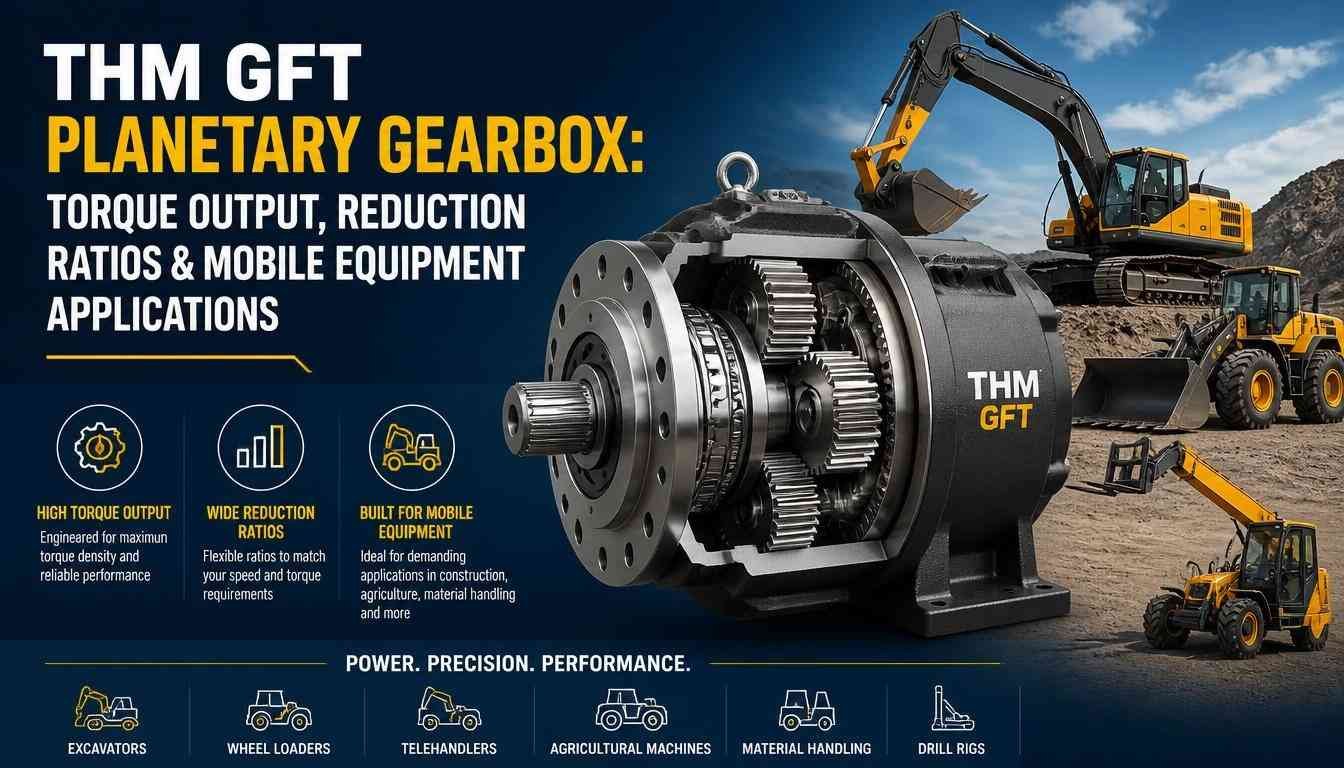
The THM GFT planetary gearbox is designed for these demanding applications. It combines compact construction with high torque transmission, making it suitable for hydraulic travel drives, winches, swing systems, and other mobile equipment that requires dependable speed reduction and efficient power transfer.
For OEM designers and engineers searching for a planetary gearbox for hydraulic drive USA, selecting the correct gearbox involves more than choosing a reduction ratio. Torque capacity, mounting compatibility, shaft configuration, efficiency, and application requirements all influence long-term performance.
This guide explains how the THM GFT planetary gearbox works, its technical characteristics, key specifications, and the factors engineers should evaluate before integrating it into mobile hydraulic equipment.
What Is the THM GFT Planetary Gearbox?
Understanding the gearbox design is the first step in selecting the right drivetrain component.
The THM GFT planetary gearbox is a compact reduction gearbox that uses a planetary gear arrangement to multiply torque while reducing output speed. Unlike conventional gear systems that rely on a single gear pair, planetary gearboxes distribute the load across multiple planet gears surrounding a central sun gear.
This balanced design allows higher torque transmission within a relatively compact housing while improving durability and efficiency.
Planetary gearboxes are commonly paired with hydraulic motors to create complete drive units for heavy-duty mobile equipment.
Typical characteristics include:
- Compact design
- High torque density
- Multiple reduction ratios
- Efficient power transmission
- Even load distribution
- Smooth rotational movement
- Robust housing construction
- Long operating life with proper maintenance
These features make the gearbox well suited to equipment operating under high loads and continuous duty cycles.
How a Planetary Gearbox Works
To understand why planetary gearboxes are widely used in hydraulic drive systems, it helps to examine their operating principle.
A planetary gearbox consists of four primary components:
- Sun gear
- Planet gears
- Planet carrier
- Ring gear
The hydraulic motor drives the sun gear. As the sun gear rotates, it causes the surrounding planet gears to revolve while meshing with the fixed or rotating ring gear.
The combined motion of these gears transfers rotational power to the planet carrier, producing lower output speed while increasing torque.
The basic operating sequence is as follows:
- The hydraulic motor rotates the input shaft.
- The sun gear transfers motion to the planet gears.
- The planet gears rotate around the sun gear.
- The ring gear controls gear movement according to the selected configuration.
- The planet carrier transmits rotational power to the output shaft.
- Output speed decreases.
- Output torque increases.
- Power is delivered to the driven equipment.
Because several gears share the transmitted load, stress is distributed more evenly than in conventional gearbox designs.
Why Planetary Gearboxes Are Used in Hydraulic Drives
Hydraulic drive systems often require a compact transmission capable of handling high torque while maintaining reliable performance.
The THM GFT planetary gearbox provides several advantages that make it suitable for these demanding conditions.
Compared with traditional gearbox designs, planetary gear systems generally offer:
- Higher torque capacity
- Compact dimensions
- Better load distribution
- High transmission efficiency
- Reduced gear stress
- Smooth power delivery
- Multiple reduction ratio options
- Improved durability under heavy loads
These characteristics explain why planetary gearboxes are widely used in construction machinery, mining equipment, drilling systems, and other heavy-duty hydraulic applications.
Technical Specifications of the THM GFT Planetary Gearbox
Selecting the appropriate gearbox begins with reviewing the technical specifications alongside the machine’s operating requirements.
Although exact values vary by model, the THM GFT planetary gearbox family typically offers the following characteristics.
| Specification | Typical Configuration |
| Gearbox Type | Planetary reduction gearbox |
| Drive Type | Hydraulic motor compatible |
| Torque Output | High torque transmission |
| Reduction Ratios | Multiple configurations available |
| Mounting | Standard industrial mounting options |
| Shaft Options | Various output shaft configurations |
| Housing | Heavy-duty compact construction |
| Lubrication | Internal gear lubrication |
| Operating Environment | Mobile hydraulic equipment |
Different models may provide varying:
- Torque capacities
- Gear reduction ratios
- Output shaft styles
- Mounting flange designs
- Input configurations
- Bearing arrangements
- Overall dimensions
Matching these specifications to the application helps ensure reliable long-term operation.
Understanding Torque Output and Reduction Ratios
One of the primary functions of a planetary gearbox is to convert high-speed input from a hydraulic motor into lower-speed, higher-torque output.
Torque multiplication depends largely on the gearbox reduction ratio.
As the reduction ratio increases:
- Output torque increases.
- Output speed decreases.
- Load-carrying capability improves.
- Machine control becomes smoother for heavy-duty applications.
Engineers should select a reduction ratio that balances torque requirements with the desired operating speed.
An oversized reduction ratio may unnecessarily reduce travel speed, while an undersized ratio may prevent the machine from generating sufficient torque.
Common Applications of the THM GFT Planetary Gearbox
The THM GFT planetary gearbox is used across many industries where hydraulic equipment must transmit high torque within a compact space.
Typical applications include:
- Hydraulic excavators
- Crawler cranes
- Rotary drilling rigs
- Winch drive systems
- Mobile drilling equipment
- Tracked vehicles
- Forestry machinery
- Tunnel boring equipment
- Mining machinery
- Material handling systems
- Offshore equipment
- Agricultural machinery
These applications benefit from the gearbox’s ability to deliver reliable torque while maintaining compact installation dimensions.
THM GFT Planetary Gearbox vs Conventional Gearboxes
Engineers often compare planetary gearboxes with conventional parallel shaft gearboxes during equipment design.
The following comparison highlights their key differences.
| Feature | THM GFT Planetary Gearbox | Conventional Gearbox |
| Torque Density | High | Moderate |
| Size | Compact | Larger |
| Load Distribution | Even across multiple gears | Concentrated on fewer gears |
| Efficiency | High | Moderate |
| Shock Load Handling | Excellent | Good |
| Mobile Equipment Suitability | Excellent | Moderate |
| High Torque Applications | Excellent | Good |
Because planetary gearboxes distribute forces across multiple gears, they are generally preferred for heavy-duty mobile hydraulic equipment requiring compact dimensions and high torque output.
How to Select the Right THM GFT Planetary Gearbox
Selecting a planetary gearbox requires careful evaluation of both the hydraulic drive system and the mechanical load. Choosing the correct model helps improve efficiency, extend component life, and minimise downtime in demanding applications.
The following factors should be reviewed before specifying a THM GFT planetary gearbox.
Required Output Torque
The gearbox should provide enough continuous and peak torque for the application’s operating conditions.
Engineers should calculate the maximum expected load rather than relying solely on average operating conditions. Maintaining an appropriate safety margin helps improve reliability during sudden load changes.
Reduction Ratio
The reduction ratio determines the relationship between input speed and output speed.
A higher reduction ratio increases output torque while reducing rotational speed. Selecting the correct ratio depends on the machine’s operating requirements, including travel speed, lifting speed, or rotational movement.
Hydraulic Motor Compatibility
Planetary gearboxes are commonly paired with hydraulic motors to create complete drive systems.
Before selection, verify:
- Input shaft dimensions
- Mounting flange compatibility
- Hydraulic motor torque output
- Maximum input speed
- Operating pressure
Matching the gearbox with the hydraulic motor ensures efficient power transmission throughout the drive system.
Mounting Configuration
OEM designers should confirm that the gearbox integrates with the equipment frame without requiring major structural modifications.
Typical mounting considerations include:
- Flange dimensions
- Bolt pattern
- Pilot diameter
- Output shaft position
- Overall installation space
Proper alignment helps reduce bearing loads and improves drivetrain reliability.
Operating Environment
Environmental conditions influence gearbox performance and maintenance intervals.
Engineers should consider:
- Ambient temperature
- Dust exposure
- Moisture
- Shock loading
- Continuous operating hours
- Corrosive environments where applicable
Selecting a gearbox designed for these conditions contributes to longer service life.
Applications in Excavators, Cranes, and Drilling Equipment
The THM GFT planetary gearbox is widely used in mobile equipment because it combines high torque transmission with compact dimensions.
Excavators
Excavators rely on planetary gearboxes in travel drives and swing systems.
These gearboxes convert hydraulic motor output into the torque needed to move heavy tracked machines across uneven terrain while providing smooth and controlled operation.
Crawler Cranes
Crawler cranes require reliable torque transmission for travel drives, winch systems, and slewing mechanisms.
A high torque gearbox helps maintain stable movement while handling substantial lifting loads.
Rotary Drilling Rigs
Drilling equipment often operates under continuously changing loads.
Planetary gearboxes provide the torque multiplication needed for rotary drilling operations while maintaining dependable performance during prolonged operating cycles.
Winch Systems
Industrial winches depend on controlled torque to lift and lower heavy loads safely.
Planetary gearboxes allow precise load control while supporting high pulling forces.
Tracked Vehicles
Tracked equipment used in construction, mining, and forestry benefits from planetary gearboxes that deliver high torque for climbing, turning, and operating across difficult terrain.
Installation Best Practices
Correct installation helps maximise gearbox performance and reduce maintenance requirements.
Before installing the THM GFT planetary gearbox, engineers should inspect both the mechanical mounting surfaces and the associated hydraulic drive components.
Recommended installation practices include:
- Clean all mounting surfaces thoroughly.
- Inspect seals before installation.
- Verify shaft alignment.
- Tighten mounting fasteners according to specification.
- Confirm coupling alignment.
- Check gearbox lubrication before startup.
- Rotate the gearbox manually where appropriate before commissioning.
- Perform initial testing under light load.
- Monitor operating temperature during startup.
- Inspect for leaks after commissioning.
These steps help ensure smooth operation from the beginning of the equipment’s service life.
Lubrication Requirements
Proper lubrication is essential for maintaining gearbox efficiency and protecting internal gear components.
The lubricant forms a protective film between gear teeth, reducing friction and minimising wear during operation.
Maintenance teams should monitor:
- Lubricant level
- Lubricant cleanliness
- Oil temperature
- Oil degradation
- Water contamination
- Scheduled lubricant replacement intervals
Using the correct lubricant helps maintain gear efficiency while extending bearing and gear life.
Routine Maintenance Recommendations
Although planetary gearboxes are designed for demanding applications, routine inspections remain essential for dependable operation.
Recommended maintenance activities include:
- Inspect external seals.
- Check mounting bolts.
- Monitor gearbox temperature.
- Listen for unusual operating noise.
- Inspect output shaft condition.
- Check lubricant quality.
- Replace lubricant at recommended intervals.
- Monitor vibration levels.
- Inspect couplings for wear.
- Record maintenance observations for trend analysis.
A preventive maintenance programme helps identify wear before it affects equipment availability.
Common Troubleshooting Issues
Even robust drivetrain components can develop issues if surrounding systems are not properly maintained.
The table below outlines common symptoms, possible causes, and recommended inspection points.
| Problem | Possible Cause | Recommended Check |
| Excessive operating noise | Low lubricant level | Check lubrication system |
| High operating temperature | Lubricant degradation | Inspect oil condition |
| Oil leakage | Damaged seals | Replace worn seals |
| Reduced output torque | Hydraulic motor issue | Verify motor performance |
| Excessive vibration | Shaft misalignment | Check coupling alignment |
| Premature gear wear | Contaminated lubricant | Inspect lubricant cleanliness |
Many gearbox issues originate from poor lubrication, incorrect alignment, or hydraulic drive problems rather than internal gear failure. A systematic inspection of the complete drivetrain helps identify the root cause before major repairs become necessary.
Why OEM Designers in the USA Choose Planetary Gearboxes
Demand for reliable planetary gearbox for hydraulic drive USA solutions continues to grow as manufacturers develop more capable mobile equipment for construction, mining, agriculture, and infrastructure projects.
OEM designers often specify planetary gearboxes because they provide high torque transmission within a compact package, allowing machinery to deliver greater performance without increasing drivetrain size.
The balanced load distribution of planetary gear systems also contributes to longer service life, making them well suited to equipment operating under continuous heavy loads.
Many manufacturers also invest in comprehensive online technical documentation to help engineers compare drivetrain components more efficiently. Technical marketing specialists such as RankFast support these efforts by improving the visibility of engineering resources, specification guides, and application content, helping procurement teams and equipment designers make informed decisions.
Buying Considerations Before Choosing a THM GFT Planetary Gearbox
Choosing the right gearbox during the design stage helps improve equipment performance, reduce maintenance requirements, and support long-term reliability. Before selecting a THM GFT planetary gearbox, engineers should evaluate the complete drive system rather than considering the gearbox as an isolated component.
The following checklist can help simplify the specification process.
- Determine the required continuous and peak output torque.
- Select a reduction ratio that matches the desired operating speed.
- Verify compatibility with the hydraulic motor.
- Confirm mounting flange dimensions and bolt pattern.
- Check output shaft configuration.
- Review the expected radial and axial loads.
- Ensure the gearbox fits within the available installation space.
- Verify lubricant requirements and maintenance intervals.
- Consider ambient temperature and environmental conditions.
- Confirm that the gearbox supports the machine’s expected duty cycle.
Reviewing these parameters before procurement helps minimise installation challenges while ensuring dependable operation throughout the equipment’s service life.
Why Choose the THM GFT Planetary Gearbox?
The THM GFT planetary gearbox is designed for demanding mobile hydraulic applications where compact size, high torque transmission, and reliable operation are essential.
Its planetary gear arrangement distributes loads across multiple gears, reducing stress on individual components while maintaining efficient power transfer. This balanced design makes it well suited to equipment that operates under heavy loads and varying working conditions.
Key advantages include:
- High torque transmission within a compact housing
- Multiple reduction ratio options
- Efficient power transfer
- Smooth and stable operation
- Even load distribution across planetary gears
- Robust construction for demanding environments
- Long service life with proper lubrication and maintenance
- Compatible with a wide range of hydraulic drive systems
- Suitable for OEM equipment and replacement projects
These characteristics make the gearbox an effective solution for excavators, cranes, drilling rigs, winches, and other heavy-duty mobile machinery.
Conclusion
The THM GFT planetary gearbox provides a dependable solution for mobile hydraulic equipment that requires efficient torque multiplication, compact installation, and reliable long-term performance. Its planetary gear design enables high torque transmission while maintaining smooth power delivery, making it suitable for demanding applications such as excavators, cranes, drilling rigs, tracked vehicles, and winch systems.
For OEM designers searching for a planetary gearbox for hydraulic drive USA, selecting the right gearbox requires careful consideration of torque requirements, reduction ratios, hydraulic motor compatibility, mounting arrangements, and operating conditions. Evaluating these factors together helps ensure that the gearbox integrates seamlessly into the drive system and performs reliably throughout its service life.
Whether you are designing new machinery or upgrading existing equipment, the gft planetary gearbox offers the strength, efficiency, and durability needed for modern hydraulic drive systems. Its compact design and high torque capability make it an excellent choice for applications where performance and reliability cannot be compromised.
If you need assistance selecting the appropriate THM GFT planetary gearbox for your equipment, contact the THM Huade team with your operating requirements, hydraulic motor specifications, and application details. Their technical specialists can recommend a gearbox configuration that matches your performance objectives and supports reliable operation.
Frequently Asked Questions
What are the main applications of a GFT planetary gearbox?
These gearboxes are widely used in excavators, crawler cranes, drilling rigs, winch systems, tracked vehicles, forestry machinery, mining equipment, agricultural machines, and other applications that require high torque transmission.
Why are planetary gearboxes preferred for hydraulic drives?
Planetary gearboxes distribute loads across multiple gears, allowing them to transmit higher torque within a compact housing. They also provide smooth power transfer, high efficiency, and excellent durability under heavy operating conditions.
How do I choose the correct reduction ratio?
The reduction ratio should be selected based on the required output speed and torque of the application. Higher reduction ratios provide greater torque while reducing output speed. Engineers should calculate operating requirements before selecting a gearbox.
What maintenance does a planetary gearbox require?
Routine maintenance includes checking lubricant levels and condition, inspecting seals, monitoring operating temperature, verifying mounting bolt tightness, inspecting shaft alignment, and replacing lubricant according to the recommended maintenance schedule.
Is the THM GFT planetary gearbox suitable for mobile hydraulic equipment in the USA?
Yes. The THM GFT planetary gearbox is suitable for a wide range of planetary gearbox for hydraulic drive USA applications, provided the selected model matches the hydraulic motor, torque requirements, mounting configuration, and operating conditions of the equipment.