Hydraulic systems power some of the most demanding industrial machines in the world. From manufacturing equipment to heavy construction machinery, these systems rely on precise fluid control to perform efficiently.
At the center of this performance is the hydraulic flow control valve. This component regulates how quickly hydraulic fluid moves through a circuit, directly influencing actuator speed, system stability, and operational accuracy.
However, not all flow control valves function the same way. Engineers often face a critical choice between pressure-compensated and non-compensated valves. Each design offers unique advantages depending on system demands.
So the question becomes clear: Which type of hydraulic flow control valve is right for your hydraulic circuit?
This guide explores the differences, benefits, and applications of both valve types so you can make an informed decision for optimal hydraulic performance.
What Is a Hydraulic Flow Control Valve and Why Is It Important?
A hydraulic flow control valve regulates the rate at which hydraulic fluid moves through a system. By controlling fluid flow, it determines the speed of hydraulic actuators such as cylinders and motors.
In simple terms, when the valve restricts or allows fluid movement, it controls machine motion.
This regulation is critical for several reasons:
- Maintaining consistent actuator speed
- Preventing system overload or instability
- Improving machine efficiency
- Protecting system components such as hydraulic valve seal elements from excessive stress
Flow control valves also work alongside other advanced components such as load sensing proportional valve systems and electric hydraulic valve configurations in modern hydraulic circuits.
Without proper flow regulation, machines may operate unpredictably or inefficiently.
What Is a Non-Compensated Hydraulic Flow Control Valve?
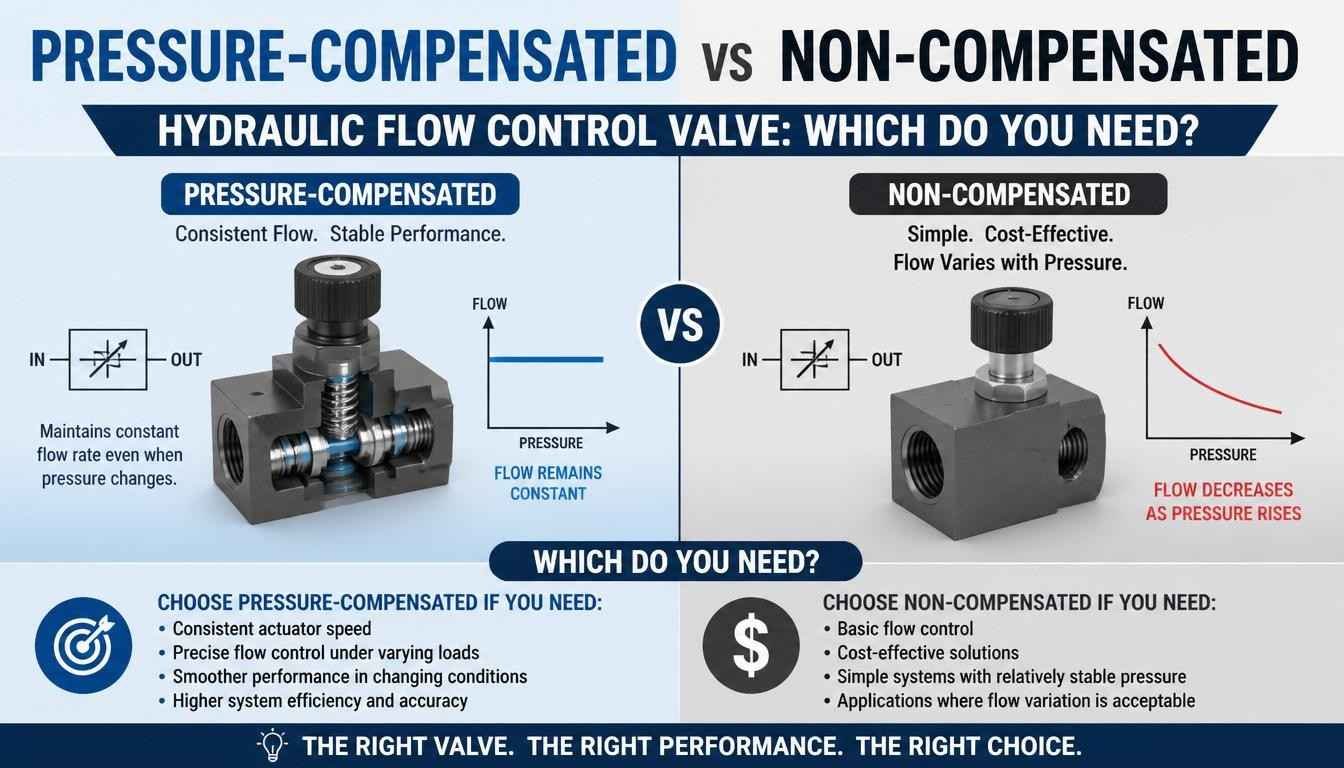
A non-compensated hydraulic flow control valve is the simplest form of flow regulation. It controls flow by restricting the passage through which hydraulic fluid travels.
The valve opening determines how much fluid flows through the system.
How It Works
These valves operate using a fixed or adjustable orifice. When the valve restricts the opening, fluid flow slows. When the opening increases, flow speeds up.
However, this system does not adjust automatically when pressure changes.
Key Characteristics
Non-compensated valves offer several advantages:
- Simple design
- Lower cost
- Easy installation and maintenance
However, they also have limitations.
Because they do not compensate for pressure fluctuations, the flow rate may vary when system pressure changes. As a result, actuator speeds may become inconsistent.
Typical Applications
Non-compensated valves are commonly used in systems where:
- Load pressure remains stable
- Speed accuracy is not critical
- Equipment operates under predictable conditions
Examples include simple lifting equipment, agricultural machinery, and basic industrial tools.
What Is a Pressure-Compensated Hydraulic Flow Control Valve?
A pressure-compensated hydraulic flow control valve is designed to maintain a constant flow rate regardless of pressure variations in the system.
This capability allows hydraulic systems to operate with greater precision and stability.
How Pressure Compensation Works
These valves contain an internal compensator mechanism. The compensator automatically adjusts the valve opening to maintain a consistent flow rate even when load pressure changes.
If pressure increases, the valve adjusts to restrict flow slightly. If pressure decreases, it opens further to maintain the set flow rate.
The result is steady actuator speed under varying conditions.
Key Advantages
Pressure-compensated valves offer several benefits:
- Consistent actuator speed
- Improved system stability
- Higher precision for automated equipment
- Better compatibility with advanced hydraulic controls
These valves are particularly valuable in systems using hydraulic servo control system technology or load sensing proportional valve designs.
How Do Pressure Changes Affect Hydraulic Performance?
Pressure fluctuations are common in hydraulic systems because loads change, valves shift, and multiple actuators often operate at the same time. When a standard hydraulic flow control valve does not include pressure compensation, these variations can directly affect machine behavior and overall system stability.
For example, increased load pressure may slow actuator movement, while reduced pressure can cause unexpected speed increases. As a result, system performance becomes inconsistent. To avoid this issue, many precision systems use pressure-compensated valves or advanced solutions such as electric hydraulic valve assemblies integrated with electronic controllers.
Pressure-Compensated vs Non-Compensated: Key Differences
Understanding the functional differences between these valves helps engineers select the correct solution.
Flow Stability
Pressure-compensated valves maintain consistent flow regardless of pressure changes.
Non-compensated valves allow flow to fluctuate when pressure varies.
System Precision.
Precision machinery typically requires pressure-compensated valves. These valves support technologies such as hydraulic servo control system configurations used in robotics and automated production lines.
Cost Considerations
Non-compensated valves are generally more affordable due to their simple construction.
Pressure-compensated valves cost more but deliver improved control and reliability.
System Complexity
Advanced hydraulic systems often integrate:
- Load sensing proportional valve technology
- Electronic controllers
- Electric hydraulic valve actuators
These systems benefit significantly from pressure-compensated flow control.
When Should You Choose a Non-Compensated Flow Control Valve?
Despite their limitations, non-compensated valves remain useful in many applications.
They are a practical choice when:
- System loads remain constant
- High precision is unnecessary
- Budget constraints are a concern
Industries that commonly use these valves include:
- Agriculture
- Basic material handling
- Small manufacturing equipment
In such environments, a simple hydraulic flow control valve can provide adequate performance without the complexity of compensation systems.
How Do Supporting Components Affect Valve Performance?
Flow control valves rarely operate alone. Their performance depends heavily on other hydraulic components.
For example:
Hydraulic Valve Seal Integrity
The hydraulic valve seal plays a crucial role in maintaining internal pressure and preventing leaks. High-quality seals ensure accurate flow regulation and extend valve lifespan.
Electric Hydraulic Valve Integration
An electric hydraulic valve allows electronic control of hydraulic systems. These valves often work with sensors and controllers to adjust system parameters automatically.
Hydraulic Servo Control System Precision
A hydraulic servo control system provides highly accurate motion control. In these systems, pressure-compensated flow valves help maintain precise actuator speeds required for automated machinery.
Together, these components create a hydraulic system capable of delivering both power and precision.
How Do Engineers Select the Right Hydraulic Flow Control Valve?
Choosing the correct valve requires evaluating several system parameters.
Engineers typically consider:
- Load variations
- Required motion accuracy
- System pressure range
- Budget constraints
- Integration with electronic controls
If a system experiences frequent pressure changes or requires consistent actuator speed, a pressure-compensated hydraulic flow control valve is usually the preferred solution.
However, if the system operates under stable conditions, a non-compensated valve may offer a cost-effective alternative.
Final Thoughts
Both valve types serve important roles in hydraulic engineering. A non-compensated hydraulic flow control valve offers simplicity, affordability, and reliability in stable operating conditions.
Meanwhile, pressure-compensated valves provide consistent flow, improved precision, and better compatibility with advanced hydraulic technologies such as load sensing proportional valve, electric hydraulic valve, and hydraulic servo control system solutions.
Ultimately, the right choice depends on system complexity and performance requirements.
By understanding how these valves function and how they interact with other hydraulic components, engineers can design circuits that deliver reliable, efficient, and precise operation.
Enhance your hydraulic system performance with reliable solutions from THM Huade. Our high-quality hydraulic flow control valve and advanced hydraulic components are engineered for precision and durability. From electric hydraulic valve systems to load sensing proportional valve technology, we support demanding industrial applications.
Our experts help you select the right solutions for efficient and stable hydraulic operations.
Contact THM Huade today to find the ideal hydraulic solution for your project.
FAQs
What is the main advantage of pressure-compensated flow control valves?
Pressure-compensated valves maintain a constant flow rate even when system pressure changes. This stability ensures consistent actuator speeds and improves performance in systems that use load sensing proportional valve technology or advanced hydraulic servo control system applications.
Where are non-compensated hydraulic flow control valves commonly used?
Non-compensated valves are typically used in simpler hydraulic systems where load pressure remains stable. These include agricultural machines, small industrial equipment, and basic material handling systems where precise speed control is not essential.
How does an electric hydraulic valve improve system performance?
An electric hydraulic valve allows electronic signals to control hydraulic flow and pressure. This integration enables automation, precise control, and compatibility with modern hydraulic servo control system technologies used in advanced industrial equipment.
Why is the hydraulic valve seal important in flow control valves?
The hydraulic valve seal prevents fluid leakage and maintains internal pressure within the valve. High-quality seals improve valve efficiency, enhance durability, and help ensure accurate operation of the hydraulic flow control valve in demanding industrial environments.