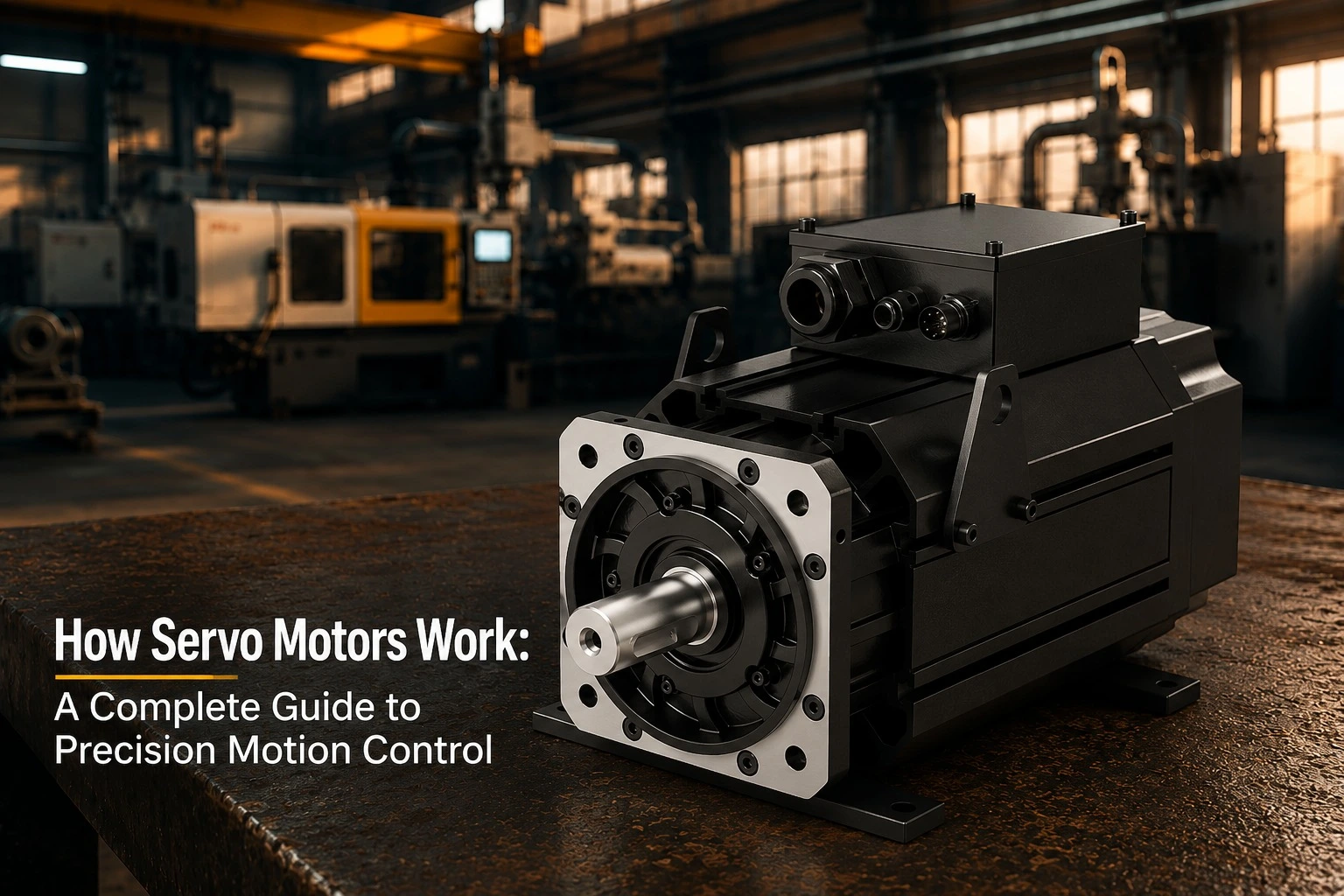
In order to increase the accuracy, speed and efficiency of their machine, manufacturers need to know how servo motors work. A servo motor is constructed to provide accurate control of position, speed and torque and as such it is an important element in contemporary automation. Servo technology is assisting industries in India with the production of high productivity and low-energy usage especially in CNC machines and robotics, packaging and plastic processing equipment.
With the ever-increasing automation within the manufacturing industry in India, companies are investing in new, and more sophisticated servo motor systems to enhance precision and minimize down times. This guide describes the principle of working of the servo motor, the parts, use and the process of selecting the correct solution to your industrial requirements.
What is a Servo Motor?
A servo motor is an electric motor which works with feedback mechanism to ensure extremely precise control of movement. It continuously measures the position and automatically changes its movement to give the desired output unlike traditional motors.
This feedback control feature makes servo motors suitable in processes that demand accurate movement control.
How Servo Motors Work
The principle of operation of the servo motor is that there is continuous feedback between the motor, the encoder and the servo drive.
Step 1: The Controller gives an Order
The controller tells the servo drive the required position, speed, or torque.
Step 2: The Servo Drive Powers the Motor
The servo drive translates the command into electrical signals and provides power to the motor.
Step 3: The Motor Produces Motion
The servo motor is an electric motor which rotates as the command received.
Step 4: Feedback is given by the Encoder
An encoder will continuously read the real position and speed of the motor.
Step 5: Automatic Correction
When the actual motion is not equal to the commanded motion, then the servo drive corrects the motor immediately until the error is removed.
The action of how servo motors operate so precisely and reliably is due to this fast feedback loop.
Main Components of a Servo Motor System
All servo motor systems comprise a number of major components that interact.
Servo Motor
Produces rotational movement.
Servo Drive
Adjusts voltage, current, speed and torque.
Encoder
Record motor position and gives continuous feedback.
Motion Controller
Gives orders according to the needs of machines.
The combination of these factors forms a very precise motion control system.
Why Servo Motors Deliver Precision Motion Control
Servo motors continuously match the actual movement to the commanded position.
This allows:
- Extremely accurate positioning
- Smooth acceleration
- Stable speed control
- Large torque at low speeds.
- Quick adaptation to load variations
These features qualify them as the most precise servo motors.
Types of Servo Motors
Various applications have varying technologies of the servos.
AC Servo Motor
The servo motor that is predominantly used in industrial automation is the AC servo motor because of its efficiency, reliability, and long life.
DC Servo Motor
DC servo motors provide excellent speed control and are often used in smaller automation systems.
Both models accommodate high-precision motion control, depending on the use.
Where Servo Motors Are Used
The uses of servo motors are ever-growing in Indian industries today.
Common applications include:
- CNC machines
- Robotics
- Packaging equipment
- Plastic injection molding equipment.
- Textile machinery
- Printing machines
- Material handling systems
- Semiconductor manufacturing
These businesses require precision in positioning and consistent movement.
Benefits of Using Servo Motors
Manufacturers of modern machines have adopted servo systems since they enhance the overall performance of the machines.
Higher Accuracy
Servo motors have a very fine positioning.
Faster Response
The motor responds practically instantly to varying commands.
Better Energy Efficiency
The consumption of power is only on demand.
Lower Maintenance
Mechanical wear is minimized, through closed-loop operation.
Increased Productivity
More precise machines create a better quality product with minimal wastage.
How to Choose the Right Servo Motor
The choice of the appropriate motor enhances efficiency and reliability.
- Calculate Load Requirements: Understand the necessary torque, speed and inertia.
- Understand Operating Conditions: Take into account temperature, dust, and vibration, and duty cycle.
- Choose the Right Power Rating: Select a motor that will suit present and future production requirements.
- Align the Servo Drive: The servo drive and motor should be perfectly compatible.
- Work with Experienced Suppliers: The suppliers are reliable to provide long-term performance and technical support.
Common Servo Motor Selection Mistakes
Proper motor selection leads to many performance problems.
Avoid these mistakes:
- Undersized motors
- Ignoring inertia matching
- Incorrect encoder selection
- Lack of compatibility with servo drives
- Overlooking environmental conditions
Adequate planning helps to avoid unnecessary downtimes and cost of repair.
Why Servo Motors Are the Future of Motion Control
With the smarter and more automated factories, precision gains more relevance.
A good quality servo motor provides:
- Better machine accuracy
- Reduced production errors
- Lower operating costs
- Faster cycle times
- Long-term reliability
Servo technology is still among the best investments that manufacturers can make to achieve increased productivity and enhance automation.
Conclusion
Understanding the mechanics of Knowing How servo motors can encourage manufacturers to make more informed automation and generally enhance the overall production process. They are invaluable in the modern industrial world due to the high-quality positioning, quick responsiveness, and controlled motion.
With Indian industries moving towards smart manufacturing, an investment in the advanced servo technology can guarantee improved productivity, uniform quality, and cost-saving in the long run.
Reliable and high-performance servo solutions: THM Huade provides a full spectrum of industrial servo motors, drives and motion control systems based on the requirements of the newer manufacturing.
Automate with THM Huade. Call today to select the most appropriate servo motor solution to your business and attain the best precision and performance.
FAQ’s
What is a servo motor and how does it work?
A servo motor is an ultra-precision electric motor where position, speed and torque are controlled (via a feedback device and controller) to achieve motion control in a process.
What are servo motors used for?
CNC machines, robotics, packaging equipment, printing presses, textile machinery, plastic injection molding machines, industrial automation systems are some of the applications of servo motors.
What is the difference between a servo motor and a regular electric motor?
A servo motor offers a controlled position, speed and torque with a closed-loop feedback system and a standard electric motor does not use a continuous feedback system.
Why are servo motors important in precision motion control?
Servo motors provide precision, quick reaction, fluid movement, and repeatability thus they are suitable in the use where high precision in movement is required.
How do I choose the right servo motor?
Select a servo motor depending on the torque needs, velocity, load inertia, positioning precision, duty cycle, working environment, and capability with the servo drive and controller.