A hydraulic pressure reducing valve is used to keep the pressure at a constant level in a section of a hydraulic circuit. This is also critical in cases where various parts may need varying pressure levels in order to run safely and efficiently. The right valve may safeguard delicate parts of industrial machinery, enhance the ability to control actuators, and maintain consistent machine operation.
Hydraulic systems are usually at high pressure, yet not all circuits require a uniform pressure. These differences are controlled by pressure reducing and check valves that do not affect the entire hydraulic system.
What is a Hydraulic Pressure Reducing Valve
Hydraulic pressure reducing valve keeps the downstream pressure to a set pressure. If the required downstream pressure is less than the input pressure then the valve changes the flow path to ensure that the pressure remains at the desired level.
This helps the valve to be handy in hydraulic systems where a portion of a system requires lower pressure than the main system.
To illustrate, a machine can be run on a high-pressure main circuit but a clamping or auxiliary circuit could need low pressure. The required pressure can be given by a reducing valve such that it does not alter the pressure available to the remainder of the system.
How Does a Pressure Reducing Valve Work in a Hydraulic System
The principle of operation is the downstream pressure control.
Once the downstream pressure is equal to the set point, the valve begins to limit the flow to avoid an excessive pressure. When the pressure down the line drops, the valve opens more to get the necessary pressure.
This enables a pressure reducing valve in hydraulic system to offer a greater amount of constant pressure.
The performance in real life is based on:
- System pressure
- Required downstream pressure
- Flow rate
- Valve size
- Hydraulic fluid
- Machine operating conditions
What is the Difference between Pressure Reducing and Check Valve
A pressure reducing and check valve is a single valve that has both the benefit of pressure reduction and a check.
The pressure-reducing action regulates the downstream pressure, and the check action permits flow to flow in the desired direction, and avoids undesired reverse flow.
This combination may come in handy in cases where a hydraulic circuit requires both a pressure control and one-way flow protection.
Hydraulic Pressure Reducing Valve vs Hydraulic Check Valve
A hydraulic check valve is primarily used to regulate the flow direction of fluids. It generally enables the flow of fluid in a single direction and keeps it unidirectional.
A different purpose of a pressure-reducing valve is different. It controls downstream pressure, but not necessarily the direction of flow.
Both of the valves may be installed in tandem where a hydraulic circuit may need to be controlled in pressure and guard against reverse flow.
Types of Pressure Reducing Valves
Various hydraulic circuits have varying valves. Common options include:
Adjustable Pressure Reducing Valve
An adjustable pressure reducing valve enables one to adjust the pressure rate based on the needs of the machine. This may be handy at times when the working conditions or actuator specifications change.
Pressure Reducing and Check Valve
This valve system offers pressure relief and a check feature. It may simplify the design of the circuit in cases where both functions are needed.
Industrial Pressure Reducing Valve
The choice of an industrial pressure reducing valve is based on the need of constant pressure and strenuous environments in the operating conditions.
Pressure Reducing Valve Applications in Industrial Machinery
The type of pressure reducing valve applications varies with the hydraulic circuit and machine design.
These valves can be used in:
- Hydraulic presses
- Machine tools
- Material handling equipment
- Injection molding machinery
- Clamping systems
- Industrial automation equipment
- Hydraulic power units
- Mobile and construction machinery
They are especially good when the various parts of a single hydraulic system need varying levels of pressure.
Hydraulic Pressure Control Valve for Better Circuit Performance
A hydraulic pressure control valve assists in controlling pressure depending on the needs of the hydraulic circuit. The use of pressure control is of particular importance when the presence of excessive pressure may lead to the failure of seals, cylinders, motors, or other hydraulic components.
An appropriate pressure control hydraulic valve can be used to ensure the operating conditions are more steady and unnecessary stresses on the system components are minimized.
The valve must be chosen based on the pressure range needed, flow capacity, connection size and conditions of use.
Important: Pressure Setting Must Match the Application
The connection size of a pressure reduction valve cannot be the sole criterion in choosing it. The range of pressure and flow needs are important as well.
Prior to choosing a valve, check:
- Maximum system pressure
- Required reduced pressure
- Maximum and minimum flow
- Port and mounting setting
- Hydraulic fluid compatibility
- Operating temperature
- Required adjustment range
Over- or under sizing may lead to unstable pressure, over-pressure drop, or machine under-performance.
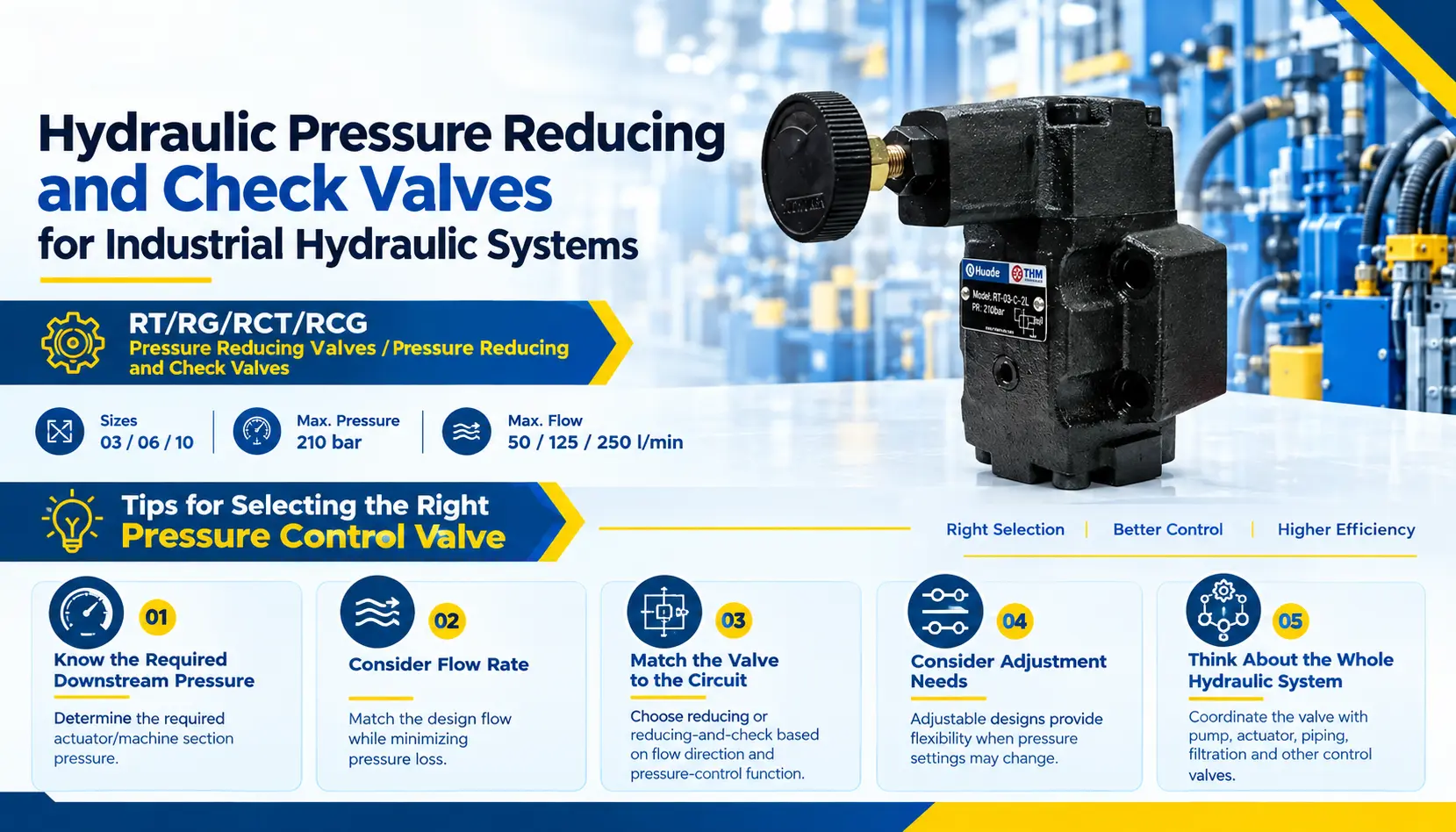
Tips for Selecting the Right Pressure Control Valve
There are several points to consider when choosing a pressure control valve. Here are a few tips for selecting the right pressure control valve.
Tip 1: Know the required downstream pressure
Determine the required actuator/machine section pressure before choosing the valve.
Tip 2: Take into account flow rate
The valve should be used to accommodate the design flow without any other pressure loss.
Tip 3: Valve matching to the circuit
Select reducing valve or reducing-and-check option depending on the direction of flow as well as the pressure-control function.
Tip 4: Take into account adjustment needs
Adjustable designs can offer more flexibility, in case pressure levels might need to be adjusted.
Tip 5: Think about the whole hydraulic system
The valve must function properly in conjunction with the pump, actuator, piping, filtration and other control valves.
Final Considerations
The first step in good pressure control is to select a pressure control valve to meet the circuit’s actual needs. The correct PRV/check valve can help stabilize pressure at the downstream location, prevent component damage and help keep machines running smoothly.
In industrial applications, THM Huade provides hydraulic valves for various pressure-control needs. Before choosing a valve, check your pressure, flow, circuit, and operating conditions.
Contact THM Huade today and consult about your application to find the right hydraulic pressure-control solution.
FAQs
What is a pressure reducing valve and why is it used in hydraulic systems?
A pressure reducing valve regulates and reduces the downstream pressure to a desired value. When a certain portion of a hydraulic system is desired to work at a lower pressure than the rest of the system.
How does a hydraulic pressure reducing valve maintain lower downstream pressure?
A hydraulic pressure reducing valve is a valve that automatically changes its opening based on the pressure downstream. Once the pressure reaches the set pressure, the valve will restrict flow to maintain the desired pressure.
What is the difference between a pressure reducing valve and a pressure reducing check valve?
The main purpose of a pressure reducing valve is to control the pressure downstream. Pressure reducing check valve is a combination of a pressure reducing valve and a check function, which enable it to pass the flow in a controlled manner in a direction and prevent the flow in reverse direction to some extent.
When should a pressure reducing and check valve be used in a hydraulic circuit?
It should be used where a hydraulic circuit needs to have lower downstream pressure, and also one-way flow control. It is helpful in safeguarding the components and for the controlled operation of certain portions of the circuit.
Where are pressure reducing valves commonly used in industrial hydraulic machinery?
Common applications for pressure reducing valves include hydraulic presses, machine tools, injection molding machines, material handling equipment, clamping systems, hydraulic power units and industrial automation machinery.