Industrial machinery requires a dependable supply of hydraulic power for lifting, pressing, clamping, moving and positioning heavy loads. A hydraulic power pack is used to combine the hydraulic system elements into a single system and allow the machines to perform these tasks with controlled force and movement. Whether it’s a car lift, an industrial press or a material handling machine or mobile machinery, the ideal power pack can provide effective and efficient operation while meeting the pressure, flow and space needs of the machine.
Hydraulic Power Packs for Industrial Machinery
An industrial hydraulic power pack is used to generate high pressure fluid to be sent to a hydraulic cylinder or hydraulic motor. It can be used alone or in combination in a hydraulic circuit depending on the machine.
A power pack differs from the systems with separate components installed throughout a machine in that it concentrates important components in one assembly. This can make installation, servicing and hydraulic connections easier.
Common applications include:
- Lifts and hydraulic presses in industry.
- Lifting equipment such as car lifts and workshop equipment.
- Equipment for recycling, material handling machinery
- Production machinery and equipment.
- Agricultural machines and mobile machines
- Clamping, pushing and positioning systems are used to secure and position components.
The selection of the proper configuration depends upon the workload, operating cycle, available power supply and required hydraulic movement of the machine.
Hydraulic Power Pack Components
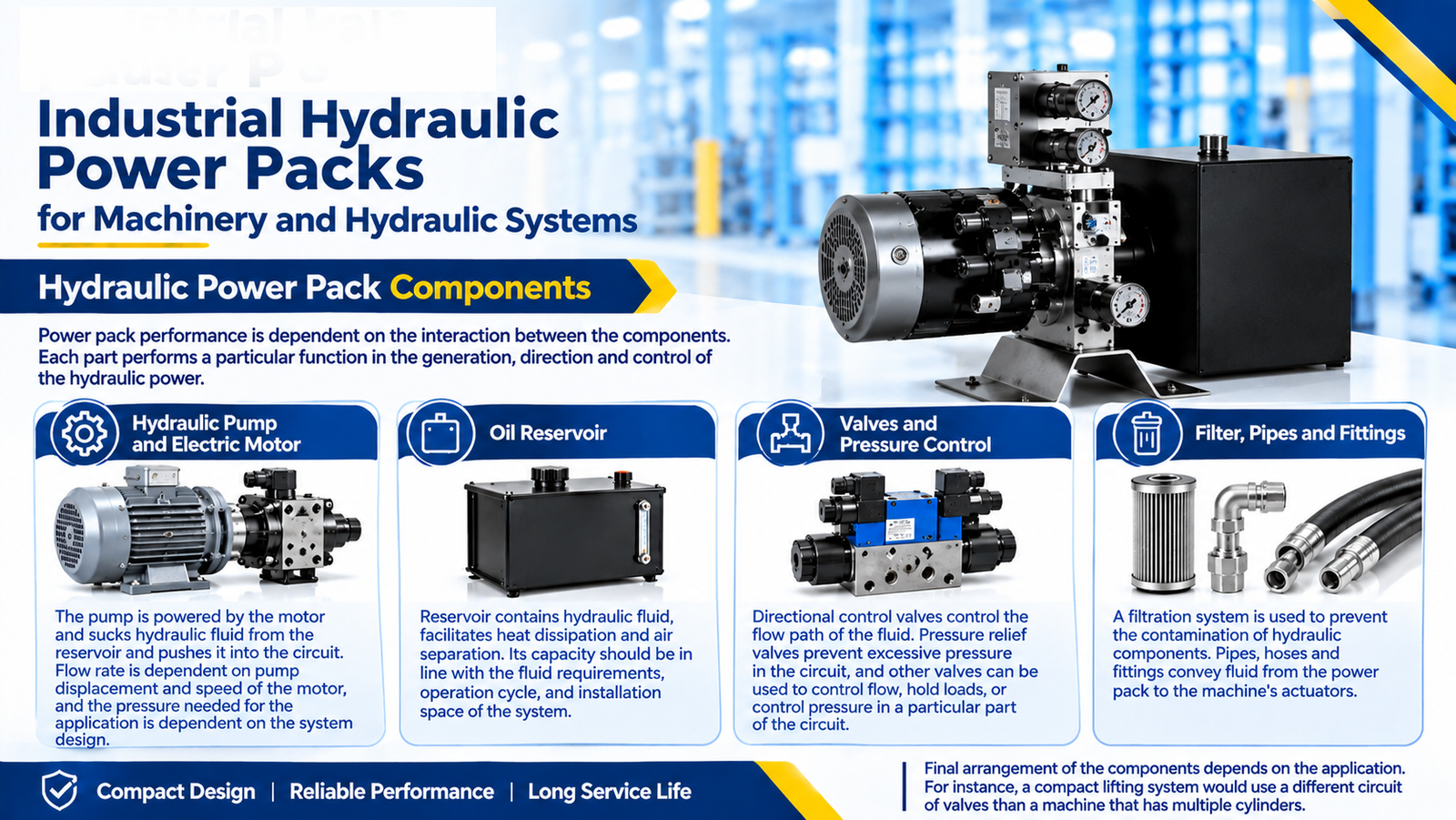
Power pack performance is dependent on the interaction between the components. Each part performs a particular function in the generation, direction and control of the hydraulic power.
Add hydraulic Pump and Electric Motor
The pump is powered by the motor and sucks hydraulic fluid from the reservoir and pushes it into the circuit. Flow rate is dependent on pump displacement and speed of the motor, and the pressure needed for the application is dependent on the system design.
Oil Reservoir
Reservoir contains hydraulic fluid, facilitates heat dissipation and air separation. Its capacity should be in line with the fluid requirements, operation cycle, and installation space of the system.
Valves and pressure control
Directional control valves control the flow path of the fluid. Pressure relief valves prevent excessive pressure in the circuit, and other valves can be used to control flow, hold loads, or control pressure in a particular part of the circuit.
Filter, Pipes and Fittings
A filtration system is used to prevent the contamination of hydraulic components. Pipes, hoses and fittings convey fluid from the power pack to the machine’s actuators.
Final arrangement of the components depends on the application. For instance, a compact lifting system would use a different circuit of valves than a machine that has multiple cylinders.
Hydraulic Power Pack Working Principle
When the motor operates the pump, the hydraulic power pack working process starts. The pump removes fluid from the reservoir and pumps it into the system.
The control valves are used to route the fluid under pressure to the desired actuator. A hydraulic cylinder could move out or back in, and a hydraulic motor could provide rotation.
The valve directs the fluid or stops the actuator when the machine is in the desired position as determined by the valve circuit. Pressure control components help to maintain the system within its desired operating parameters.
The system should be designed to fit the pump flow, pressure, motor size, valve size and actuator. If the size is not correct, it may cause slow movement, over heating or unnecessary energy loss.
Hydraulic Power Pack Applications Across Different Industries
Various machines require various power packs. Power source, hydraulic circuit and size of components should be appropriate to the equipment’s operation.
AC hydraulic power packs for Industrial Machinery.
AC-powered units can be used for stationary equipment that has access to a mains electricity supply.
Typical applications include:
- Two post and four post car lifts
- Scissor lifts and wheel alignment equipment
- Industrial lifts and hydraulic presses
- Shop machinery and recycling
- Material handling equipment that remains in a fixed place
These applications can be situations where lift is required all the time, controlled movement is needed and a power pack is required to match the operating cycle.
DC Hydraulic Power Packs for Mobile Equipment
If a machine is using a battery or DC electrical system, then DC-powered units are helpful. They are compact and can be used where space is a concern or a fixed AC source is not available.
Examples of applications include lifting equipment such as lift gates, wing-body trucks, pallet trucks, stacking equipment and mobile lifting systems.
Before choosing a unit, the voltage, battery capacity, pressure, and flow requirements of the motor should be checked.
PTO Hydraulic Power Packs for Agricultural Machinery
PTO power packs are powered mechanically from the power take off of a machine. They may be used in other mobile equipment and agricultural machinery where an appropriate PTO drive is available.
The drive system must match the hydraulic, power output and speed of the machine.
Selection of Hydraulic Power Unit in Industrial Machinery
The hydraulic power unit to select when connecting an industrial machine must be based on the power needs of the machine you are connecting, but not the machine size or the size of the motor.
These are some of the considerations that need to be taken into account when choosing a configuration.
- Operation pressure: Determine the pressure needed to generate the force needed by the actuator.
- Flow rate: The flow is to be determined to get the desired speed of a motor or a cylinder.
- Selection of power source: choose an AC, DC or PTO driven setup based on the power source of the machine.
- Duty cycle: Take into account the number of times and the duration of the machine running cycle.
- Installation space: The space to install the equipment, the reservoir size and accessibility to maintain the equipment should be provided.
- Valve adjustment: Bond direction and pressure control valves to movement and hydraulic circuit.
In selecting an industrial hydraulic power unit, environmental factors such as the working environment, fluid purity and temperature should also be put into consideration.
Small Hydraulic Power Pack on Equipment with limited space
A small hydraulic power pack could be beneficial in the case that the machine will be placed in a tight space. Combining the motor, pump, reservoir and valves into a single unit can make installation easier and minimize the number of individual parts that are mounted in proximity to the equipment.
Small lifting systems, mobile equipment, machine tools, and other small space applications are typically done with compact units.
But the small size shouldn’t compromise the necessary pressure, flow, cooling or reservoir volume. The design should continue to meet requirements for the machine’s workload and operating cycle.
High Pressure Hydraulic Power Pack Requirements
High pressure hydraulic power pack is used for applications where the operating pressure is required to be high. These systems can be applied to machinery with high clamping and pressing forces, such as industrial presses.
High pressure alone does not determine performance. The capacity of the pumps, power of the motors, valve pressure rating, seals, hoses, fittings and actuator specifications should be appropriate for the intended condition.
The circuit should be provided with suitable pressure protection and be arranged, installed and maintained in accordance with instructions given by the manufacturer of the equipment. Do NOT over-pressure any component.
THM Huade provides hydraulic services of industrial equipment and hydraulic systems. . To help you select the correct configuration that you require, you can call us today and discuss your application, pressure, flow, power and installation requirements.
How to choose the best hydraulic power pack?
- Determine the use first: determine the movement, load and operating cycle that the machine will need.
- Determine pressure and flow: This is needed to match the pump and motor to the actuator.
- Select power source to use – (AC, DC, PTO drive).
- Check the valve circuit: Check the availability of the required valve movement and load control on the actuators by the valves.
- Maintenance: Have access to filters, fluid connections and serviceable parts.
- Consider heating and contamination: Cooling and filtration of fluids can be significant to provide reliable operation.
Final Considerations
Evaluate the entire hydraulic circuit, and not just a single component or specification when making a choice. The correct choice of the appropriate size, pressure ratings and their correspondence to the operating cycle can reduce the possible issues of performance and maintenance.
THM Huade is a producer of hydraulic solutions applicable in different industries and mobile machines. Send us an email today to talk about your machine requirements and identify a hydraulic power pack system that will work within your system.
FAQs
Q. In industrial machinery, what is a hydraulic power pack?
A hydraulic power pack is a system which provides the pressurized fluid for the cylinders and hydraulic motors. It is found in machinery for controlled lifting, pushing, clamping or positioning; car lifts; presses; and material handling systems and industrial lifts.
Q. Which are the key components of a hydraulic power pack for industry?
These are usually composed of hydraulic pump, electric motor (or any other source of power), oil reservoir, valves, filters and hydraulic connections. Additional components can be included depending on the pressure control, cooling and machine needs.
Q. How does an industrial hydraulic power pack work?
The drive source rotates the pump which takes fluid from the reservoir and sends it to the hydraulic circuit. Control valves send the fluid to cylinders or motors to generate the desired movement in the machine.
Q. What is the difference between hydraulic power pack AC and DC?
An AC hydraulic power pack is a hydraulic power pack that is powered by an AC motor and can generally be used in stationary industrial equipment. A DC hydraulic power pack is a hydraulic power pack powered by a DC motor and is typically chosen for battery-powered or mobile applications. The choice of the proper option depends upon the power supply and application requirements.
Q. What do you use to choose a hydraulic power pack for machinery?
Establish first, the pressure, flow, actuator type, operation and power cycle. Next evaluate reservoir capacity, valve configuration, installation space and component ratings to determine if the entire system is appropriate for the machine.
Q. Choosing the proper hydraulic power solution?
An appropriate hydraulic power pack makes certain that a machine operates at the right pace, consumes the right amount of force and occupies the right area to execute the task that is supposed to be performed by it. For stationary industrial machines, AC powered systems can be useful, while DC or PTO-driven systems may be more appropriate for mobile machines.