The source of power must be capable of providing a dependable performance in a small machine without occupying unnecessary space. A DC hydraulic power unit is a convenient replacement to a battery or DC-powered electrical section of mobile and industrial equipment. These units are able to assist with lifting, pushing, clamping, tilting, positioning and other hydraulic tasks in small machines.
DC powered hydraulic systems may be built around the pressure, flow, voltage and duty cycle needed by the machine, and this may be lift gates, pallet trucks, industrial lifts, or material handling equipment.
Compact Hydraulic Power for Different Machine Applications
Hydraulic power packs are applied to a very diverse industry, mobile, and agricultural equipment. This depends on the power source that is required depending on the way the machine will be used and its location.
Some typical hydraulic power pack designs are:
- Car lift power packs (AC)
- AC electrical power sources to lifts and machinery in industries.
- DC power supplies to mobile equipment.
- Agricultural and mobile machinery PTO power packs.
This enables hydraulic power units to be used both as stationary and mobile.
Hydraulic Power Pack Applications
The type of hydraulic power pack depends on the application. An AC-powered system may be used in a stationary industrial machine and a DC or PTO system may be required in a vehicle-mounted machine.
AC Power Packs on Car Lifts
AC hydraulic power packs are typically fitted to vehicle lifting equipment where there is a fixed electrical supply.
Typical applications include:
- 2-post car lifts
- 4-post car lifts
- Scissor lifts
- Wheel alignment equipment
These systems offer hydraulic power to controlled vehicle lifting and lowering activities.
AC Power Packs for Industrial Lifts and Machinery
Various industry lifting and machinery applications can also be powered by using the AC power packs. They can be used in the equipment that is fed by a standard electrical supply.
Applications can include:
- Industrial lifts
- Hydraulic presses
- Recycling equipment
- Shop machinery
- Material handling systems
- Industrial lifting equipment
Depending on the needed hydraulic pressure, flow, actuator size, and operating cycle, the power unit can be set.
DC Power Packs for Mobile Equipment
A DC hydraulic power pack is especially handy when the machine is powered by a battery or DC electrical system. It offers hydraulic power without the need to have a fixed AC connection.
Typical applications include:
- Wing-body trucks
- Lift gates
- Pallet trucks
- Stacking equipment
- Mobile lifting systems
- Small material handling machines
This is why a mobile hydraulic power unit can be an effective choice in machines that move frequently between the sites.
PTO Power Packs for Farm Machinery
PTO hydraulic power packs tap into mechanical power of power take-off system in a machine. They may be installed where there is already a suitable mechanical power source such as the vehicle or the agricultural machine.
Typical applications include:
- Farm machinery
- Agricultural equipment
- Mobile hydraulic equipment
- Vehicle-mounted hydraulic systems
The PTO setup will be able to supply hydraulic power without relying on a dedicated electric motor.
DC Hydraulic Power Unit for Compact Machinery
A DC hydraulic power unit is a compact hydraulic power unit that integrates an electric motor, hydraulic pump, reservoir and control parts.
The hydraulic pump is powered by a DC electrical supply to the motor. The pump withdraws hydraulic fluid in the reservoir and delivers pressurized oil to the hydraulic circuit of the machine.
The flow of hydraulic fluid can also be used to power a cylinder or a hydraulic motor, depending on the valve arrangement, to different motions of the machine.
It is compact in the areas where the motor, pump, and reservoir will need excessive space to be installed separately.
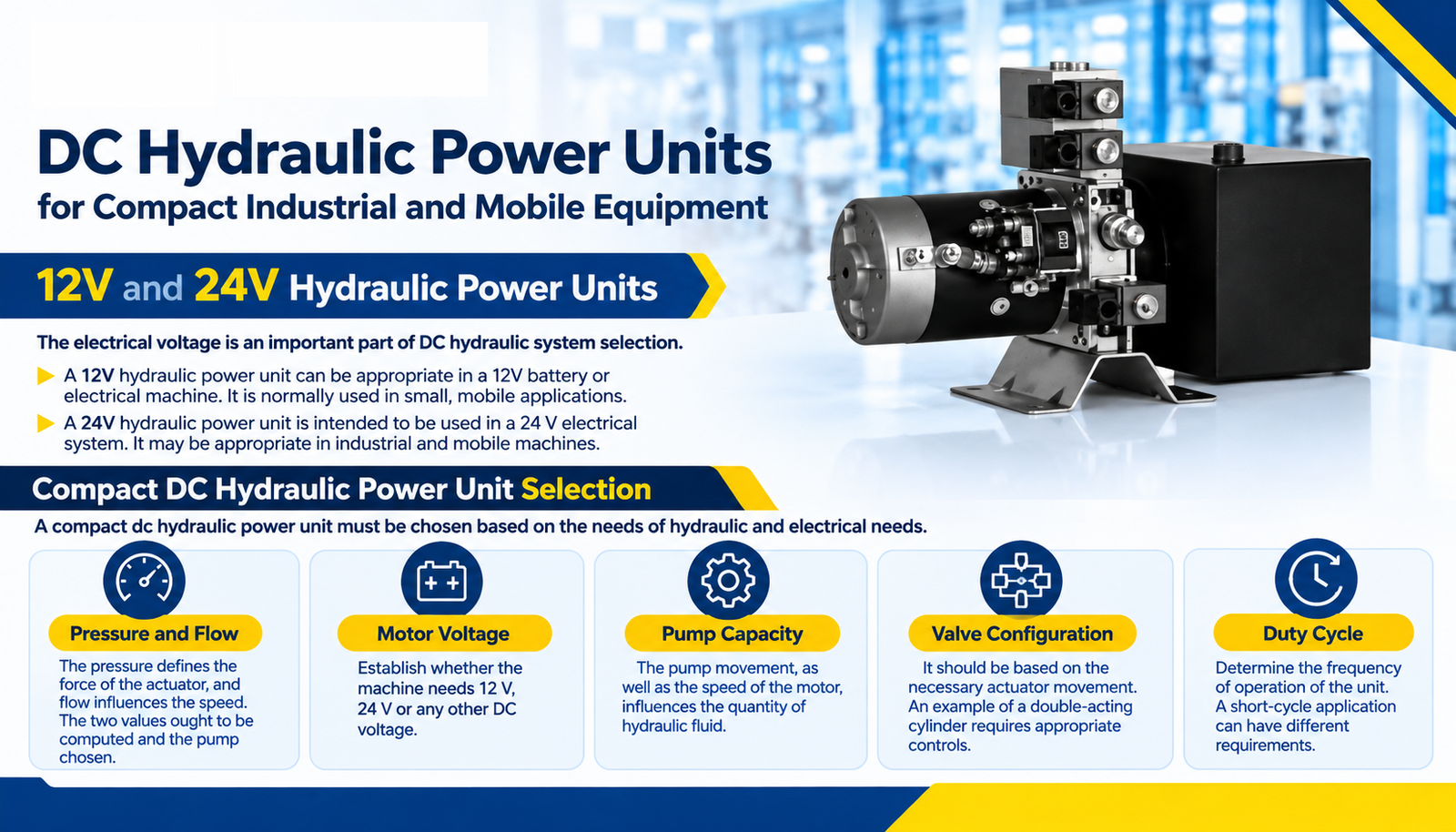
12V and 24V Hydraulic Power Units
The electrical voltage is an important part of DC hydraulic system selection.
A 12V hydraulic power unit can be appropriate in a 12V battery or electrical machine. It is normally used in small, mobile applications.
A 24V hydraulic power unit is intended to be used in a 24 V electrical system. It may be appropriate in industrial and mobile machines that have 24V DC power supply.
The voltage must be equal to the electrical architecture of the machine. There should also be considerations on motor power, current requirements, battery capacity and operating cycle.
Hydraulic Power Unit with Battery Power to operate mobile equipment
When mains electricity is not available or is not feasible, a battery powered hydraulic power unit can be used to provide hydraulic power.
This setup may be applicable to:
- Mobile lifting equipment
- Lift gates
- Pallet trucks
- Material handling equipment
- Compact service machinery
- Agricultural equipment
- Battery-operated machines
The motor receives electrical power supplied by the battery and the hydraulic pump transforms the mechanical power into hydraulic power.
In the case of mobile equipment, the entire system must be tailored to the amount of battery capacity and anticipated operating cycle.
Electric Hydraulic Power Unit for Industrial Machinery
A compact and controlled hydraulic power source can be supplied by an electric hydraulic power unit to industrial machinery.
Depending on the configuration, these systems can support:
- Lifting
- Clamping
- Pressing
- Pushing
- Tilting
- Positioning
- Material handling
The selection of the motor and pump needs to be based on the hydraulic load and not by the electrical voltage that is available.
Hydraulic Power Unit for Mobile Equipment
A mobile equipment hydraulic power unit must consider other conditions that are unlike those of stationary machines.
Mobile equipment can be subject to vibration, altering loads, lack of space to install and frequent start-stop. The choice of the power unit should be based on the overall machine design.
Important considerations include:
- Hydraulic pressure
- Hydraulic flow
- Motor voltage
- Pump displacement
- Reservoir capacity
- Actuator requirements
- Duty cycle
- Mounting space
- Operating environment
An appropriate chosen unit may offer good hydraulic motion and make the entire machine compact.
Compact DC Hydraulic Power Unit Selection
A compact dc hydraulic power unit must be chosen based on the needs of hydraulic and electrical needs.
Pressure and Flow
The pressure defines the force of the actuator, and flow influences the speed at which the actuator works. The two values ought to be computed and the pump chosen.
Motor Voltage
Establish whether the machine needs 12 V, 24 V or any other DC voltage.
Pump Capacity
The pump movement, as well as the speed of the motor, influences the quantity of the hydraulic fluid provided to the system.
Valve Configuration
It should be based on the necessary actuator movement. An example of a double-acting cylinder requires appropriate controls to extend and to retract.
Duty Cycle
Determine the frequency of operation of the unit. A short-cycle application can have some dissimilar requirements compared to equipment with long periods of operation.
Guidelines to Choosing a DC hydraulic power unit
Tip 1: Determine the pressure and flow needed and then select the pump.
Tip 2: Synchronize the motor voltage with the electrical system of the machine.
Tip 3: Make sure the type of actuator used and the movement required and then choose the valves.
Tip 4: Keep in mind the space at which the machine will be installed at the very inception of the machine design.
Tip 5: In the case of mobile equipment, think of vibration and environmental factors.
Tip 6: Correlate battery capacity to motor power and anticipated operating time.
Tip 7: Have hydraulic and electrical parts easily visible to service.
Important: Match the Complete Hydraulic System
The choice of power unit based on its voltage alone or physical size alone may result in poor system operation.
The motor, pump, pressure, flow, valve, reservoir, actuator and duty cycle should be thought of as a unit. Proper matching can avoid issues of slow movement of actuators, overheating, unwarranted energy use as well as erratic functioning.
Battery capacity and operating frequency are also crucial in the case of mobile equipment. In the case of fixed industrial machines, constant functioning, thermal control, and maintenance might be more significant.
Final Considerations
The various machines use varied sources of hydraulic power. AC power packs can be used in numerous stationary applications like automobile lifts and industrial products. DC power packs offer a convenient alternative to mobile and battery-operated equipment, and PTO power packs may be practical with agricultural equipment and other machinery that has a PTO drive available.
The solution to this is the fully applied solution and not a single specification.
A small hydraulic power system can deliver controlled and reliable movement of machines with the right combination of motor, pump, valves, reservoir, pressure and flow.
THM Huade provides hydraulic power systems to various industries and mobile uses. When choosing a new unit, or when replacing an existing hydraulic power system, call now to talk about the requirements of your machine and locate an appropriate hydraulic configuration.
FAQs
What is a DC hydraulic power unit and how does it generate hydraulic power?
A DC hydraulic power unit uses a DC electric motor to drive a hydraulic pump. The pump converts mechanical energy into hydraulic energy by pressurizing hydraulic oil to operate cylinders and motors.
How does a DC hydraulic power unit operate in mobile and compact machinery?
It operates using a battery-powered DC motor that drives the hydraulic pump. This makes it suitable for mobile equipment, lifting systems, and compact machinery where AC power is not readily available.
What are the main applications of DC hydraulic power units in industrial equipment?
DC hydraulic power units are commonly used in hydraulic lifts, tail lifts, material handling equipment, scissor lifts, and mobile machinery. They provide reliable hydraulic operation in space-limited applications.
What is the difference between a DC hydraulic power unit and an AC hydraulic power unit?
A DC hydraulic power unit operates using a DC power source, such as a battery, while an AC unit uses an AC electrical supply. DC units are preferred for mobile and battery-powered equipment, whereas AC units are commonly used in stationary industrial machinery.
When is a compact DC hydraulic power unit suitable for a hydraulic system?
A compact DC hydraulic power unit is suitable when the system requires limited installation space, battery-powered operation, and controlled hydraulic performance. It is ideal for mobile equipment and applications requiring independent hydraulic power.