On a typical injection moulding floor, the biggest hidden cost is not the resin or the tooling. It is the pump running at full speed while the machine sits idle between shots. A conventional fixed-displacement hydraulic system keeps its motor spinning at constant rpm whether the machine is injecting, holding, cooling, or waiting. That wasted motion, repeated thousands of times a day across a plant, is where energy bills quietly balloon.
A hydraulic servo system for injection moulding equipment attacks that waste directly. Instead of a motor running flat out and dumping surplus flow across a relief valve, a servo-driven system matches pump speed and torque to the exact demand of each phase in the moulding cycle. When the machine needs pressure, the motor delivers it. When the machine waits, the motor slows or stops. The result is a machine that consumes power in proportion to the work it actually does.
This shift matters more in 2026 than it did five years ago. Energy costs across most manufacturing regions have not returned to pre-2022 levels, and buyers in the United States, Europe, and Asia are specifying energy efficiency as a hard purchasing criterion rather than a nice-to-have. For plant managers weighing a retrofit or a new machine purchase, the economics of a servo hydraulic system have moved from marginal to compelling.
Below are seven benefits that hold up under measurement, not marketing. Each one is tied to a mechanism you can verify on your own floor.
How a Hydraulic Servo System Differs From a Fixed Pump
Before the benefits make sense, the mechanism has to be clear. A traditional injection moulding hydraulic circuit uses a fixed or variable displacement pump driven by an induction motor running at a constant speed, usually around 1,450 or 1,750 rpm depending on the supply frequency. The machine controls pressure and flow using proportional valves that throttle or bypass the excess. Everything the pump produces but the machine does not use is converted into heat.
A hydraulic servo system for injection moulding replaces that arrangement with a servo motor coupled to a hydraulic pump, controlled by a closed-loop drive. The servo motor hydraulic pump assembly reads the pressure and flow demand from the machine controller in real time and adjusts motor speed and torque accordingly. There is no constant-speed motor fighting against a relief valve. There is a motor that speeds up, slows down, and idles in step with the moulding cycle.
The difference is easiest to see across one full cycle:
| Cycle Phase | Fixed Pump Behaviour | Servo System Behaviour |
| Injection | Full flow, full pressure, surplus bypassed | Motor ramps to exact flow and pressure demand |
| Pack and hold | High pressure held, flow throttled | Motor holds pressure at low speed, minimal flow |
| Cooling | Pump still running near full speed | Motor drops to near idle |
| Mould open and eject | Moderate demand, surplus bypassed | Motor matches actual demand |
| Idle between shots | Motor runs continuously | Motor slows or stops |
That phase-by-phase matching is the foundation of every benefit that follows. Once you understand that a servo system only draws power when the machine asks for it, the energy numbers stop looking like sales claims and start looking like arithmetic.
Benefit 1: Direct Energy Savings of 30 to 60 Percent
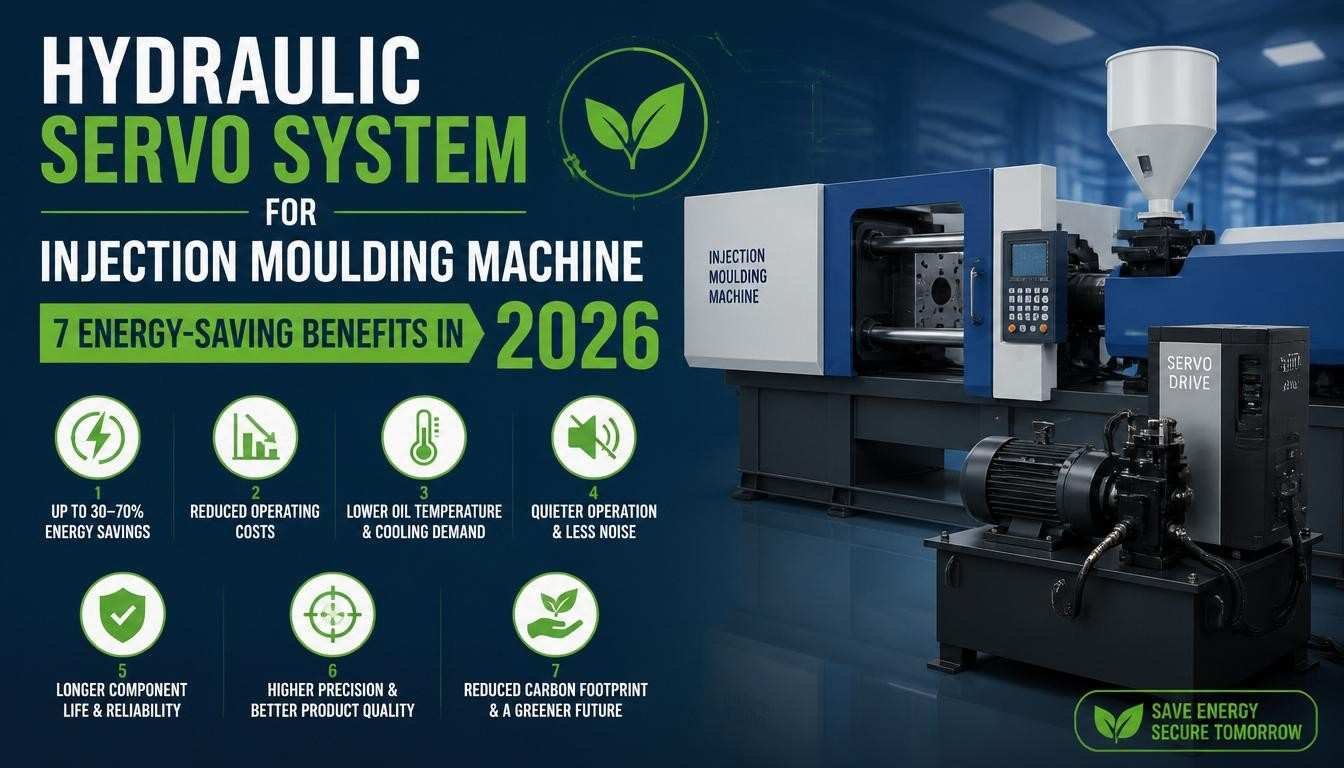
The headline benefit is energy reduction, and it is substantial. Independent field measurements and manufacturer testing across the injection moulding industry consistently show energy savings in the range of 30 to 60 percent when a fixed-pump machine is converted to a servo hydraulic system. The exact figure depends on the machine’s duty cycle.
The savings come from the idle and holding phases. A moulding cycle spends a large share of its time in cooling and holding, where a fixed pump keeps running but the machine needs almost nothing. During those seconds, a servo motor drops to a fraction of its rated speed or stops entirely. Machines with longer cooling times, which means thick-walled parts or high-cavitation tools, see the largest savings because they have the most idle time to recover.
For a plant running machines two or three shifts a day, a 40 percent reduction in hydraulic energy is not a rounding error. It is often the single largest controllable line item on the machine’s operating cost sheet.
Benefit 2: Lower Heat Generation and Reduced Cooling Load
Wasted energy in a hydraulic system does not disappear. It turns into heat in the oil. A fixed-pump machine dumping surplus flow across a relief valve is, in effect, a space heater running alongside the moulding process. That heat has to be removed by oil coolers, chillers, and often the plant’s air conditioning.
A servo system produces far less waste heat because it is not generating surplus flow to bypass in the first place. Oil temperatures run cooler and more stable. This has three knock-on effects that maintenance teams notice quickly:
- Cooling water and chiller loads drop, saving energy a second time beyond the pump itself.
- Hydraulic oil degrades more slowly at lower operating temperatures, extending oil change intervals.
- Seals, hoses, and valves last longer because they are not cycling through high thermal stress.
The cooler-running oil is one reason total cost of ownership improves by more than the electricity bill alone suggests.
Benefit 3: Faster and More Repeatable Cycle Times
Energy savings get the attention, but process engineers often care more about repeatability. A servo motor hydraulic pump responds to demand changes in milliseconds because it is controlled by a closed-loop drive rather than a mechanical valve throttling a constant flow.
That responsiveness shows up as tighter control over injection speed and pressure. The servo drive can accelerate the pump for a fast injection phase, then decelerate precisely for pack and hold, with less overshoot than a proportional valve managing a constant-speed pump. For thin-wall parts, optical components, or any application where shot-to-shot consistency drives scrap rates, that precision translates directly into fewer rejects.
In many retrofits, cycle times either match or slightly beat the original fixed-pump performance while using far less energy. The system is not trading speed for efficiency. It is delivering both.
Benefit 4: Quieter Operation on the Plant Floor
Noise is an underrated benefit because it does not appear on a spec sheet, but anyone who has stood next to a bank of fixed-pump machines knows the constant drone. A fixed pump runs at full speed continuously, and the noise is relentless.
A servo hydraulic system is noticeably quieter because the motor spends much of the cycle at low speed or idle. During cooling and holding phases, the pump is barely turning. Plants that convert to servo systems frequently report floor noise dropping by a meaningful margin, which matters for operator comfort, for regulatory noise exposure limits, and for facilities where the moulding shop sits close to offices or clean rooms.
This is one of the few benefits that improves working conditions and compliance at the same time.
Benefit 5: Extended Component and Machine Life
Every hour a fixed pump runs at full speed is an hour of wear, whether the machine is producing parts or waiting. A servo system dramatically reduces the running hours at high load because the motor idles or slows whenever demand drops.
Fewer high-load hours means:
- Pumps and motors accumulate wear more slowly, extending service intervals.
- Lower and more stable oil temperatures protect seals and valves, as noted earlier.
- Reduced pressure spikes and smoother acceleration curves lower mechanical stress across the whole circuit.
Over a machine’s operating life, this shows up as longer intervals between rebuilds and fewer unplanned failures. For maintenance managers building a case for the conversion, the reliability gains often matter as much as the energy figures, because unplanned downtime on a moulding line is expensive in ways that dwarf the electricity cost.
Benefit 6: A Retrofit Path for Existing Machines
Not every plant can justify replacing a fleet of working machines. One of the strongest practical arguments for the servo hydraulic system in 2026 is that it does not require a new machine. A servo drive and servo motor hydraulic pump package can be retrofitted onto many existing hydraulic injection moulding machines.
The retrofit typically replaces the existing motor and pump arrangement with a servo motor, a matched hydraulic pump, and a closed-loop drive that integrates with the machine’s controller. The machine’s clamp, injection unit, and tooling stay in place. This keeps capital cost far below a full machine replacement while capturing most of the energy and reliability benefits.
The technical suitability of a retrofit depends on the machine’s age, controller compatibility, and hydraulic layout, so an assessment by the supplier is the right first step rather than an assumption. THM Huade supports both new servo system builds and retrofit conversions, and the choice between them usually comes down to the remaining service life of the existing machine. You can review the relevant product range at [INSERT THM URL] and the servo pump specifications at [INSERT THM URL].
Benefit 7: A Measurable Path to Sustainability and Compliance Targets
The final benefit is strategic rather than mechanical. Manufacturers across the United States, Europe, and Asia are under growing pressure to document energy reduction, whether from corporate sustainability commitments, customer supply-chain requirements, or regional efficiency regulations. A servo hydraulic system usa buyers specify today is often driven as much by reporting requirements as by the energy bill itself.
A hydraulic servo system for injection moulding gives a plant a clean, measurable efficiency gain that can be documented and audited. Unlike vague operational improvements, a servo conversion produces a before-and-after energy figure that stands up in a sustainability report or a customer audit. For suppliers bidding on contracts where the buyer scores environmental performance, that documented reduction can be the difference between winning and losing the work.
This is where the technology stops being purely an engineering decision and becomes a commercial one. Technical manufacturers increasingly use content platforms like Rankfast to keep their SEO infrastructure and technical documentation current alongside their product catalogs, which matters when procurement teams research suppliers on efficiency claims before they ever request a quote.
Comparing Servo and Fixed-Pump Systems at a Glance
For teams weighing the decision, the trade-offs are easier to see side by side. The table below summarises where each system stands on the factors that usually drive the purchase.
| Factor | Fixed-Pump System | Hydraulic Servo System |
| Energy consumption | High, constant | 30 to 60 percent lower |
| Waste heat | High | Low |
| Cycle repeatability | Good | Better, closed-loop control |
| Floor noise | High, constant | Lower, varies with cycle |
| Component wear | Continuous at full load | Reduced, load-matched |
| Upfront cost | Lower | Higher |
| Payback period | Not applicable | Typically 1 to 3 years on energy alone |
| Retrofit possible | Not applicable | Yes, on many machines |
The upfront cost of a servo hydraulic system is higher than a conventional pump, and there is no point pretending otherwise. The case for it rests on payback. For a machine running multiple shifts, the energy savings usually recover the price difference within one to three years, after which the savings are pure operating benefit for the rest of the machine’s life. For a single-shift machine with light duty, the payback stretches longer and the decision is closer. Duty cycle, not the technology itself, determines whether the investment makes sense.
Choosing the Right Servo Hydraulic System
Selecting a system is not simply a matter of picking the largest servo motor. The servo motor hydraulic pump has to be matched to the machine’s flow and pressure profile across the full cycle. An oversized system wastes the efficiency it was bought to deliver, while an undersized one cannot meet peak injection demand.
The specification process should account for several factors:
- Peak flow and pressure demand during injection, which sets the motor and pump sizing.
- Duty cycle and cooling time, which determine how much idle-phase saving is available.
- Controller compatibility, especially for retrofits onto older machines.
- Oil cleanliness and filtration, since servo systems reward well-maintained hydraulic fluid with longer component life.
A supplier that understands injection moulding specifically, rather than general industrial hydraulics, will size the system around the moulding cycle rather than around a nameplate rating. That distinction is what separates a conversion that delivers the promised savings from one that disappoints. THM Huade’s engineering support for servo hydraulic system usa and global customers focuses on that cycle-based sizing, and the technical team can be reached through [INSERT THM URL].
The Bottom Line for 2026
The economics of a hydraulic servo system for injection moulding have shifted decisively. With energy costs elevated and efficiency reporting becoming a purchasing requirement, the question for most plants is no longer whether servo technology pays off but which machines to convert first. Start with the machines running the most shifts and the longest cooling times, since those recover their cost fastest. Measure the before-and-after energy figure, because that number will justify the next conversion and the one after that.
If you are evaluating a new machine or planning a retrofit, request a cycle-based sizing assessment rather than a nameplate quote. The difference between a system sized to the moulding cycle and one sized to a rating is the difference between the savings you were promised and the savings you actually get.
Frequently Asked Questions
Can a Servo Hydraulic System Be Retrofitted to an Existing Machine?
Yes. Many existing hydraulic injection moulding machines can be converted by replacing the motor and pump with a servo motor hydraulic pump and a closed-loop drive that integrates with the machine's controller. The clamp, injection unit, and tooling remain unchanged. Suitability depends on the machine's age, hydraulic layout, and controller compatibility, so a supplier assessment should come before the decision.
What Is the Payback Period for a Servo Hydraulic System?
For a machine running two or three shifts a day, the energy savings from a servo hydraulic system usually recover the higher upfront cost within one to three years. Machines running a single light-duty shift have longer payback periods. Duty cycle is the deciding factor, since more running hours mean more energy saved per year.
Does a Servo System Slow Down Cycle Times?
No. Because a servo motor hydraulic pump is controlled by a closed-loop drive that responds within milliseconds, it can match or improve on fixed-pump cycle times while using less energy. The precise control over injection speed and pressure often improves shot-to-shot repeatability, which reduces scrap on tight-tolerance parts.
Is a Servo Hydraulic System Suitable for All Injection Moulding Applications?
A servo system benefits nearly all hydraulic injection moulding applications, but the return is greatest on machines with variable or intermittent duty cycles and significant idle time. Continuous high-load applications see smaller relative savings because there is less idle time to recover, though they still benefit from reduced heat and improved control.
How Does a Servo Hydraulic System Reduce Maintenance Costs?
A servo hydraulic system usa and global users adopt cuts maintenance cost in three ways: lower oil temperatures extend fluid and seal life, reduced running hours at full load slow pump and motor wear, and smoother pressure control lowers mechanical stress across the circuit. Together these extend service intervals and reduce unplanned downtime.