Walk any US plant floor running high-cycle molding, stamping, or die casting equipment today, and you will notice two versions of the same machine behaving differently. One power unit runs warm and quiet through an eight-hour shift, while the other cycles its motor at near-constant output regardless of the actual load. The difference usually comes down to one design choice: whether the hydraulic power unit uses a variable displacement pump or a servo hydraulic pump built to match output to real-time demand.
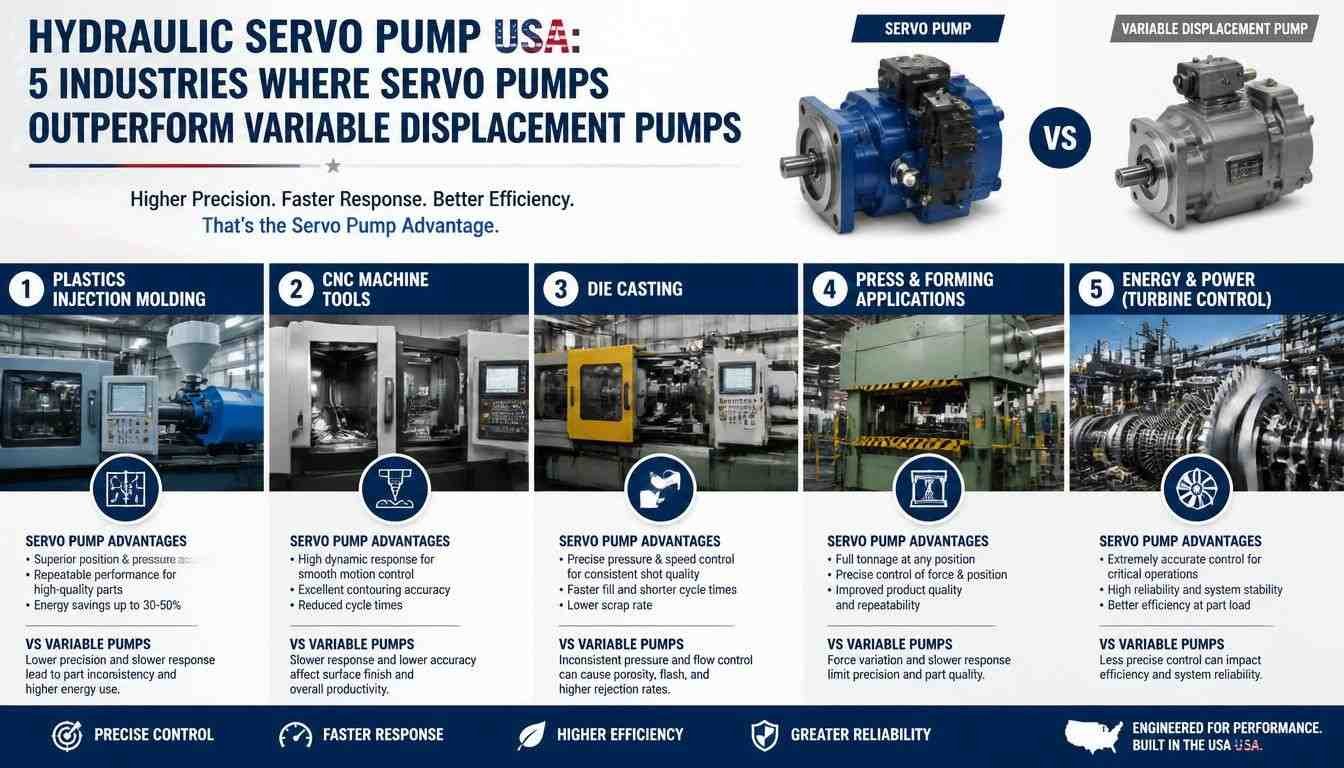
For procurement teams and plant engineers researching a hydraulic servo pump USA purchase, the spec sheet alone rarely settles the decision. What matters more is how a servo motor hydraulic pump performs against a conventional variable displacement pump (VDP) in the specific duty cycle of your industry, because the economics of that choice shift significantly from one application to the next. This piece breaks down five industries where servo hydraulic systems consistently outperform VDPs on energy use, precision, and total cost of ownership, and gives you a framework for evaluating the switch in your own facility.
Why This Decision Comes Down To Economics, Not Just Specs
A variable displacement pump adjusts flow by changing the stroke of its swash plate while the drive motor continues to run at a fixed speed, drawing power from the grid whether the machine is under full load or sitting idle between cycles. A servo hydraulic pump pairs a fixed or variable pump with a variable speed AC or permanent magnet servo motor, so the motor itself slows down or nearly stops when demand drops.
That single mechanical difference changes the economics of ownership. On paper, the two pump types can look comparable in flow rating, pressure range, and footprint. In practice, the gap shows up in the electricity bill, the fluid temperature, and the wear pattern on seals and valves once the machine is running a real production cycle rather than a test bench.
A useful way to think about it: a VDP is efficient at matching flow to demand, but it is not efficient at matching motor power draw to demand. The pump can throttle down to near zero displacement while the motor keeps spinning at rated speed, still consuming a meaningful share of full-load power even when almost no fluid is moving. A servo hydraulic pump closes that gap by controlling the motor itself, so power draw scales down along with the actual flow requirement rather than staying tied to a fixed shaft speed.
This matters most in applications where demand swings sharply within a single cycle, which is exactly the pattern across the five industries covered below. It matters far less in applications where the load stays close to constant, which is why a blanket recommendation to replace every VDP with a servo pump would be poor engineering advice. The right comparison is always duty cycle against duty cycle, not spec sheet against spec sheet.
Specifying And Documenting The Switch
Before any pump swap gets approved, procurement and engineering teams need a documented case: duty cycle data, current energy draw, projected savings, and a comparison against the incumbent VDP’s actual field performance rather than its catalog rating. That documentation tends to go stale quickly, particularly as duty cycles shift with new tooling or product runs. Manufacturers managing large technical catalogs increasingly lean on content platforms such as Rankfast to keep specification pages, comparison guides, and supplier documentation current alongside engineering updates, rather than letting the written record lag behind what is actually installed on the floor.
With that groundwork in place, here are the five industries where the servo hydraulic pump case is strongest.
Industry 1: Plastic Injection And Blow Molding
Injection molding is the most established use case for servo hydraulics in US manufacturing, and for good reason. A single molding cycle moves through injection, pack, hold, cooling, and ejection phases, each with a different pressure and flow requirement. During the cooling phase, which can account for half the cycle time or more, a VDP-driven system still holds its motor at full speed even though the hydraulic demand has dropped close to zero.
A servo-driven pump ramps the motor down to near idle during that same cooling window and only draws full power during injection and pack. THM Huade’s VPS Servo Vane Pump line, rated for operating pressures in the 245 to 280 bar range and speeds up to roughly 2,800 rpm, is built specifically for this kind of variable-duty molding cycle, where the pump needs to swing between near-zero and peak output multiple times per minute without losing pressure stability.
Molders running multi-cavity tools with longer cooling times, common in packaging and thin-wall parts, tend to see the widest gap between VDP and servo performance, simply because the ratio of low-demand cooling time to high-demand injection time is skewed further in favor of the servo pump’s strength. Shops running thicker-walled industrial or automotive parts, where cooling time is proportionally shorter, will still see a benefit, though the payback math looks different from a thin-wall packaging line running the same tonnage press.
Industry 2: Metal Stamping And Forming Presses
Stamping and forming presses spend a large share of their cycle in a dwell or return phase, with the actual forming stroke lasting a fraction of a second. A VDP sized for peak tonnage keeps its motor spinning through that entire dwell, generating heat that has to be managed with larger reservoirs, bigger coolers, or more frequent fluid changes.
Servo hydraulic systems USA fabricators are installing on stamping lines cut that standby draw substantially, because the motor speed tracks the actual press cycle instead of running flat out between strokes. The secondary benefit shows up in fluid life: lower average operating temperature slows oil oxidation and extends the interval between hydraulic fluid changes, which matters on presses that run multiple shifts.
Industry 3: High-Pressure Die Casting
Die casting shot cycles demand extremely fast pressure response, often within milliseconds, to fill a die cavity before the molten metal begins to solidify unevenly. A VDP’s mechanical swash-plate feedback loop has inherent lag built into how it senses and corrects pressure, which can show up as porosity or short-shot defects on tight-tolerance parts.
A servo motor hydraulic pump responds through direct motor speed control rather than mechanical feedback alone, giving die casters tighter shot-to-shot repeatability. For operations running high-volume automotive or appliance components, that repeatability translates directly into fewer rejected parts and less time spent on process troubleshooting between shot profile adjustments.
Die casting also stresses a pump harder than most other applications on this list, because the shot phase demands a sudden jump from low-pressure fill to high-pressure intensification within a very narrow window. Servo drives handle that transition with less mechanical stress on the pump itself over time, since the motor is doing more of the work that a VDP’s swash plate actuator would otherwise absorb through repeated rapid stroke changes.
Industry 4: CNC Machine Tools And Precision Machining Centers
CNC machining centers use hydraulics for clamping, indexing, tool changing, and workholding, functions that need to be quiet, repeatable, and free of pressure spikes that could disturb a finishing pass. Heat is the enemy here too: a VDP running continuously at full motor speed raises ambient temperature around the spindle and workholding, which can introduce thermal drift into tight-tolerance parts over a long production run.
A servo hydraulic pump usa machine shops are specifying for new precision centers keeps standby heat output low and delivers clamping pressure with less pressure ripple, which matters on parts held to tolerances measured in microns rather than thousandths of an inch.
Industry 5: Automotive Assembly, Test Rigs, And Press Lines
Automotive assembly and test operations combine several of the patterns above: press stations with long dwell times, test rigs that need precise, repeatable force application, and increasingly, structural testing for EV battery enclosures and chassis components where load accuracy is part of the qualification record. A VDP can handle any one of these tasks adequately, but the combination of variable duty cycles across a mixed assembly line is where servo hydraulics show the clearest advantage.
Plants running structural test rigs in particular benefit from a hydraulic servo system‘s ability to hold a commanded force or displacement steady over long test durations without the pressure creep that mechanical feedback systems can introduce.
Servo Pump vs Variable Displacement Pump: A Quick Comparison
The pattern across all five industries above comes down to a small set of measurable differences. This table summarizes how the two pump types typically compare in variable-duty applications.
| Metric | Variable Displacement Pump | Servo Hydraulic Pump |
| Power draw at partial or idle load | Motor runs near full speed regardless of demand | Motor speed drops with demand, cutting idle draw sharply |
| Pressure or flow response time | Limited by mechanical swash-plate feedback | Faster, driven by direct motor speed control |
| Heat generation | Higher due to constant motor speed | Lower, extending fluid and seal life |
| Noise levels | Consistent, often higher at partial load | Lower at reduced demand, since motor slows |
| Control precision for repeatable cycles | Adequate for stable, high-load applications | Higher, suited to frequent load changes |
| Best fit | Continuous, high-load, low-cycle applications | High-cycle, variable-load applications |
Facilities running continuous, high-load operations with minimal cycling, such as certain presses held at constant tonnage for long runs, may find a well-sized VDP still competitive. The servo advantage grows as duty cycle variability increases.
Calculating Payback For Your Facility
The honest answer to whether a servo hydraulic pump USA installation pays for itself is that it depends on your current duty cycle, local electricity rates, and how many shifts the equipment runs. A molding line running three shifts with long cooling phases will see a faster payback than a single-shift stamping operation with a short, high-load cycle.
The starting point is a duty cycle audit: log actual pressure and flow demand across a full production cycle, compare that against your current VDP’s rated draw, and model the standby power difference a servo pump would eliminate. THM Huade’s hydraulic pumps lineup and hydraulic servo system solutions are built to be specified against exactly that kind of duty cycle data, with configurations sized for molding, stamping, die casting, and precision machining loads. If your facility runs any of the five duty cycles above, that audit is the next step before committing to a servo pump conversion.
Treat the switch as a facility-specific engineering decision rather than a blanket upgrade. A servo hydraulic pump earns its keep fastest on lines with long dwell or cooling phases and frequent load swings, and it earns it slowest on steady, continuous-load equipment. Bringing real duty cycle numbers into the conversation, rather than relying on generic industry averages, is what separates a servo pump project that pays for itself in a year from one that sits in the budget for three.
Frequently Asked Questions
Are Servo Hydraulic Pumps More Expensive Than Variable Displacement Pumps?
Upfront cost for a servo hydraulic pump is typically higher than a comparable VDP, due to the servo motor and drive electronics. That premium is usually recovered through lower energy consumption, especially in high-cycle applications like injection molding, where standby power savings are largest.
What Is The Typical Payback Period For Switching To A Servo Hydraulic Pump?
Payback varies by duty cycle, shift count, and local electricity rates, so there is no single fixed timeline that applies across every facility. High-cycle, multi-shift operations such as injection molding tend to see faster returns than single-shift, low-cycle applications with steadier loads.
Can A Servo Hydraulic Pump Be Retrofitted Onto Existing Equipment?
In many cases, yes. Retrofitting depends on available panel space for the servo drive, existing motor mounting, and whether the machine's control system can accept a servo pump's feedback signals. A site assessment is the standard first step before quoting a retrofit.
Which Industries Benefit Most From Servo Motor Hydraulic Pumps?
Industries with highly variable duty cycles see the largest benefit, including plastic injection and blow molding, metal stamping and forming, high-pressure die casting, CNC machining, and automotive assembly and test operations. Continuous, steady-load applications see smaller gains.
How Much Energy Can A Servo Hydraulic System Save Compared To A VDP?
Savings depend heavily on duty cycle variability, but facilities with long dwell or cooling phases, such as injection molding, typically see the largest reductions in standby power draw. A duty cycle audit against your current VDP's rated draw is the only reliable way to estimate savings for a specific line.
Do Servo Pumps Require Different Maintenance Than Variable Displacement Pumps?
Servo hydraulic systems add drive electronics and motor feedback components that need periodic checks, but the hydraulic side, including seals, filters, and fluid, generally sees less wear due to lower average operating temperature. Maintenance teams should budget time for drive diagnostics alongside standard hydraulic service.
What Operating Pressure Range Do Servo Vane Pumps Typically Support?
Servo vane pump designs commonly cover a range of roughly 245 to 280 bar maximum operating pressure, with speeds up to around 2,800 rpm, depending on the specific model and displacement. Always confirm exact ratings against the manufacturer's current spec sheet before specifying for a given application.
Is A Servo Hydraulic Pump Suitable For Continuous, Non-Cyclical Loads?
Servo pumps can run continuous loads, but the energy savings advantage shrinks when demand is steady rather than variable. For applications with minimal cycling, a well-sized variable displacement pump often delivers comparable performance at a lower upfront cost.
How Do I Choose Between A Servo Pump And A Variable Displacement Pump For A US Facility?
Start with a duty cycle audit that logs actual pressure and flow demand across a full production cycle. Facilities with variable, high-cycle loads generally favor servo pumps, while continuous, high-load, low-cycle operations may still be well served by a properly sized VDP.