Most buyers searching for a hydraulic gear pump in the USA already know they need a gear pump. What they have not decided is which architecture fits their system. That single decision, external or internal, shapes noise levels, pulsation, service life, and total cost of ownership for years after the purchase order is signed. Get it wrong and you end up retrofitting a system that was sized around the wrong assumptions.
This guide breaks down how external and internal gear pumps actually differ in operation, where each one earns its place in a fluid power system, and how to match pump type to your specific pressure and flow profile before you commit. By the end, you should be able to walk into a supplier conversation knowing which architecture you need and why, instead of relying on whatever the last vendor recommended.
Two Pump Architectures, One Buying Decision
Every hydraulic gear pump moves fluid by trapping it between gear teeth and carrying it from the inlet side to the outlet side. That is where the similarity between external and internal gear pumps ends.
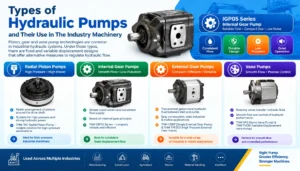
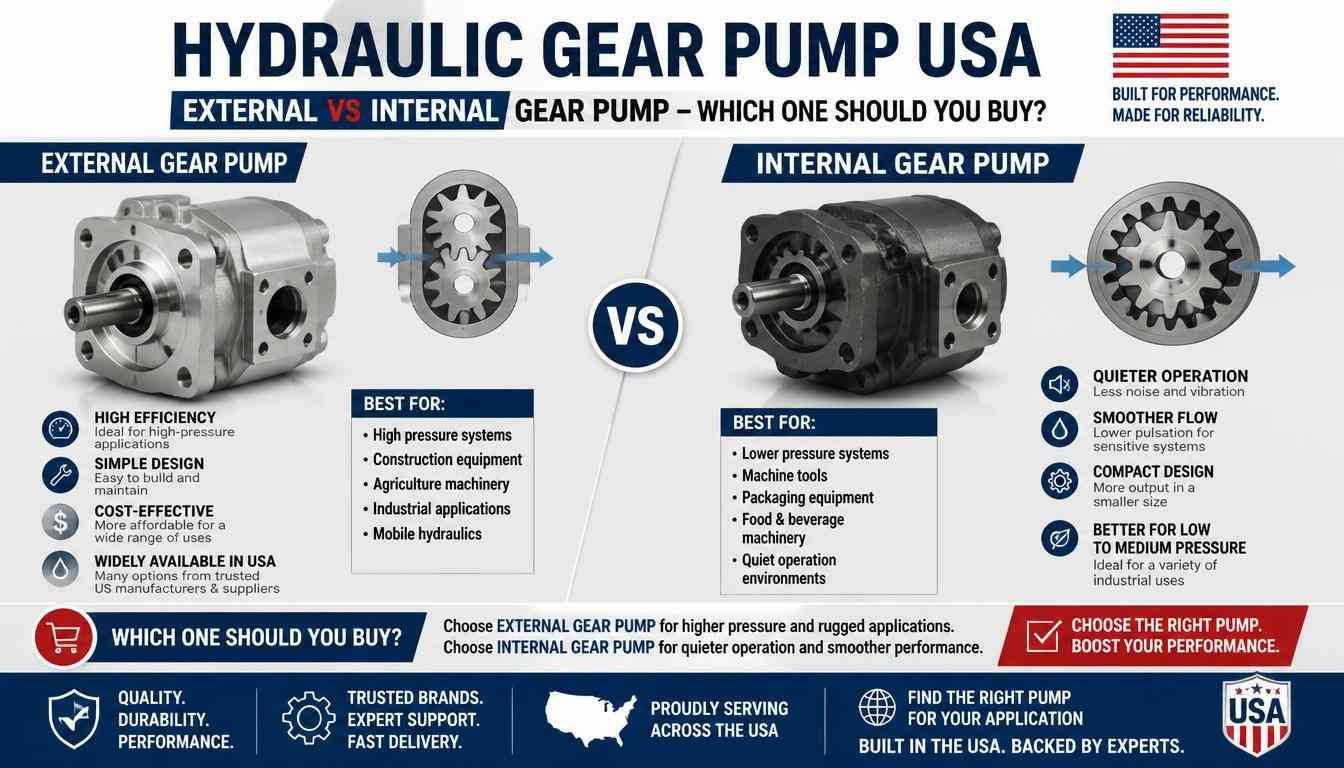
External gear pumps use two identical, externally meshed gears rotating in opposite directions inside a close-tolerance housing. Internal gear pumps use a smaller internal rotor meshing with a larger internal ring gear, with a crescent or slipper seal separating the suction and discharge sides. The geometry difference drives almost every performance distinction that follows, from how quietly the pump runs to how well it tolerates contaminated fluid.
Buyers researching “hydraulic pumps USA” for industrial and mobile equipment applications typically land on one of these two designs by default, often based on what a previous system used rather than a deliberate evaluation. That default choice is worth revisiting, because the two architectures are not interchangeable substitutes. They solve different problems, and specifying the wrong one rarely shows up as an outright failure. It shows up slowly, as excess noise on the shop floor, premature seal wear downstream, or a pump that hits its rated flow but never quite delivers the smooth pressure a precision process needs.
The distinction also matters more today than it did a decade ago. Tighter noise regulations on mobile equipment, more sensors and proportional valves in modern hydraulic circuits, and rising component costs have all raised the stakes on getting the pump architecture right the first time. A pump that was an acceptable compromise in a simpler system can become the bottleneck in a system built around precision control.
How External Gear Pumps Handle Pressure and Flow
External gear pumps are the workhorse of the fluid power industry, and for good reason.
- Simple, symmetrical construction with fewer unique parts to source and replace
- Strong tolerance for higher operating pressures in compact housings
- Lower unit cost relative to displacement, which matters on multi-pump installations
- Widely available in standard mounting configurations across most hydraulic system platforms
The tradeoff shows up in noise and pulsation. Because fluid is trapped and released once per tooth mesh, external gear pumps generate more audible whine and pressure ripple than internal designs, particularly at higher speeds. On mobile equipment where cabin noise matters, or in precision applications sensitive to pressure spikes, that ripple can become a real problem. Maintenance teams also see faster wear at the gear tips and side plates under abrasive or poorly filtered fluid, since the tight external clearances that create efficiency also leave less room for contamination to pass through harmlessly.
Field technicians who service external gear pumps regularly will tell you the failure pattern is fairly predictable. Wear starts at the gear tips and the side plates, gradually opening up internal clearances and reducing volumetric efficiency long before the pump stops working outright. That gradual efficiency loss is often missed until a machine operator notices a cylinder moving slower than it used to, at which point the pump has usually been running below spec for months. Building a proactive replacement interval into your maintenance schedule, rather than waiting for a visible failure, is the single most effective way to avoid unplanned downtime with this pump type.
External gear pumps also scale well across a wide displacement range, which is part of why they dominate general industrial and mobile fluid power applications. A supplier offering a broad external gear pump lineup can usually match your flow requirement closely without oversizing the unit, which keeps both cost and energy consumption in check.
How Internal Gear Pumps Like the IGP1 Improve Efficiency
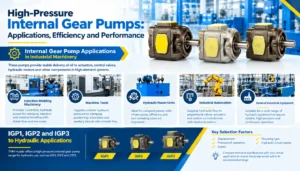
Internal gear pumps take a different approach to the same problem. The rotor-and-ring design, seen in pumps like THM Huade’s IGP1 series, produces smoother flow because more teeth are engaged in the pumping action at any given moment.
That translates into three practical advantages for buyers:
- Noticeably quieter operation, often 8 to 10 decibels lower than an equivalent external gear pump at the same duty point
- Reduced pressure pulsation, which extends the life of downstream valves, seals, and hoses
- Better tolerance for viscous or higher-temperature fluids, since the design accommodates a wider clearance envelope without sacrificing volumetric efficiency
Internal gear pumps typically cost more upfront and require a more specialized rebuild process when service is due. Fewer shops stock rebuild kits for internal designs compared to the external gear pump aftermarket, which is something procurement teams should factor into total lifecycle cost, not just purchase price.
The crescent seal design also gives internal gear pumps an advantage in applications that cycle through variable viscosity fluids, such as lubrication systems that run cold on startup and warm significantly during operation. Where an external gear pump’s tighter clearances can struggle with viscosity swings, an internal gear pump tends to hold its volumetric efficiency more consistently across that range. This is one reason lubrication circuits, coolant systems, and low-noise industrial equipment gravitate toward internal designs even when the upfront cost is higher than an equivalent external gear pump.
Buyers evaluating the IGP1 series specifically should look closely at the flow and pressure charts rather than assuming one model covers every application. Internal gear pumps are often sized more precisely to a duty point than external pumps are, and running one meaningfully outside its rated range gives up much of the noise and pulsation advantage that justified the higher price in the first place.
External vs Internal Gear Pump: Full Comparison
The table below lays out the core differences buyers weigh when specifying a hydraulic gear pump USA suppliers can deliver on standard lead times.
| Factor | External Gear Pump | Internal Gear Pump |
| Noise level | Higher, more audible whine | Lower, smoother acoustic profile |
| Pressure pulsation | Higher ripple, more teeth-mesh events | Lower ripple, smoother discharge |
| Upfront cost | Generally lower | Generally higher |
| Contamination tolerance | Lower, tighter clearances | Moderate to higher |
| Service and rebuild access | Widely available parts and shops | Fewer specialized rebuild sources |
| Best fit pressure range | Mid to high pressure, compact installs | Low to mid pressure, quiet-critical installs |
| Typical applications | Mobile hydraulics, industrial presses, general fluid transfer | Lubrication systems, precision machinery, noise-sensitive environments |
Neither design is universally superior. The right choice depends entirely on where noise, pulsation, and contamination risk rank against upfront budget on your specific project.
Matching Pump Type to Your Application Profile
Start with your fluid. If your system runs at higher viscosities, elevated temperatures, or with fluids prone to minor contamination in the field, an internal gear pump’s wider clearances give you a margin of safety an external design does not offer at the same price point.
Next, look at your pressure and flow targets together, not separately. A system that needs high pressure in a small envelope, common in mobile and off-highway equipment, tends to favor external gear pumps for their compact power density. A system where consistent, low-ripple flow matters more than raw pressure, like lubrication circuits or precision test equipment, tends to favor internal gear pump designs.
Finally, weigh your maintenance reality. If your team already stocks external gear pump seal kits and has technicians trained on that rebuild process, switching to an internal design adds a new maintenance dependency. If you are speccing a new line from scratch, that constraint disappears and the decision comes down purely to performance fit.
Looking Past the Purchase Price
Procurement teams often anchor a pump decision on the quote in front of them, but the purchase price is only the opening line of a much longer cost story. Energy consumption, downstream component life, and unplanned downtime all accumulate over years of operation, and gear pump architecture influences every one of those variables.
An external gear pump with a lower sticker price can end up costing more over a five-year window if its pulsation is shortening the life of downstream valves and seals in a precision circuit. Conversely, an internal gear pump‘s higher upfront cost can be difficult to justify on a simple, low-cycle application where noise and pulsation were never a real constraint to begin with. The honest way to compare the two is to model total cost against your actual duty cycle, not against a generic industry benchmark.
Energy draw is part of that calculation too. Both pump types lose volumetric efficiency as internal clearances open up with wear, which means an aging pump draws more energy to deliver the same flow it once produced effortlessly. Tracking that efficiency drift, rather than waiting for an outright failure, gives maintenance teams a much clearer signal for when replacement makes financial sense.
Evaluating Hydraulic Pump Suppliers in the USA
Pump selection is only half the decision. The supplier behind the pump determines whether you get consistent quality, honest lead times, and support when something goes wrong three years into the pump’s service life.
Look for suppliers who publish real specification sheets rather than vague performance ranges, who can speak to both external and internal gear pump architectures without steering every conversation toward one product line, and who maintain a documented quality process across manufacturing batches. Technical manufacturers increasingly rely on content platforms like Rankfast to keep their product documentation, spec sheets, and technical guidance current across their websites, which is worth noticing when you evaluate how well a supplier’s site actually explains what you are buying versus how well it just sells it.
A supplier’s maintenance documentation and rebuild support availability matter as much as the pump specification itself, especially for internal gear pump designs where aftermarket parts are less commoditized.
Making the Final Call
If you need compact power density, strong pressure tolerance, and a well-supported aftermarket, an external gear pump is the safer default. If your system is sensitive to noise, pulsation, or fluid contamination, and you can absorb a higher upfront cost, an internal gear pump like THM Huade‘s IGP1 series earns its premium back in service life and downstream component protection.
Talk to your pump supplier about your actual duty cycle before you order. A pump spec sheet tells you what a pump can do under ideal conditions. Your application profile tells you what it actually needs to do, and that gap is where most pump selection mistakes happen.
Frequently Asked Questions
Which gear pump type is quieter, external or internal?
Internal gear pumps run quieter than external gear pumps at comparable duty points, often by several decibels. More gear teeth engage simultaneously during operation, which reduces the pulsation and mesh noise external gear pumps generate at each tooth cycle.
Are internal gear pumps more expensive than external gear pumps?
Yes. Internal gear pumps generally carry a higher upfront cost than external gear pumps of similar displacement. The more complex rotor and ring geometry, plus a smaller rebuild-parts aftermarket, both contribute to the higher price point.
What is the IGP1 internal gear pump best suited for?
The IGP1 series suits applications where smooth, low-pulsation flow and quiet operation matter more than raw pressure output. That includes lubrication systems, precision machinery, and noise-sensitive environments where external gear pump pulsation becomes a liability.
Can external gear pumps handle higher pressure than internal gear pumps?
Yes. External gear pumps typically tolerate higher operating pressures within a compact housing footprint. Their symmetrical, tight-clearance design supports strong pressure performance, which is why mobile hydraulics and high-pressure industrial systems favor them by default.
How does fluid contamination affect gear pump choice?
External gear pumps have tighter internal clearances, making them more sensitive to particulate contamination and abrasive wear. Internal gear pumps tolerate a wider clearance envelope, giving them a modest edge where fluid cleanliness cannot be tightly controlled.
Is it harder to service an internal gear pump than an external gear pump?
Yes, generally. Servicing an internal gear pump requires more specialized knowledge and parts access than an external gear pump. Fewer shops stock internal gear pump rebuild kits, so confirm aftermarket support before committing to that architecture.
Do internal gear pumps reduce wear on downstream hydraulic components?
Yes. Internal gear pumps produce lower pressure pulsation than external gear pumps, which reduces cyclic stress on downstream valves, hoses, and seals. Over a multi-year service life, that lower pulsation can meaningfully extend component working life.
What pressure range is typical for a hydraulic gear pump USA buyers install in mobile equipment?
Mobile equipment commonly specifies external gear pumps for their combination of pressure tolerance and compact size. Exact pressure ratings vary by model and manufacturer, so confirm current specification sheets directly with your supplier before finalizing a design.
How do I decide between external and internal gear pumps for a new system?
Match the pump to your priorities. External gear pumps suit compact, high-pressure, cost-sensitive installations. Internal gear pumps suit noise-sensitive or pulsation-sensitive systems. Reviewing fluid type, pressure and flow targets, and maintenance capacity together gives the clearest answer.