The selection of the appropriate types of hydraulic pumps can have an immediate impact on the speed, force, efficiency, and reliability of industrial equipment.Various machines require varying sets of pressure, flow, displacement, and control.Since the radial and axial piston designs, the gear and vane pumps, there is a certain place of each type of pump technology in the hydraulic power systems.
Why Hydraulic Pumps Matter in Industrial Machinery
A hydraulic pump is used to change mechanical energy into hydraulic energy by pumping fluid through the system. The flow is provided by the pump and system pressure is developed based on the resistance generated by the load and hydraulic components.
This renders the selection of pumps not just a specification check. The pump must be compatible with the working cycle, pressure needs, flow demand, speed of operation and hydraulic fluid of the machine.
In the case of industrial equipment, a right industrial hydraulic pump may assist in maintaining the stable operation and ensure the management of energy consumption and maintenance needs.
Main Hydraulic Pump Types
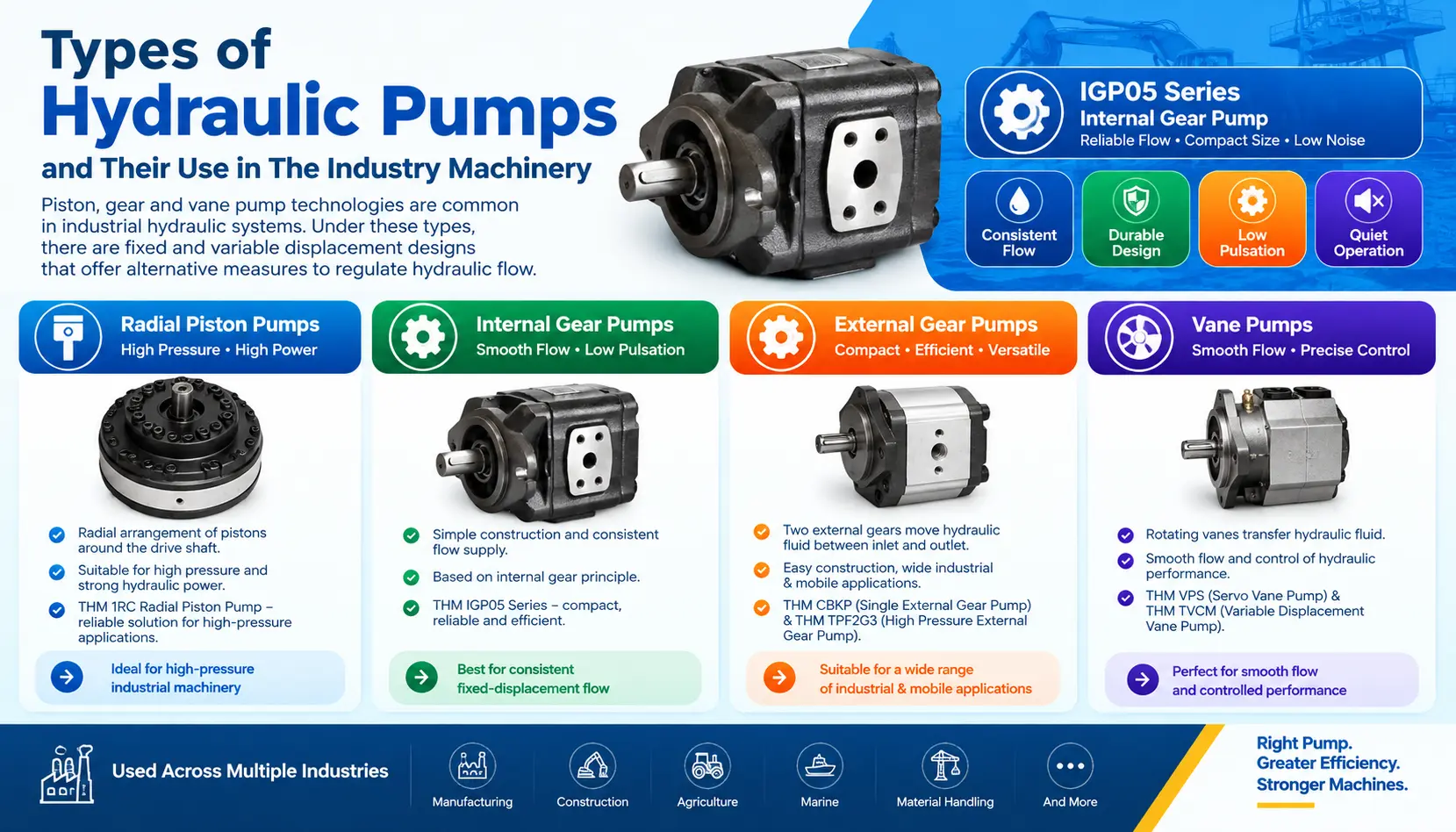
Piston, gear and vane pump technologies are common in industrial hydraulic systems. Under these types, there are fixed and variable displacement designs that offer alternative measures to regulate hydraulic flow.
Radial Piston Pumps for High-Pressure Operation
Radial piston pumps feature pistons that are laid out in a radial manner, around the drive shaft. The construction is applicable in areas where high pressure and strong hydraulic power is needed.
One such solution is the THM 1RC Radial Piston Pump, which may be regarded in a situation where high pressure is required and a reliable work of hydraulic machines is of significance.
Axial Piston Pumps for Demanding Hydraulic Systems
An axial piston pump has its pistons at right angles to the drive shaft. These types of pumps are commonly applicable when there is a need to achieve high pressure, high power density, or when changing the flow rate.
A hydraulic piston pump may be either fixed or variable displacement. Variable displacement enables the flow delivered to vary based on system needs and this can enhance control and energy efficiency in a suitable application.
Gear Pumps for Reliable Fixed-Displacement Flow
Gear pumps are usually chosen due to their simple construction design, consistent flow supply, and small size.
A hydraulic gear pump is a device that pumps fluid through the openings in rotating gears. The design is suitable in those applications where a reliable fixed flow is needed.
The products of THM are the THM IGP05 Series Internal Gear Pump, which is based on the internal gear principle, and the THM TGR Series Silent Gear Pump, which can be used where the operating noise is a key factor.
Internal gear design may offer smooth fluid flow and low pulsation, whereas a silent gear pump aims at minimizing the noise in operations in the hydraulic system.
External Gear Pumps for Industrial Hydraulic Systems
External gear pump involves the use of two external gears which move the hydraulic fluid between the inlet and outlet. It has easy constructions and can be applied in numerous industrial and mobile hydraulic applications.
The THM CBKP Single External Gear Pump is a compact pump ideal in hydraulic circuits where constant displacement is needed along with consistent oil delivery.
To accommodate high-pressure needs of systems, another gear pump will be the THM TPF2G3 Series High Pressure External Gear Pump.
It is possible to choose these pumps based on the necessary flow, pressure, speed, fluid viscosity and machine duty cycle.
Vane Pumps – Fluidic Smooth Hydraulic
In vane pumps, rotating vanes are used to transfer hydraulic fluid in the pump chamber. They have operating features that render them applicable in cases where smooth flow and ability to control the hydraulic performance is needed.
The THM VPS Servo Vane Pump is designed to be used in those applications where hydraulic flow must operate with the servo-based control. Such a design may come into play in machinery where accuracy in hydraulic response and power saving is essential.
In applications where the flow conditions need to be variable, the THM TVCM Variable Displacement Vane Pump offers a variable displacement solution. The pump is able to vary displacement with the hydraulic requirement instead of providing the same theoretical volume at each operating condition.
Fixed Displacement Pump vs Variable Displacement Pump
How the pump regulates flow is the major distinction between a variable and a fixed displacement pump.
A fixed-displacement design provides a specified volume per revolution. The flow rate is changed by adjusting the speed of a pump, and the displacement of the pump itself is constant.
A variable displacement pump is a pump that can vary its displacement during operation. This is applicable in systems whereby flow demand varies with various machine movements or production stages.
Each method cannot be applied to all machines. It is selected based on the hydraulic circuit, control method, duty cycle and energy demand.
Application of hydraulic pumps in industry machinery
Applications of the hydraulic pumps differ significantly due to the fact that hydraulic power is applied in a wide variety of devices.
Pumps may provide hydraulic flow to cylinders, motors, valves, clamping systems, lifting systems, pressing systems and automated movements in industrial machinery.
To illustrate, a high-pressure piston design can be used when a machine demands high hydraulic power. A gear pump might be a better choice when a fixed flow is required simply, and a vane or servo pump might be chosen when a flowing control and variable flow are essential.
This is an application-oriented method that ensures that the selection of pumps is not based on their maximum pressure rating but rather the pump.
Selection and Sizing of Hydraulic Pumps
The first step in selecting an effective hydraulic pump is to know what the machine really requires.
Important factors include:
- Required flow rate
- Working and peak pressure.
- Pump speed
- Displacement
- Hydraulic fluid viscosity
- Operating temperature
- Duty cycle
- Prime-mover or motor power.
- Space and mounting requirements
The size of hydraulic pumps must also take into account the actual cycle of machine and not just the maximum load. Over-sizing may lead to the use of more energy and be more expensive whereas undersizing may restrict the performance of a machine.
Tips for Better Pump Selection
- Begin with needed flow and pressure instead of selecting a pump by model.
- Continuous and peak operating conditions should be checked separately.
- Adjust pump displacement and speed to the necessary hydraulic flow.
- Take into account fluid viscosity and temperature since they have an effect on leakage, lubrication, and efficiency.
- Test the entire hydraulic circuit, the valves, actuators, filtration and pressure protection.
Hydraulic Pump Efficiency in Real Applications
The efficiency of a hydraulic pump is subject to a number of factors such as the pressure, speed, the viscosity of the fluid in it, internal leakage, mechanical losses and the temperature at which it operates.
A pump that does not operate within the recommended range may lose its efficiency and produce unwarranted heat. Proper sizing, appropriate hydraulic oil, appropriate filtration and maintenance assistance can be used to ensure consistency in performance.
In the case of variable-demand machinery, a variable displacement design can minimize flow generation that is not required in the case of a fixed-displacement arrangement with appropriate system configurations.
Important: Pressure Is Not the Only Selection Factor
The hydraulic pump of high pressure should not be taken just because it has the highest pressure rating.
The machine can run at a reduced normal pressure and yet a given flow, speed or displacement is necessary. Operating a pump in an inappropriate state in a continuous mode may compromise efficiency and life of components.
Always check the pressure, flow, speed, temperature and fluid specification of the manufacturer against the machine requirements.
Final Considerations
Not all industrial machines have the same pump design. The correct decision would be based on the required flow and pressure of the system, the nature of work of the machine, and the accuracy of hydraulic power regulation.
The TGR Silent Gear Pump, CBKP External Gear Pump, TPF2G3 High Pressure External Gear Pump and TVCM Variable Displacement Vane Pump are a few examples of technologies that cater to various hydraulic needs.
To have a good hydraulic pump to use in industrial machinery, it is best to consider the entire application of the type of pump and not just a single characteristic. Call today to connect with THM Huade and talk about the pump set up that fits your hydraulic system.
FAQs About Hydraulic Pumps
What are the chief kinds of hydraulic pumps?
It is primarily in the form of piston pumps, gear pumps and vane pumps. They are further classified into the designs of radial piston, axial piston, internal gear, external gear, fixed displacement and variable displacement pumps.
What is the best hydraulic pump to use in high pressure?
Piston and piston pumps are widely utilized in high-pressure hydraulic service, but some gear and vane pump designs can also be used in high-pressure service. The pressure and flow needed should be verified against specifications of the manufacturer.
What is the difference between a gear pump and a piston pump?
A gear pump relies on rotating gears to transfer fluid and can be found in a fixed-displacement design. A piston pump involves the use of reciprocating pistons, and can provide either fixed or variable displacement based on its design.
What is my selection of a hydraulic pump?
Begin with the necessary flow, working pressure, speed, displacement, hydraulic fluid, temperature, duty cycle and control requirements. This pump must then be connected to the entire hydraulic circuit.
What is a variable displacement pump?
A variable displacement pump may alter the quantity of fluid that is delivered with each turn. This enables the hydraulic flow to be fine-tuned by the demands of the changing machine.
What can be done to increase the efficiency of hydraulic pumps?
Efficient pump performance can be facilitated by proper sizing, appropriate operating speed, fluid viscosity, clean hydraulic oil, proper filtration and using within the recommended operating range of the manufacturer.