A hydraulic system for plastic machines should be more than a hydraulic power system. In addition, modern injection molding machines, industrial machines demand accurate motion, stable pressure, quick response and uniform cycles. A hydraulic servo system is a combination of hydraulic power, electronic feedback and servo control that is used to control the movement of a machine more accurately. This is help for plastic injection machines, presses, CNC machines and other automated machines that demand a consistent performance from cycle to cycle.
What is a Hydraulic Servo System?
A hydraulic servo system is a closed hydraulic control system which relies on electronic feedback to regulate pressure, flow, speed, position, or force.
The system constantly compares the required output to the actual machine response as opposed to a simple hydraulic circuit. The controller will then use the hydraulic output to decrease the difference.
A standard system can consist of:
- Servo motor and servo drive
- Hydraulic pump
- Servo or proportional valve
- Hydraulic motor or hydraulic cylinder
- Position and pressure sensors
- Controller or PLC
- Hydraulic reservoir and filtration system
This mixture enables hydraulic power to be driven with the precision desired in the contemporary automation systems.
How Hydraulic Servo Control Works
The principle is quite simple: command, movement, feedback, correction.
The controller transmits a desired speed, pressure, position or force. A sensor measures the actual result and the hydraulic actuator responds. The controller alters the system in the event that the measured value is not equal to the target.
This is a closed loop strategy which is key to hydraulic servo control.
As an illustration, in an injection molding cycle, the machine might need a lot of flow during the injection, but a lot less output during pressure holding or cooling. These varying requirements can be met by a servo-controlled system which varies the hydraulic output to meet these requirements rather than running at a single constant level over the cycle.
Studies concerning servo-hydraulic injection molding have revealed the ability to control the speed of filling, pressure, and velocity to pressure transition and reveal why feedback is essential in challenging molding processes.
Electro Hydraulic Servo System Components
An electro hydraulic servo system is a system that links electrical control to hydraulic power.
The motor is run by the servo drive and the hydraulic pump is run by the motor. The controller receives feedback in the form of sensors and hydraulic output is controlled by valves or pump control.
What is obtained is a synchronized servo hydraulic system as opposed to electrical and hydraulic functions.
Servo Motor and Pump
The hydraulic servo motor controls the pump as per the necessary working condition. The pump can supply the flow required by the cylinders, hydraulic motors or other actuators depending on the machine design.
A servo hydraulic pump system is thus able to react to the fluctuating machine demand whilst keeping the hydraulic output in check.
Sensors and Feedback
Feedback is essential for precision. Position sensors are used to monitor actuator movement and pressure sensors are used to provide information on hydraulic load.
These signals are used by the controller to correct as it is being operated.
It will be particularly helpful when minor changes in location, pressure or velocity can influence product quality.
Why Precision Hydraulic Control Matters
The machines used in industries can hardly work at a single speed and load.
One stage might need a fast movement of a plastic injection machine and another stage might need pressure that is in control. A press might require quick approach with subsequent precise force control. Machinery that is CNC may demand smooth and repeatable motion.
This is where precision hydraulic control can come in handy.
An appropriately designed system of hydraulic motion control can afford:
- Accurate positioning
- Regulated acceleration and deceleration
- Stable pressure
- Repeatable machine cycles
- Rapid reaction to dynamic loads
- Improved alignment of automation controls
Its actual performance is determined by the entire hydraulic system, feedback systems, controller parameters, pump, valves, actuator and machine dynamics.
Hydraulic System various industrial applications
Servo hydraulics is flexible and can be used in various industrial applications.
Typical hysteria uses of servos:
- Plastic injection molding machines.
- Hydraulic presses
- CNC machinery
- Press brakes
- Metal forming equipment
- Testing machines
- Material handling equipment
- Industrial automation systems
PLCs, sensors, drives and machine-control software can also be combined with a hydraulic automation system to produce something automated.
Hydraulic System for Plastic Machines
A plastic machine hydraulic system must be able to accommodate the fast varying flow and pressure needs during the process of molding.
Not all machine activities (injection, clamping, pressure holding, screw movement and others) need the same hydraulic output. These varying requirements can be synchronized with hydraulic power by servo control.
Due to this fact, modern injection molding systems are closely related to servo-hydraulic technology. According to the suppliers of industrial machines, servo drives are the motor speed control to the pump to adjust the pump output based on the required pressure and flow.
The advantages may be:
- Increased movement of machines controlled.
- Consistent molding cycles
- Reduce unwarranted hydraulic output.
- Improved pressure and flow control.
- Less heat production under appropriate working conditions.
- Improved integration with automation
THM Huade offers hydraulic servo products to industrial markets where high accuracy and efficient hydraulic drive is needed. When designing or updating a hydraulic system on plastic machines, call now to find out what hydraulic and control needs are required on your application.
Energy Efficiency in Servo Hydraulic Systems
Another factor that makes manufacturers look at servo hydraulics is energy efficiency.
Conventional hydraulic systems can still supply hydraulic power when the machine is not in need of it. A motor speed and pump output can be controlled by a servo-driven system to meet demand.
This has the potential of saving a lot of unnecessary energy usage when the machine is in low-demand conditions.
Nevertheless, the saving of energy is subject to the design of the machine, operating cycle, load profile, type of pump, motor, control strategy and working conditions. A servo system is to be considered, however, as a whole machine system and not on the efficiency of the motor.
Hydraulic Servo Valve System and Motion Control
A hydraulic servo valve system has the ability to deliver very responsive hydraulic flow and actuator movement control.
The controller, actuator and feedback sensors operate in a closed-loop circuit with the valve. Control system is always responding to the discrepancy between the desired and the actual condition.
This method is applicable in cases where a machine needs a high level of control in speed, position, pressure or force.
Tips for Better Servo Hydraulic Performance
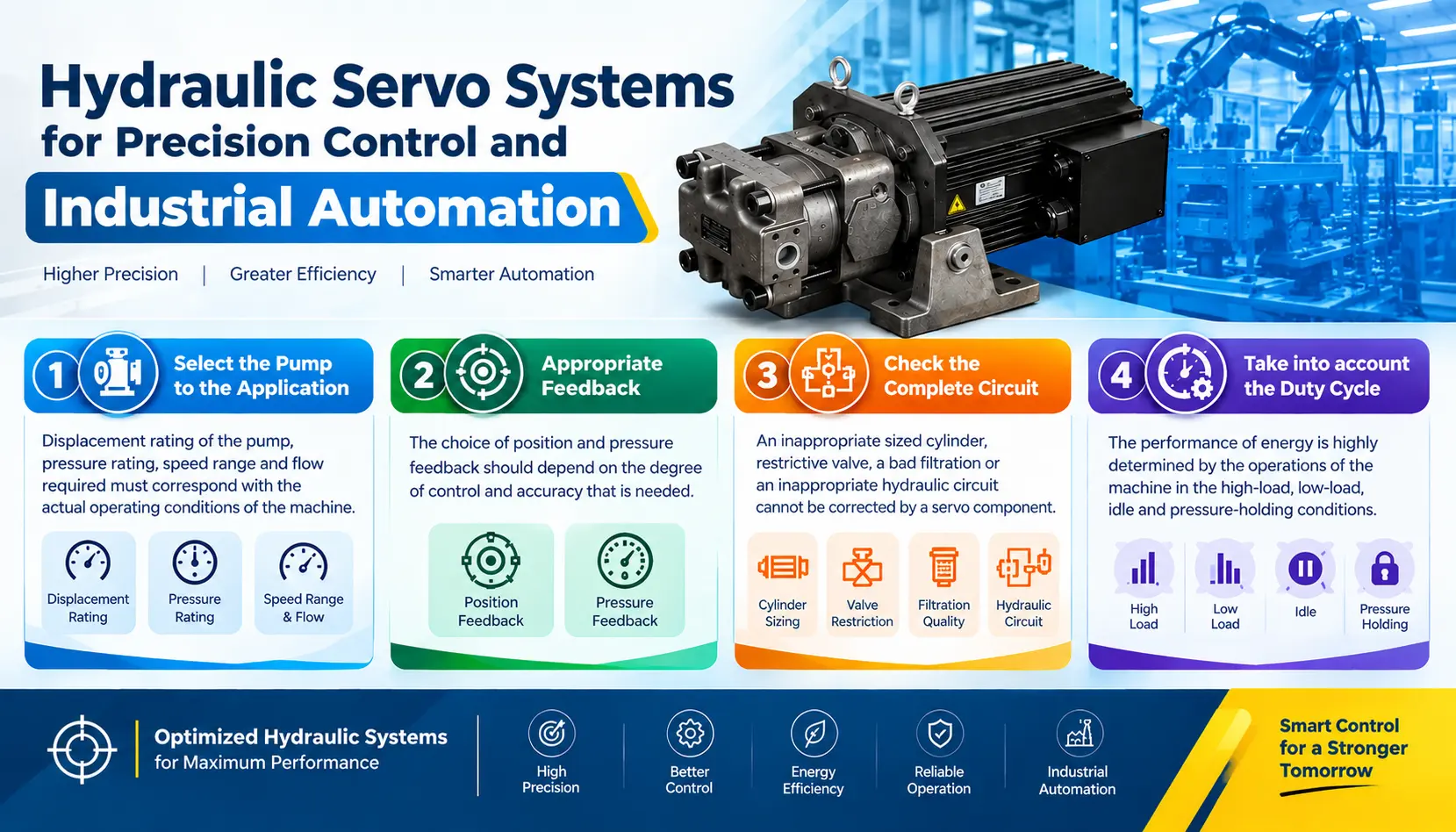
Tip 1: Select the Pump to the Application
Displacement rating of the pump, pressure rating, speed range and flow required must correspond with the actual operating conditions of the machine.
Tip 2: Appropriate Feedback
The choice of position and pressure feedback should depend on the degree of control and accuracy that is needed.
Tip 3: Check the Complete Circuit
An inappropriate sized cylinder, restrictive valve, a bad filtration or an inappropriate hydraulic circuit cannot be corrected by a servo component.
Tip 4: Take into account the Duty Cycle
The performance of energy is highly determined by the operations of the machine in the high-load, low-load, idle and pressure-holding conditions.
Important: Servo Control Is a Complete System
One of the most frequent errors is to consider servo technology as a servo drive or servo motor.
In practice, the entire system is reliable in terms of performance. The ultimate result is affected by the pump, motor, drive, valves, sensors, controller, actuator, oil quality, filtration, and mechanical structure.
In the case of an industrial hydraulic servo system, proper integration is as essential as the quality of the components.
Final Considerations
A servo hydraulic system cannot be just a matter of adding a servo motor. It is how power, feedback, control and machine movement interact.
Controlled pressure, changing flow requirements, repeatable motion, and automation In use where repeatable movement is required, controlled pressure, or changing flow requirements, and automation: Servo hydraulics may offer a practical compromise between conventional hydraulic power and the precision control demanded by modern technology.
For your plastic machine hydraulic system, the choice of pump, motor, valves, sensors and control architecture are all critical. Through THM Huade, you can take the hydraulic needs into consideration and design a solution according to the operational conditions of your machine. Call us now with your hydraulic servo needs.
FAQs
What is a servo hydraulic system?
A servo hydraulic system combines hydraulic power with electronic feedback and control. It is able to control the variables of pressure, flow, speed, position or force based on the needs of the machine.
What is the operation principle of a hydraulic servo system?
A controller transmits an intended command and the sensors measure the actual machine response. The controller then compares the two values and varies the hydraulic output to minimize the error.
What are the benefits of a hydraulic servo system?
The key benefits may consist of accurate motion, repeatability of operation, rapid response, controlled pressure and flow and enhanced energy efficiency in appropriate variable load applications.
What is the difference between a servo hydraulic system and a conventional hydraulic system?
A traditional system can utilize a fixed speed motor and traditional hydraulics. Electronic control and feedback is added to a servo hydraulic system to enable the hydraulic output to be more tuned to the varying machine demands.
What is the application of hydraulic servo systems?
They are utilized in plastic injection molding equipment, presses, CNC machines, metal forming machinery, testing equipment, as well as other industrial automation equipment.
Is it possible that servo hydraulics can enhance plastic injection molding?
Yes. An injection molding cycle can be controlled using servo-hydraulic to control pressure, speed and position in various phases. Studies have particularly explored the use of servo-hydraulic control in injection molding during filling, packing and transitioning velocity to pressure.