Servo drive technology is a valuable component of the contemporary industrial automation wherein machines require precise positioning, regulated speed, rapid response, and repeatable motion. A servo drive is controlled by a servo motor, controller and a feedback system to control machine motion depending on the application. Whether it is CNC machines and robotics, or packaging and automated production equipment, the correct servo drive system can offer highly accurate and responsive motor control.
With increasing automation of industrial machinery, manufacturers are seeking further than simple motor action. They require improved acceleration, deceleration, position, speed and torque control. This is where a well chosen industrial servo drive comes in handy.
What is a Servo Drive?
A servo drive is an electronic gadget which drives a servo motor by maintaining a certain electric power flow to the motor. The drive is controlled by a controller and is regulated by a motor feedback to modify its functioning.
This is a closed-loop method that enables the motor to react to varying machine demands. When there is a difference between the commanded movement and the actual movement, the control system is able to correct.
A typical servo motor drive system incorporates a full-fledged motor drive that links the motor to the drive, controller, feedback, power, and mechanical load. All these elements combine to form a synchronized motion-control mechanism as opposed to just driving the motor at a constant speed.
How Servo Drive Technology Supports Precision Motion
The primary idea behind the use of the Servo Drive Technology is to control and predict the movement of machines.
When operating, the controller transmits a command of a given movement. The servo drive processes control and provide the necessary electrical drive to the motor. An encoder or other feedback device provides feedback to enable the system to observe actual motor behaviour.
This process assists in proper positioning and movement control. It also can offer regulated acceleration and deceleration, constant speed, and reactive torque management.
This type of control may be especially helpful with machines that are started and stopped, reversed, or changed in speed quite often.
Servo Drive Systems in Industrial Automation
An automation servo drive is required in cases where a machine requires precise and coordinated movement of a motor. Automated machines may need constant speed and position changes unlike applications where a motor just runs continuously.
Applications of servo drives:
- CNC machines
- Robotics
- Packaging machinery
- Printing equipment
- Textile machinery
- Injection molding machines
- Automated assembly systems
- Material handling equipment
- Pick-and-place machines
- Precision production machinery
To illustrate, a servo drive on CNC machines can be used to move the motor based on machining commands programmed. Coordinated servo motion in robotics assists the various axes to move to the necessary positions in a repeatable manner.
The real drive needs are determined by the motor, mechanical load, controller and operating cycle.
Servo Motor and Drive: How They Work Together
A drive and a servo motor have various yet related roles.
The electric energy is transformed into a mechanical motion by the motor. The servo drive is in charge of the operation of that motor and it is able to provide control of speed, torque, and position based on the command and feedback.
This connection renders the compatibility of servo motor and drive particularly significant. Even a high-quality motor cannot give the desired performance when the drive is not chosen or set appropriately.
The controller, drive, motor and the feedback device should hence be considered as a single motion-control system.
Servo Drive Selection for Industrial Machines
When choosing which servo drive to use, it is best to begin with the specifications of the machine in question. Power in motors is not the sole consideration.
The operating speed needed, constant torque, peak torque, acceleration, load inertia, duty cycle, feedback system, and method of control may have an impact on the appropriate drive.
A machine that undergoes high acceleration and changes of direction quickly might be in need of different requirements compared to a machine whose speed is relatively constant.
This is why the choice of a drive based on the matching of the rated power of the motor can be not the final image.
Servo Drive Sizing and Motor Requirements
The size of servo drives should be based on the normal operating conditions and momentary peak requirements.
As an example, a motor might be running at a continuous load of moderate power, but needs significantly greater torque when accelerating. These operating conditions require the drive to be able to handle the necessary current and torque.
Another factor is load inertia. Acceleration and deceleration performance may be influenced by a large or quickly-varying load.
To choose a drive, it is helpful to know:
- Motor power and rated current.
- Continuous and peak torques.
- Required operating speed
- Deceleration profile and acceleration profile.
- Mechanical load and inertia
- Feedback requirements
- Controller interface
- Machine duty cycle
These considerations aid in developing a better size of drive.
THM Servo Drive Models for Industrial Applications
The THM Huade has servo drive models available to suit various industrial power needs. The series of available THSD-23 series comes with several 380 V three-phase models.
The range includes:
- THSD-23-380V-3P5.5
- THSD-23-380V-3P7.5
- THSD-23-380V-3P11
- THSD-23-380V-3P15
- THSD-23-380V-3P18.5
- THSD-23-380V-3P22
- THSD-23-380V-3P30
- THSD-23-380V-3P37
- THSD-23-380V-3P45
- THSD-23-380V-3P55
- THSD-23-380V-3P75
- THSD-23-380V-3P90
- THSD-23-380V-3P110
- THSD-23-380V-3P132
- THSD-23-380V-3P160
This model range enables the user to take into account various drive capacities depending on their machine and motor needs. The appropriate model must be chosen based on the entire technical requirements and working conditions and not based on the model number.
AC Servo Drive for Precision Applications
A common application of AC servo motors in industrial motion-control is an AC servo drive. It controls the motor operation based on the control system commands and motor feedback.
AC servo systems may be employed in applications where speed, torque and positioning control is necessary. Their applicability is based on motor characteristics, drive capacity, feedback set-up, controller communication and machine duty cycle.
The drive in case of an industrial machine is supposed to be a part of the entire automation architecture.
Servo Drive Compatibility with Servo Motors
Servo drive compatibility with Servo motors This is based on whether the servo motor type is compatible with the servo drive or not.
One of the most critical considerations when choosing a drive is that of servo drive compatibility.
The drive and motor must be electrically and functionally coupled. They should have compatible voltage, current, power, torque, speed, feedback and communication requirements.
Closed-loop control requires feedback compatibility in particular. The drive must be able to get and interpret feedback of the motor properly in order to be able to react to the changes in real motion.
The compatibility of communication is also important when the drive is related to a PLC, motion controller or other automation devices.
An appropriate mix will assist in offering stable operation and minimizing chances of commissioning issues.
Speed, torque and position control
The possibility to control the various aspects of motor movement is one of the greatest benefits of modern servo systems.
Servo Drive Speed Control
The speed of the servo drives is controlled by the motor speed controller.
Servo drive speed control / enables the motor to track the necessary operating speed. This comes in handy where machine speed varies during production or in the cases where it has to be constant under different conditions.
Servo Drive Torque Control
Servo drive torque control can be achieved through the capacitor control of the DC motor.
The motor has a control of the torque; this is called servo drive torque control. It may find application in processes that require controlled mechanical force such as winding, tension control, pressing and others.
Position Control
Position control enables the motor to go to a specific point. Feedback assists the system to track the real position and rectify movement where needed.
The mode of control required is determined by the machine operation and the motion of the machine that is being undertaken.
Servo Drive Technology for CNC and Automated Machinery
One of the fields that precision motion control is essential is CNC equipment. The servo system should be able to comply with programmed instructions but at the same time move properly under various operating conditions.
Servo drives may be used to synchronize motion in packaging equipment with a cutting, filling, sealing or indexing process.
Precise positioning in automated assembly can assist the component in achieving the right positioning many times.
Robotic systems can need a combination of synchronized motions in many axes. Servo control can be applied to each axis to reach the necessary speed and location of the axis in accordance with the programmed sequence.
These demonstrations indicate why the application of servo drives is relevant in a very diverse range of industries and not only in one kind of a machine.
Important: Consider the Complete Motion-Control System
A single specification should not be used to select a servo drive.
Overall performance is affected by the motor, drive, controller, feedback system, mechanical load and the operating environment. What is an appropriate drive in one machine may not be appropriate in another machine with a similar power rating motor.
Review of the motor and drive specifications should be done before the installation. The real machine cycle (with acceleration, deceleration, stopping, reversing and peak loading conditions) is also worth considering.
The correct commissioning and parameter setting is also crucial once the hardware is chosen.
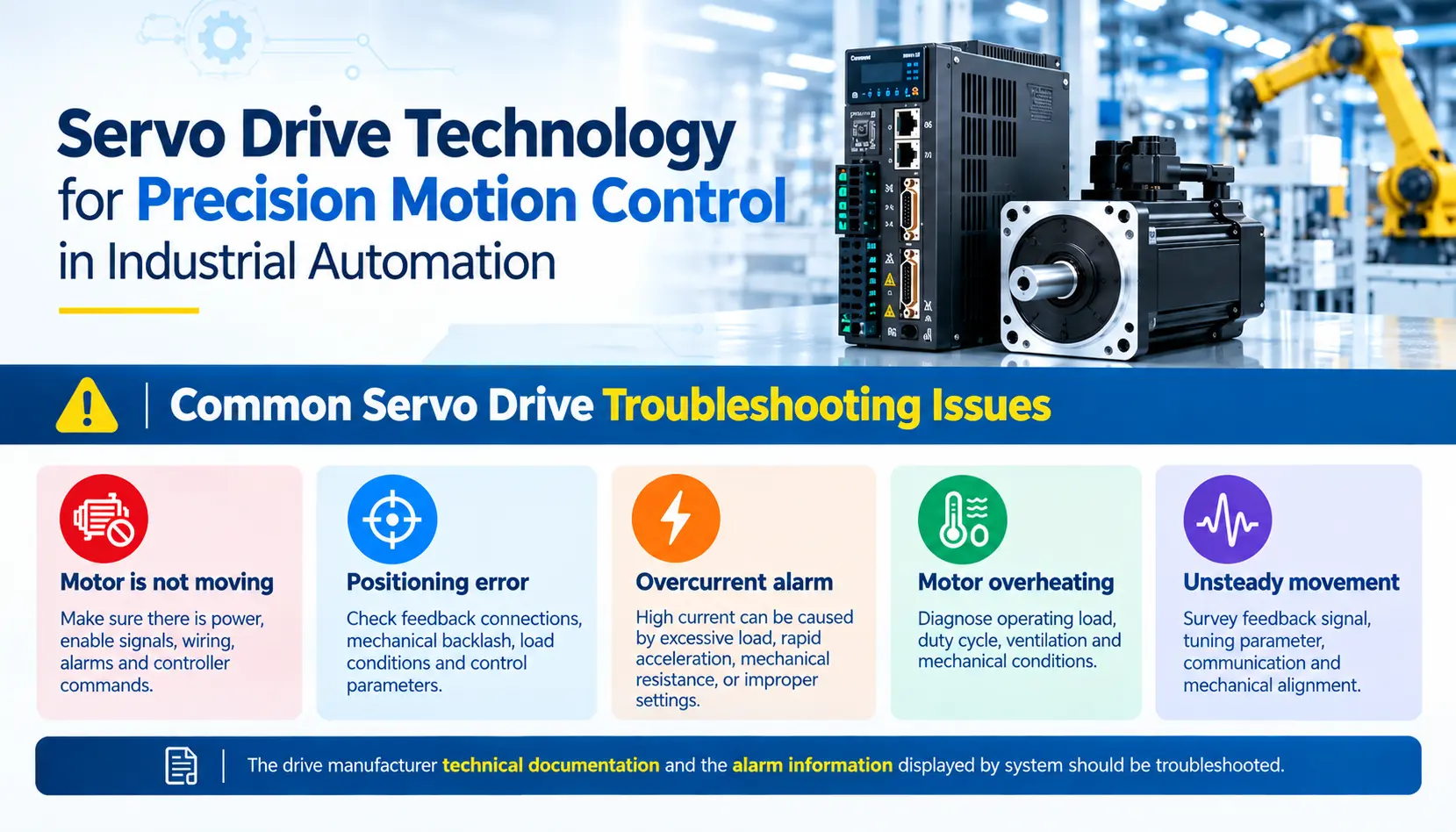
Common Servo Drive Troubleshooting Issues
Issues with a servo system are not necessarily drive related. Operation can also be affected by wiring, feedback, mechanical resistance, incorrect parameters or excessive load.
Some common symptoms include:
Motor is not moving: Make sure there is power, enable signals, wiring, alarms and controller commands.
Positioning error: Check feedback connections, mechanical backlash, load conditions and control parameters.
Overcurrent alarm: High current can be caused by excessive load, rapid acceleration, mechanical resistance, or improper settings.
Motor overheating: Diagnose operating load, duty cycle, ventilation and mechanical conditions.
Unsteady movement: Survey feedback signal, tuning parameter, communication and mechanical alignment.
The drive manufacturer technical documentation and the alarm information displayed by system should be troubleshooted.
Tips for Better Servo Drive Performance
Be careful in matching the motor and drive:
Before installation, check power, current, torque, speed, feedback and communication requirements.
Use application-based sizing:
Look at the entire load curve rather than a drive based on motor power alone.
Configure parameters correctly:
The wrong settings may interfere with speed response, positioning accuracy and stability of the system.
Check mechanical conditions:
Servo performance can be compromised by misalignment, excessive friction, backlash and high inertia.
Maintain feedback connections:
The closed-loop motion control requires reliable encoder and feedback signals.
Observation of machine cycle:
Monitors current, temperature, speed, torque and position behaviour under normal operation.
Key Takeaways for Precision Motion Control
Good automation does not merely consist of making a motor move quicker. It is all about timing all the movements at the correct speed, position, torque, and time. This is where the concept of precision industrial machinery includes the use of Servo Drive Technology.
The entire system must be taken into account, starting with the selection and sizing of servo drives, the compatibility of the motors, the control of speed, the control of torque, and feedback. When properly matched, servo systems are capable of providing precise and repeatable motion of machines over a diverse industrial usage profile.
The THM Huade offers solutions to industrial motion-control needs with several THSD-23 380 V three phase servo drive models. To select models and application-specific considerations, inquire further and consult THM Huade on your servo drive solution.
Frequently Asked Questions
How do I choose the right servo drive?
Begin with the machine and servo motor needs. Check rated power, continuous and peak torque, operating speed, load inertia, acceleration, feedback, communication and duty cycle preceding the choice of the drive.
How do I match a servo drive with a servo motor?
Ensure that the motor and drive are compatible in terms of voltage, current, power, speed, torque, feedback and communication requirements. The motor should have its feedback and control needs supported by the drive.
What is the size of the servo drive required?
The size needed will depend on the power and current of the motor, continuous torque, peak torque, speed, load inertia, acceleration and duty cycle. The drive size should not be determined just by the motor power.
What is the difference between a servo motor and servo drive?
A servo motor is a motor that generates mechanical movement and the speed, torque, and position of the motor is controlled by the servo drive. They are in unison with a closed-loop motion-control system.
What can servo drives be used in industrial automation?
Applications of servo drives include precise motion control in CNC machines, robotics, packaging equipment, printing equipment, textile equipment, injection molding equipment, automated assembly, and material handling system.