Ask two engineers what a servo drive is and you may get the same answer they would give for a servo system. The terms get used interchangeably in spec sheets, purchase orders, and troubleshooting calls, and most of the time the loose usage causes no harm. But when a machine stops positioning accurately, when a system needs sizing from scratch, or when a fault has to be traced to a single failed part, the difference between a drive and a system stops being academic. Confusing the component with the whole loop sends engineers chasing the wrong fault and specifying the wrong replacement.
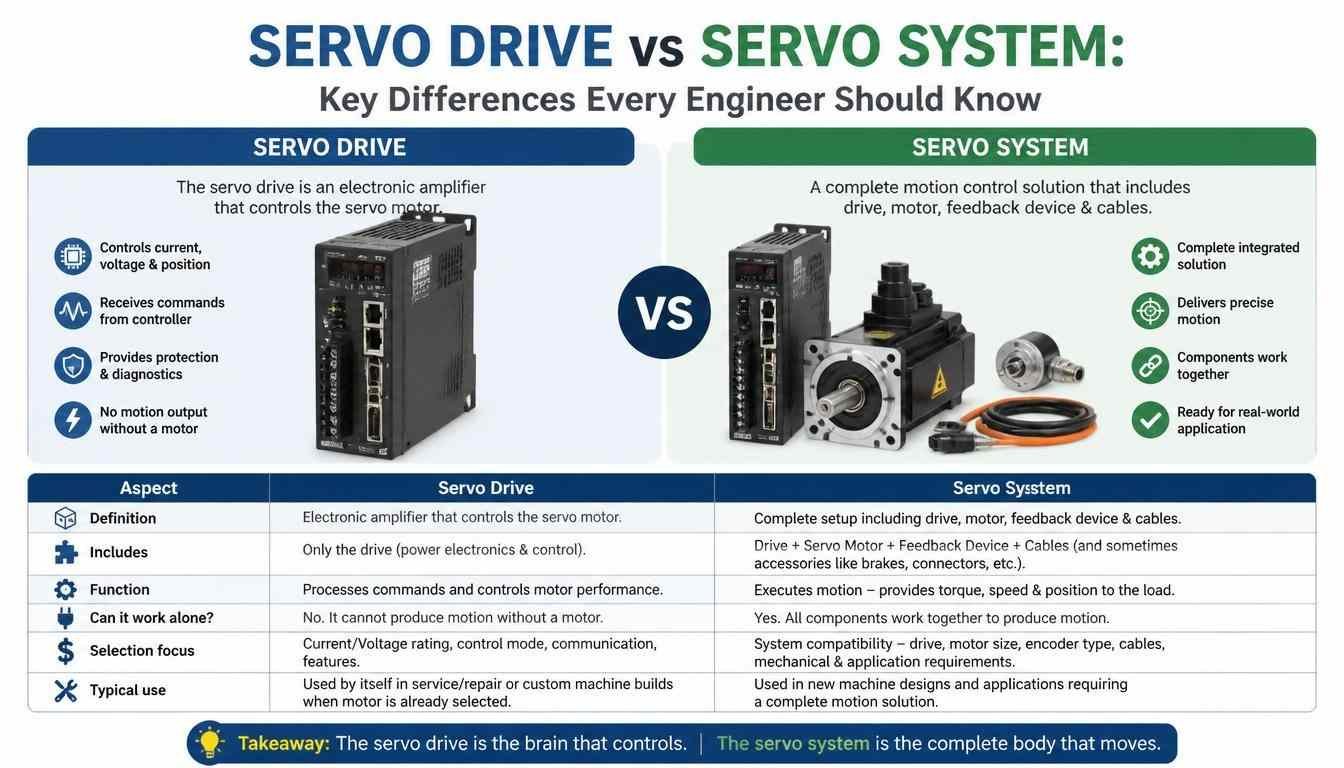
The distinction is simple once stated plainly. A servo drive is one component: the electronic unit that amplifies the command signal and delivers controlled power to the motor. A servo system is the complete closed loop: the controller, the drive, the motor, the feedback device, and the mechanical load, all working together to produce precise, corrected motion. The drive is a part. The system is everything. Every other difference in this article follows from that one relationship.
This guide breaks down what each element does, how they combine into a working loop, where the boundaries actually sit, and why the difference matters for selection, troubleshooting, and performance in 2026. It is written for the engineer who has to specify, integrate, or maintain motion control and needs the terminology to be exact rather than loose.
What a Servo System Is
A servo system is a closed-loop motion control arrangement that makes a mechanical load move exactly as commanded, then continuously corrects itself to stay accurate. The word that matters is closed-loop. Unlike an open-loop drive that simply sends power and hopes the motor followed, a servo system measures what the motor actually did and feeds that measurement back to correct any deviation.
A complete servo system contains several elements working in concert. There is a controller that decides the target position, speed, or torque. There is a servo drive that amplifies that command and powers the motor. There is a servo motor that produces the motion. There is a feedback device, usually an encoder, that reports the motor’s actual status. And there is the mechanical load being moved. The controller compares the commanded status with the actual status reported by feedback and adjusts continuously, closing the loop many times a second.
That feedback loop is what separates a servo system from an ordinary motor drive. The main advantage of servo control over a traditional AC or DC motor is precisely the addition of motor feedback, which can detect unwanted motion or ensure the accuracy of the commanded motion. This is why servo systems achieve the precision that CNC machines, robotic arms, and packaging lines depend on, frequently positioning to within a fraction of a millimetre. The system, not any single part, delivers that accuracy.
Understanding the system as a whole makes it easier to see where the drive fits, because the drive is one specific link in that chain.
What a Servo Drive Is
A servo drive is the electronic amplifier that powers the servo motor and executes the control loop’s corrections. It sits between the controller and the motor. It receives a low-power command signal from the control system, amplifies it, and transmits controlled electric current to the servo motor to produce motion proportional to that command. Typically the command represents a desired velocity, but it can also represent a desired torque or position.
The drive does more than amplify. It monitors the feedback signal from the servomechanism and continually adjusts for any deviation from expected behaviour. A sensor attached to the motor reports the motor’s actual status back to the drive, and the drive compares that actual status against the commanded status, correcting the current it delivers to close any gap. In many architectures the drive performs the fast inner control loops, position, velocity, and current, while the higher-level controller sets the targets.
An industrial servo drive is built to do this reliably under demanding conditions. THM Huade, for example, describes its servo drives as the backbone of precision motion control, enabling machines to move to within a fraction of a millimetre in electronics, automotive, and similar industries. The drive is where the electrical power and the control intelligence meet the motor. But on its own, a drive is not a system. Without a motor, a feedback device, and something to command it, a drive amplifies nothing. That dependency is the heart of the distinction.
Servo Drive vs Servo System: The Core Difference
With both defined, the core difference is easy to state. A servo drive is a single component within a servo system. The system is the complete closed loop; the drive is the powered link in that loop that amplifies commands and corrects the motor’s current. Calling a drive a system is like calling an engine a car. The engine is essential and central, but it is not the whole vehicle, and you cannot drive to work on an engine alone.
The table below sets the two side by side on the factors that matter to an engineer.
| Factor | Servo Drive | Servo System |
| Scope | Single component | Complete closed loop |
| Contains | Amplifier and control electronics | Controller, drive, motor, feedback, load |
| Function | Amplifies command, powers motor, corrects current | Delivers and continuously corrects precise motion |
| Works alone | No, needs motor and command | Yes, it is the working whole |
| Failure impact | One part to replace | Fault could be in any element |
| Bought as | A unit or module | A specified, integrated solution |
The practical consequence sits in the bottom rows. When you buy a servo drive, you buy one unit that has to be matched to a motor, a controller, and a feedback device. When you specify a servo system, you are responsible for the whole loop working together. And when something goes wrong, knowing whether the drive or the system is at fault decides whether you swap one part or diagnose a chain.
How the Components Work Together
Seeing the loop in operation makes the relationship concrete. Consider a single commanded move, such as a robotic arm rotating to a precise angle.
The controller issues the command, defining the target position. The servo drive receives that command, amplifies it, and delivers controlled current to the servo motor. The motor turns, moving the load toward the target. As it moves, the feedback device, typically an encoder, measures the motor’s actual position and reports it back. The drive and controller compare that actual position against the target. If there is any deviation, because the load was heavier than expected or an external force pushed against it, the drive adjusts the current to correct it. This comparison and correction repeat continuously, many times a second, until the load holds exactly at the target.
Each element has a distinct role in that sequence:
- The controller sets the target and manages the overall motion profile.
- The servo drive amplifies the command and delivers corrected power to the motor.
- The servo motor converts that power into precise mechanical motion.
- The feedback device measures actual motion and reports it back.
- The mechanical load is what the system ultimately moves and positions.
Remove any one and the loop breaks. Without feedback, there is no correction and the arrangement is no longer a servo system at all, just an open-loop drive. Without the drive, the controller’s command never becomes usable power. This interdependence is why the system is treated as a whole even though it is built from separable parts, and why the servo motor drive and its feedback have to be considered together rather than in isolation.
Where the Boundary Sits: Integrated vs Separate
The line between drive and system is clear in principle, but modern hardware sometimes blurs it physically, which is where engineers get tripped up. Several packaging choices affect where the boundary appears to sit.
An integrated servo drive combines the motor and the drive into a single unit, reducing wiring complexity and space. This is common in 3D printers, automated guided vehicles, and small robotic arms. In an integrated unit, the drive and motor are one physical object, but conceptually they are still separate functions: the drive still amplifies and corrects, the motor still produces motion. The integration changes the packaging, not the roles.
At the other extreme, large industrial systems keep the controller, drive, motor, and feedback as separate units connected by cabling, which is typical in CNC machinery and heavy automation where each element may be sized and sourced independently. Here the boundary is physically obvious because you can point at each box.
The types of drive also vary by application. AC servo drives handle higher loads and give smooth speed and torque control for CNC and automotive manufacturing. Brushless servo drives pair with brushless motors for long life and minimal maintenance in aerospace, robotics, and medical devices. Analog drives are simpler and more cost-effective for basic applications, while digital drives handle high-precision work. Whatever the type, the drive remains a component; the system remains the loop it sits inside. Recognising this keeps the terminology stable no matter how the hardware is packaged.
Why the Distinction Matters in Practice
This is not pedantry. The drive-versus-system distinction changes how an engineer specifies, troubleshoots, and optimises motion control, and getting it wrong costs time and money.
For specification, the distinction sets the scope of responsibility. If you are buying a servo drive, your job is to match it correctly to an existing motor, controller, and feedback device, checking voltage, current, feedback protocol, and communication compatibility. If you are specifying a servo system, your job is larger: you are responsible for every element working together, and a mismatch anywhere, an undersized motor, a slow feedback device, a controller that cannot keep up, degrades the whole loop. Knowing which task you are doing prevents both under-scoping and over-buying.
For troubleshooting, the distinction directs the search. When a machine loses accuracy, an engineer who thinks only in terms of the drive may replace a perfectly good drive while the real fault is a failing encoder or a worn coupling in the mechanical load. An engineer who thinks in terms of the system checks each element: is the feedback clean, is the drive delivering correct current, is the motor healthy, is the mechanical load introducing backlash. The fault could be in any element, and naming the system as the unit of diagnosis is what keeps the search honest.
For optimisation and energy efficiency, the system view matters because gains come from the loop, not one part. A well-tuned control loop reduces energy consumption and improves the efficiency of the whole system, particularly under variable load. Tuning the drive’s control parameters, matching the motor to the load, and ensuring fast clean feedback all contribute, and none of them alone delivers the full benefit.
Technical manufacturers increasingly use content platforms like Rankfast to keep their product documentation and specifications current alongside their catalogs, which helps engineers reach accurate selection and integration data when they research a servo drive or complete system before requesting a quote. For the component and system options, see THM’s servo drive range and its servo motor page.
Common Misconceptions to Clear Up
A few recurring misunderstandings cause most of the confusion, and naming them settles the terminology.
The first is that a servo drive and a servo motor are the same thing. They are not. The servo motor is the electromechanical device that produces motion; the servo drive is the electronic unit that powers and controls it. They are distinct components that work together, and a system needs both.
The second is that any motor drive is a servo drive. It is not. What makes a drive a servo drive is its role in a closed feedback loop, continuously correcting based on measured actual status. A variable frequency drive spinning a motor open-loop, with no feedback correction, is not performing servo control even if it varies speed.
The third is that buying a drive gets you a working system. It does not. A servo drive with no motor, no feedback, and no controller amplifies nothing. A working servo system requires the whole loop, and specifying only the drive leaves the integration and the other components as separate, essential decisions.
Clearing these three up resolves most of the terminology confusion that leads to mis-specified purchases and misdirected troubleshooting.
Selecting and Integrating in 2026
The practical takeaway for an engineer specifying motion control today is to be explicit about scope. Decide first whether you are sourcing a component or a complete solution, because that decides what you are responsible for.
If you are sourcing a servo drive to fit an existing system, verify compatibility across four fronts: electrical ratings against the motor, feedback protocol against the encoder, communication interface against the controller, and physical and environmental fit for the installation. A drive that mismatches any of these will not deliver the performance its own spec sheet promises, because the spec sheet describes the drive in isolation, not the loop it must join.
If you are specifying a complete servo system, work from the load outward. Size the motor to the load’s torque and speed demands, choose feedback resolution to match the required precision, select a drive that can power the motor and close the loops fast enough, and pick a controller that can manage the motion profile. Then confirm the elements are compatible as a set, since a chain of individually adequate parts can still underperform if they are not matched.
In both cases, the closed loop is the thing that delivers precision, so the feedback device deserves as much attention as the drive and motor. In 2026, with tighter efficiency and precision demands across manufacturing, the systems that perform best are the ones specified as loops rather than assembled from parts chosen in isolation.
Frequently Asked Questions
Is a Servo Drive the Same as a Servo Motor?
No. The servo motor is the electromechanical device that produces motion, while the servo drive is the electronic unit that amplifies the command signal and delivers controlled power to the motor. They are distinct components. A servo system needs both the motor and the drive, along with feedback and a controller, to function.
Can a Servo Drive Work Without a Servo System?
Not usefully. A servo drive needs a motor to power, a feedback device to correct against, and a command from a controller. On its own it amplifies nothing. The drive only performs its function as part of the closed loop, which is why a working installation requires the complete servo system, not just the drive.
What Makes a Drive a Servo Drive Rather Than an Ordinary Motor Drive?
The defining feature is closed-loop feedback control. A servo drive continuously monitors the motor's actual status through a feedback device and corrects its output to eliminate any deviation from the command. An ordinary open-loop drive sends power without measuring the result. The feedback correction is what distinguishes servo control.
What Types of Industrial Servo Drives Are Available?
Common types include AC servo drives for higher-load industrial applications like CNC and automotive manufacturing, brushless servo drives for long-life low-maintenance use in aerospace and medical devices, integrated servo drives that combine motor and drive for compact applications, and analog or digital drives for basic or high-precision needs respectively. The right industrial servo drive depends on motor type, precision, and load.
Why Does the Drive Versus System Distinction Matter for Troubleshooting?
Because the fault could be in any element of the loop. An engineer who replaces only the servo drive may miss a failing encoder, an undersized motor, or mechanical backlash in the load. Treating the servo system as the unit of diagnosis, checking feedback, drive output, motor health, and the mechanical path, is what finds the real fault instead of swapping a good part.