Hydraulic pumps are the lifeline of any fluid power system. From construction machinery to industrial machinery, automotive systems to precision manufacturing lines, the performance of your machine or system can only be as good as the hydraulic pump that powers it. The selection of the pump, and the pump model, can be the difference between a smooth and efficient operation and frequent downtime, energy loss, and expensive repairs.
Here is a complete guide of the various types of hydraulic pumps used today, their uses and how to choose the correct pump for your application.
Understanding the importance of hydraulic pump quality
A hydraulic pump converts mechanical energy into hydraulic energy by moving the fluid and creating a fluid flow, which creates pressure that is used to drive hydraulic actuators and motors. An improperly constructed or mismatching pump result in:
- Lower efficiency of energy transmission
- Overheating and premature wear
- Frequent leaks and seal failures
- Longer term maintenance fees
- Loss of life or property
When working under heavy loads, high pressures, continuous duty cycles and extreme temperatures, investment in a precision engineered, high efficiency hydraulic pump, manufactured of premium materials, will produce reliable performance.
Types and Specifications of Hydraulic Pumps
The specifications for all types of hydraulic pumps are the same. All types of hydraulic pumps have the same specifications.
Typical specification ranges for each type of pump are shown below. This is because exact figures depend on the model and manufacturer, so always check the specific datasheet before choosing a pump for the application.
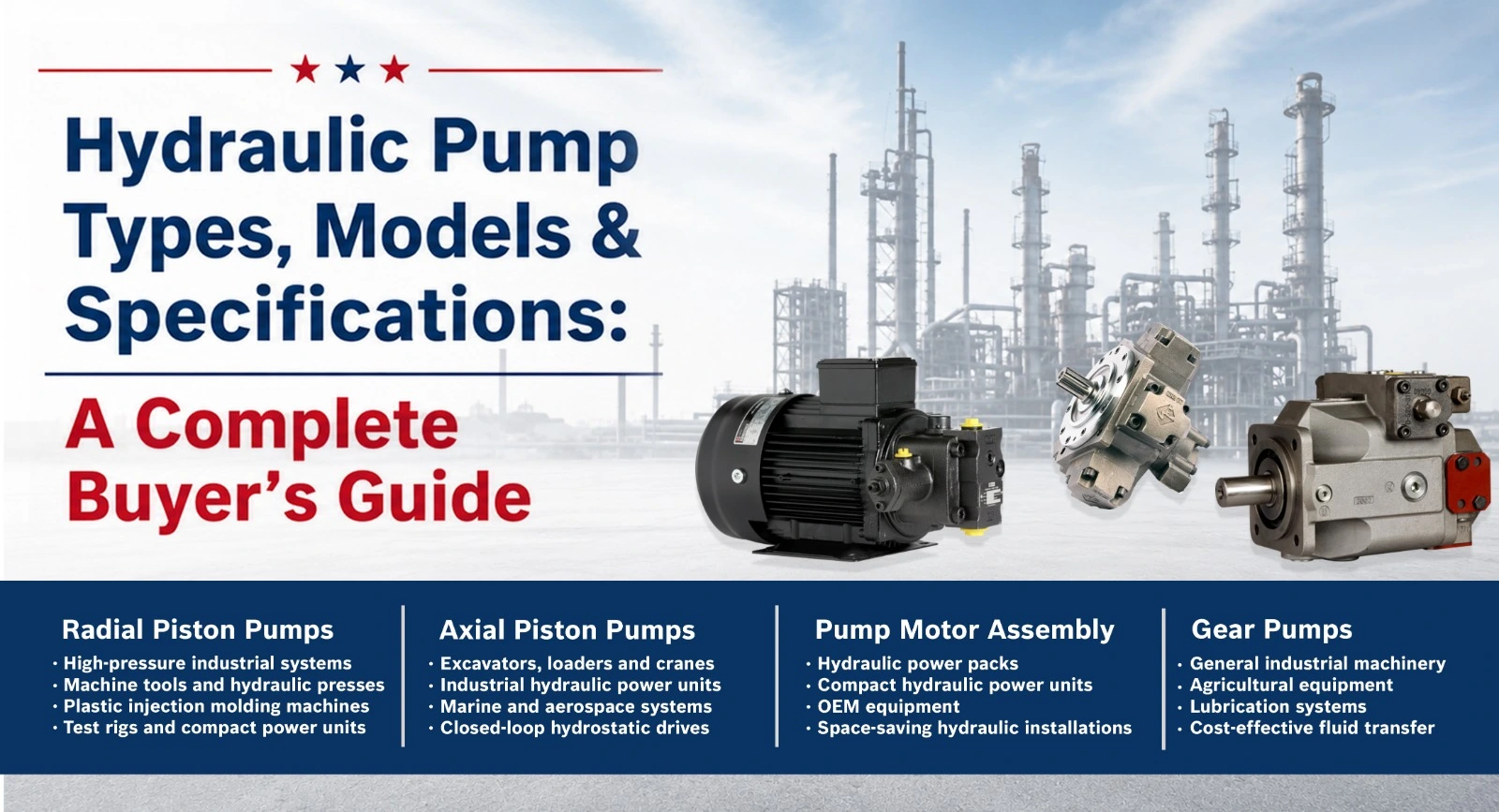
1. Radial Piston Pumps
The pistons in radial piston pumps are mounted at right angles to the drive shaft and in a radial (star-like) configuration. Through this design they are able to produce very high pressures (many times higher than a standard axial piston design), and still keep their volumetric efficiency very high.
Best for high pressure industrial applications, machine tools, presses, plastic injection molding, test rigs and power units that demand small size and high force output.
Areas of application: fixed displacement radial piston pumps, variable displacement radial piston pumps, low noise radial piston units for precision machinery.
Radial Piston Pump Specifications
| Parameter | Typical Range |
| Displacement | 2 – 250 cc/rev |
| Max. Operating Pressure | Up to 700 bar (10,000 psi) |
| Peak Pressure | Up to 800 bar |
| Rated Speed | 500 – 3,000 rpm |
| Flow Rate | 5 – 300 L/min |
| Drive Type | Fixed or variable displacement |
| Mounting | Flange or foot mount |
| Noise Level | Low to moderate |
| Applications | Presses, machine tools, test benches, plastic injection molding |
2. Servo Pumps
Servo pumps are a combination of a servo motor and a hydraulic pump, providing accurate on-demand flow and pressure control. A Servo Pump can respond to system needs and speed up or slow down in real time, instead of running at full speed at all times, and thus saving much energy.
Best for injection moulding machines, energy saving retrofit applications, applications requiring fine pressure/flow control and industries seeking sustainability and electricity cost savings.
Typical models: integrated servo motor–pumps, variable-speed servo drive pumps and closed loop servo pump systems.
Servo Pump Specifications
| Parameter | Typical Range |
| Displacement | 2 – 200 cc/rev |
| Max. Operating Pressure | Up to 350 bar (5,000 psi) |
| Motor Speed Range | 0 – 3,000 rpm (variable, closed-loop) |
| Flow Rate | 1 – 250 L/min |
| Control Type | Closed-loop servo, real-time pressure/flow control |
| Energy Savings | Up to 30–70% vs. fixed-speed systems |
| Response Time | Milliseconds (high dynamic response) |
| Applications | Injection molding machines, presses, energy-efficient retrofits |
3. Axial Piston Pumps
In axial piston pumps the pistons are parallel to the drive shaft and the displacement is usually changed by a swash-plate or bent-axis. They are valued for their efficiency, compact size, and high-pressure and variable flow capabilities.
For use in mobile hydraulics (excavators, loaders, cranes), industrial power units, marine and aerospace hydraulic systems, and closed-loop hydrostatic transmissions.
Common model classes are swash-plate axial piston pumps, bent-axis axial piston pumps, variable displacement axial piston pumps, open circuit and closed circuit configurations.
Axial Piston Pump Specifications
| Parameter | Typical Range |
| Displacement | 5 – 500 cc/rev |
| Max. Operating Pressure | Up to 480 bar (7,000 psi) |
| Rated Speed | 1,000 – 4,000 rpm |
| Flow Rate | 10 – 600 L/min |
| Design Type | Swash-plate or bent-axis |
| Circuit Type | Open circuit or closed circuit |
| Control Options | Fixed, variable, pressure-compensated, load-sensing |
| Applications | Excavators, cranes, mobile hydraulics, hydrostatic transmissions |
4. Gear Pumps
Gear pumps are one of the most basic and economical hydraulic pump designs which operate by moving the fluid as the gear teeth mesh. They are appreciated for their simplicity, reliability and performance in low and medium pressure applications.
Recommended for general industrial machinery, agricultural equipment, lubrication systems and low cost fluid transfer applications.
External gear pumps, internal gear pumps, gerotor pumps and high pressure gear pump series are among the common model classes.
Gear Pump Specifications
| Parameter | Typical Range |
| Displacement | 0.5 – 250 cc/rev |
| Max. Operating Pressure | Up to 250 bar (3,600 psi) |
| Rated Speed | 500 – 4,000 rpm |
| Flow Rate | 1 – 500 L/min |
| Design Type | External gear, internal gear, gerotor |
| Efficiency | 80 – 90% (volumetric) |
| Cost | Low to moderate |
| Applications | Agricultural equipment, lubrication systems, general industrial machinery |
5. Vane Pumps
Pumps that have sliding vanes in the rotor which form expand and contracting chambers to draw in and discharge fluid are known as vane pumps. They are low noise, possess a smooth flow output and are reasonably efficient at moderate pressures.
Suitable for machine tools, plastic and rubber processing equipment, elevators and other occasions which are required to have low noise and smooth flow.
The most popular classes of models are fixed displacement vane pumps, variable displacement vane pumps, double vane pump and triple vane pump configurations.
Vane Pump Specifications
| Parameter | Typical Range |
| Displacement | 5 – 300 cc/rev |
| Max. Operating Pressure | Up to 210 bar (3,000 psi) |
| Rated Speed | 600 – 3,000 rpm |
| Flow Rate | 5 – 400 L/min |
| Design Type | Fixed or variable displacement, single/double/triple |
| Noise Level | Very low (among the quietest designs) |
| Efficiency | High volumetric efficiency at moderate pressure |
| Applications | Machine tools, elevators, plastic/rubber processing equipment |
6. Pump Motor Assembly
A pump motor assembly is a power unit that consists of an electric motor directly connected to a hydraulic pump for use in one package. These assemblies offer easy installation, minimize alignment problems, and are commonly found in industrial and mobile equipment.
Best for hydraulic power packs, compact power units, OEM equipment manufacturing and situations where space and installation simplicity are important.
Common model classes include direct coupled motor/pump assemblies, flange mounted pump/motor assemblies, compact power pack assemblies with inbuilt reservoirs and valves.
Pump Motor Assembly Specifications
| Parameter | Typical Range |
| Motor Power | 0.5 – 200 kW |
| Motor Voltage | 110V / 220V / 380V / 440V (AC), custom DC options |
| Pump Type Compatibility | Gear, vane, piston (radial or axial) |
| Mounting Configuration | Direct-coupled, flange-mounted, foot-mounted |
| Reservoir Options | Integrated tank or standalone unit |
| Speed | 1,000 – 3,600 rpm (per motor rating) |
| Protection Rating | IP54 / IP55 (standard industrial) |
| Applications | Hydraulic power packs, OEM equipment, compact power units |
How to Choose the Right Hydraulic Pump
When choosing a hydraulic pump, one should consider:
- Pressure and flow requirements, ensure that the hydraulic pump’s rated pressure and displacement meet your system’s requirements.
- Duty cycle- Continuous duty applications – Pumps needed to have continuous duty applications that do not over heat.
- Energy conservation – variable load systems can save a lot of power when servo and variable displacement pumps are used.
- Operating environment- harsh environments need pumps constructed with corrosion resistant materials and closed precision machined parts.
- Noise sensitivity – vane pumps and a few of the axial piston types are less noisy when used in noise-sensitive applications.
Maintenance and serviceability, modular pump motor assemblies can be serviced and replaced more easily.
Conclusion
When selecting the hydraulic pump, it’s not only a question of pressure and flow. The proper pump should correspond to the load, duty cycle, speed, efficiency, operating environment and maintenance requirements of the machine. Each type has its own merits for particular applications, such as radial piston pumps, servo pumps, axial piston, gear, vane and pump motor assemblies.
Before purchasing, always check the manufacturer’s specification, compatibility, displacement, pressure rating and expected service conditions. The right hydraulic pump can help to optimize performance, reduce energy loss, reduce downtime and increase reliability.
THM Huade offers a range of hydraulic pumps and associated products to ensure a reliable hydraulic solution in industrial, mobile and manufacturing applications. Select the pump for your system and create a more efficient and reliable hydraulic operation.
Call now and talk to THM Huade experts to select the suitable hydraulic pump for your application.
Frequently Asked Questions
Q1. What types of hydraulic pumps are there?
The hydraulic pumps that are commonly used are radial piston, axial piston, servo, gear and vane pumps. These types are for varying pressures, flow and applications.
Q2. For what is a radial piston pump used?
A radial piston pump is a hydraulic pump that operates at high pressure and is characterized by its high efficiency, reliability, and precision in controlling the hydraulic pressure.
Q3. What are the applications of an Axial piston pump?
Axial piston pumps are widely found in industrial machinery, construction equipment, mobile hydraulics and others where high pressure and variable flow is required.
Q4. What is Servo Pump in Hydraulic System?
Servo pump is one type of variable-speed hydraulic pump which is controlled by a servo motor to adjust flow and pressure to the machine requirement for energy efficiency.
Q5. What is the difference between gear and vane pumps?
Gear pumps are simple in construction, durable and move hydraulic fluid by using rotating gears. Vane pumps employ sliding vanes and generally offer a quiet fluid flow.
Q6. What is meant by pump motor assembly?
A pump motor assembly is a combination of a hydraulic pump and an electric motor, which is designed to generate hydraulic power for machinery and industrial equipment.