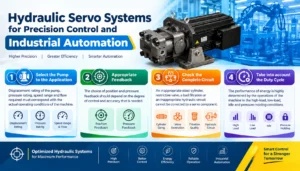
The hydraulic servo control system stands as the backbone of motion accuracy, force control, and industrial efficiency. From aerospace manufacturing to heavy-duty presses, a high-performance hydraulic servo system integrated with a robust servo motor drive ensures seamless motion.
However, even the most advanced industrial servo drive, paired with an inductive linear position sensor, is vulnerable to faults.
Users want to detect faults early in hydraulic servo control systems using diagnostic algorithms, and rightly so. Early fault detection not only prevents catastrophic failure but also protects capital investment, ensures compliance with safety standards, and enhances productivity.
Let’s explore how advanced algorithms enhance reliability in modern hydraulic servo control systems.
Why Is Fault Detection Critical in a Hydraulic Servo Control System?
A hydraulic servo control system operates under high pressure, rapid response cycles, and tight tolerance thresholds. Minor irregularities, such as sensor drift or pressure fluctuation, can escalate quickly.
The Cost of Undetected Faults
Undiagnosed faults in a hydraulic servo system can lead to:
- Cylinder misalignment
- Pressure instability
- Servo motor drive overheating
- Industrial servo drive signal distortion
Position feedback errors from a linear position sensor for a hydraulic cylinder
These issues compromise production quality and machine lifespan. In industries regulated by strict safety standards, predictive maintenance aligns with guidance from U.S. agencies like OSHA and NIST, emphasizing preventive diagnostics and equipment reliability.
Common Fault Sources in a Hydraulic Servo System
A high-performance hydraulic servo system operates under tightly controlled pressure, flow, and feedback conditions. Because it combines mechanical, hydraulic, and electronic components, even a small irregularity can impact the entire hydraulic servo control system. Most faults develop gradually due to wear, contamination, electrical drift, or environmental stress.
Recognizing these early fault sources is essential for effective diagnostics. Timely detection helps protect the servo motor drive, stabilize the industrial servo drive, and maintain precise feedback from the linear position sensor for the hydraulic cylinder, ensuring long-term system reliability.
Below are the most frequent fault sources engineers encounter in hydraulic servo applications:
Sensor Failures
A failing inductive linear position sensor may send incorrect displacement data, resulting in unstable control loops.
Hydraulic Leakage
Internal or external leakage affects pressure equilibrium, impacting the hydraulic servo control system response accuracy.
Valve Stiction and Contamination
Servo valves are precision components. Contaminants disrupt fluid flow, degrading servo motor drive responsiveness.
Industrial Servo Drive Electrical Disturbances
Voltage fluctuations in an industrial servo drive may cause erratic actuation or delayed feedback loops.
Identifying these faults early is the core purpose of advanced fault detection algorithms.
How Do Fault Detection Algorithms Work in a Hydraulic Servo Control System?
Modern fault detection in a hydraulic servo control system blends mathematical modeling, signal analysis, and intelligent computation.
Model-Based Fault Detection
Model-based algorithms compare actual system output with predicted output derived from mathematical models of the hydraulic servo system.
- If deviation exceeds a threshold, the system flags a fault.
- These models account for servo motor drive torque curves and hydraulic pressure dynamics.
- They incorporate feedback from the linear position sensor for the hydraulic cylinder to maintain accuracy.
This technique is highly effective in industrial servo drive applications requiring micrometer-level precision.
Signal-Based Monitoring Techniques
Signal-based approaches analyze:
- Pressure signals
- Flow rate variations
- Current draw in the servo motor drive
- Position signals from an inductive linear position sensor
By applying Fourier analysis or wavelet transforms, abnormal vibration patterns and oscillations can be identified before mechanical damage occurs.
This method ensures a proactive maintenance culture within any hydraulic servo control system environment.
AI and Data-Driven Diagnostics
Machine learning has elevated fault detection in hydraulic servo systems. AI-based algorithms learn normal operating patterns and automatically detect anomalies.
Key benefits include:
- Adaptive thresholds
- Reduced false alarms
- Early detection of micro-leaks
- Real-time industrial servo drive monitoring
When combined with smart sensors like an inductive linear position sensor, predictive intelligence enhances long-term reliability.
What Role Do Sensors and Drives Play in Accurate Fault Detection?
A fault detection algorithm is only as powerful as the data it receives. In a hydraulic servo control system, sensors and drives form the diagnostic foundation.
Importance of Linear Position Feedback
The linear position sensor for the hydraulic cylinder provides real-time displacement data. Even slight inconsistencies can indicate:
- Seal wear
- Piston misalignment
- Pressure imbalance
An inductive linear position sensor offers high durability and electromagnetic interference resistance, ideal for demanding hydraulic servo system environments.
Monitoring the Servo Motor Drive and Industrial Servo Drive
The servo motor drive controls torque and speed, while the industrial servo drive integrates feedback loops and system-level command processing.
Fault detection algorithms monitor:
- Current consumption
- Temperature rise
- Voltage irregularities
- Torque response lag
When deviations are detected, the hydraulic servo control system can automatically enter safe mode or trigger predictive maintenance alerts.
Advanced Strategies for Early Fault Isolation
Early fault isolation in a hydraulic servo control system focuses on detecting small performance deviations before they become major failures.
Residual Analysis
Residual signals are the differences between expected and measured outputs. Large residuals suggest faults within:
- Hydraulic servo system valves
- Servo motor drive circuits
- Linear position sensor for hydraulic cylinder
This technique isolates faults quickly without halting operations.
Observer-Based Fault Detection
Observers estimate internal states of the hydraulic servo control system. If measured outputs diverge significantly from estimated values, faults are identified in real time.
This approach is particularly effective in high-load industrial servo drive systems where downtime is costly.
Hybrid Diagnostic Systems
Modern systems combine:
- Model-based methods
- AI pattern recognition
- Real-time servo motor drive diagnostics
- Sensor validation from an inductive linear position sensor
Hybrid systems provide layered security, ensuring robust hydraulic servo control system performance.
How Can Businesses Implement Effective Fault Detection?
To enhance hydraulic servo system reliability, organizations should:
- Integrate a high-quality linear position sensor for hydraulic cylinder units.
- Ensure industrial servo drive firmware supports diagnostic APIs.
- Use condition monitoring dashboards.
- Train technicians on interpreting algorithm alerts.
Aligning maintenance practices with preventive standards recommended by industrial regulatory bodies ensures long-term compliance and operational excellence.
Conclusion
The hydraulic servo control system is evolving into a smart, self-diagnosing ecosystem. With advanced fault detection algorithms, real-time servo motor drive analytics, and precision feedback from an inductive linear position sensor, industries can move from reactive repair to predictive intelligence.
A modern hydraulic servo system supported by intelligent industrial servo drive technology and an accurate linear position sensor for hydraulic cylinder feedback is not merely efficient; it is resilient, future-ready, and strategically optimized.
Investing in advanced diagnostics ensures reliability, safeguards production, and elevates performance to a premium industrial standard.
Contact THM Huade today to upgrade your servo motor drive performance, optimize your linear position sensor for hydraulic cylinder accuracy, and future-proof your hydraulic operations with trusted engineering excellence.
FAQs
- How does a hydraulic servo control system detect early faults?
A hydraulic servo control system uses model-based algorithms, signal analysis, and AI-driven diagnostics to compare real-time sensor data with expected performance, detecting anomalies in pressure, position, and servo motor drive behavior early. - Why is a linear position sensor for a hydraulic cylinder important?
A linear position sensor for a hydraulic cylinder ensures accurate displacement feedback. It helps the hydraulic servo system maintain precise control and enables fault detection algorithms to identify misalignment or leakage issues. - Can an industrial servo drive help prevent system failures?
Yes, an industrial servo drive monitors electrical parameters and torque response. Integrated with fault detection software, it enhances hydraulic servo control system reliability and reduces unexpected downtime. - What role does an inductive linear position sensor play in diagnostics?
An inductive linear position sensor provides stable, contactless position feedback inside a hydraulic servo control system. Its accurate data enables fault detection algorithms to identify drift, vibration irregularities, and early-stage hydraulic servo system component wear. - How often should a hydraulic servo system be tested for faults?
A hydraulic servo system should undergo continuous monitoring through its industrial servo drive diagnostics and scheduled quarterly inspections. Combining automated algorithms with manual evaluation ensures optimal servo motor drive performance and long-term system reliability.