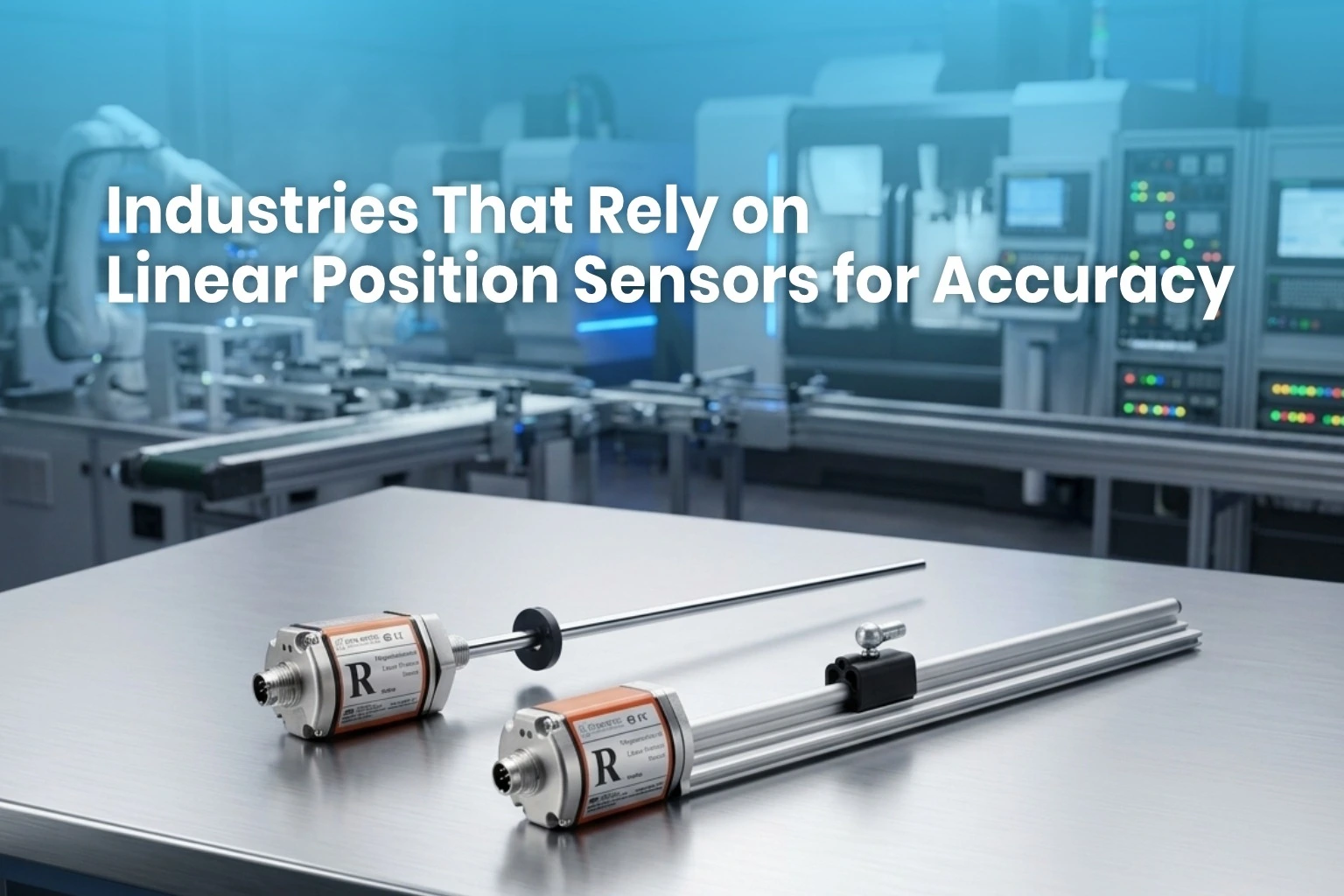
Linear position sensor is important in the contemporary industries where precision and accuracy are highly required. These sensors are extensively applied to linear motion and positioning in machines, to achieve the smooth and controlled process. With the current modern automation sensors in industries, a minor mistake in the placement can result in loss of production or quality problems.
Linear position sensors are also gaining momentum in use in manufacturing plants to heavy machinery. These sensors are used in industries to enhance efficiency, consistency and have the ability to have a precise control in the automated systems. It may be a linear displacement sensor or other industrial position sensors but these technologies are defining the future of automation.
Why Accuracy Matters in Industrial Applications
One of the most significant aspects of the contemporary production setting is accuracy. Machines need to be precise in their work in order to handle quality and minimal wastage.
Significance of Position Sensing Accuracy:
- Guarantees uniform quality of the product
- Reduces material wastage
- Improves operational efficiency
- Increases equipment safety
In most instances, systems are automatically controlled based on sensor data and errors should be reduced. That is why the industrial automation sensors are highly utilized in industries.
Industries That Use Linear Position Sensors
Linear position sensor applications are very important in many industries to ensure accuracy and performance.
Manufacturing Industry
The sensor in manufacturing industry is important in the quality of the product.
Applications:
- CNC machines
- Assembly lines
- Injection molding machines
- Packaging systems
Position sensors in automation are used in manufacturing to make sure that the machines are in precise positioning and repeatability.
Construction and Heavy Equipment
The operation of heavy machinery is dependent on the ability to move it in the right direction to complete the job effectively.
Construction Equipment Uses:
- Hydraulic cylinders
- Excavators and loaders
- Lifting equipment
Linear displacement sensor assists in tracking the movement positions of the moving parts and this makes the operations safe and precise.
Automotive Industry
Industrial position sensors are applied in the automotive industry in the process of manufacturing and testing.
Key Applications:
- Robotic welding systems
- Assembly automation
- Suspension testing systems
These sensors assist in ensuring a steady quality in the production of vehicles.
Plastic and Injection Molding Industry
Plastic processing machines need strict control of movement and pressure.
Applications:
- Injection molding machines
- Blow molding systems
- Extrusion machines
A linear position sensor provides proper positioning of the mold and a consistent quality of the product.
Linear Position Sensor Role in Automation
The automation systems are largely reliant on precise sensor data.
Key Roles:
- Provide real-time feedback
- Enabling closed-loop control systems.
- Improve machine efficiency
- Reduce human error
The position sensors in automation are indispensable in the present-day industrial processes due to these advantages.
Guidelines to Selecting the appropriate Linear Position Sensor
The choice of sensor is significant to the attainment of proper results.
Important Selection Tips:
1. Consider Application Requirements
Various applications need various kinds of sensors.
2. Check Measurement Range
Make sure that the sensor has the necessary movement range.
3. Evaluate Accuracy and Resolution
Precision applications require greater precision.
4. Compatibility with Systems
The sensor must be easy to integrate with the automation systems that are already in place.
Advantages of Linear Position Sensors
Key Advantages:
- Very high accuracy and precision
- Improved machine control
- Increased productivity
- Reduced downtime
- Better quality control
These advantages ensure that linear position sensor applications are a necessity in the contemporary industries.
Conclusion
Linear position sensor is an important device in the modern industrial environment, where success depends on accuracy and precision. In manufacturing to aerospace, these sensors assist machines to work efficiently and provide constant results. With the ever-increasing automation in the industries, there will be an increase in the need of the reliable industrial automation sensors.
Selecting the appropriate sensor and keeping it in a proper state, businesses can enhance productivity, minimize errors and guarantee the long-term performance of their systems.
To have reliable and quality solutions, THM Huade has state-of-the-art sensor technologies that will address the current industrial demands. Call today and upgrade your systems with the accuracy sensor solution and enhance your efficiency.
FAQ’s
Q1. What industries use linear position sensors the most?
Linear position sensors are used in manufacturing, automotive, aerospace, construction and automation industries which require precise control of movement.
Q2. How do linear position sensors improve accuracy in manufacturing?
They are applied to provide real time position feedback, this allows the machines to operate with high precision and consistency at the lowest level of error and wastage of materials.
Q3. What is the working principle of a linear position sensor?
Linear position sensor is an instrument that coordinates the movement and converts it into electrical signal which is used by the control systems to monitor and control the movement.
Q4. What are the different types of linear position sensors available?
The common ones consist of potentiometric, magneto strictive, inductive, capacitive and optical sensors, all of which are applicable in various industrial applications.
Q5. Why are position sensors important in industrial automation systems?
They provide proper motion control, enhance efficiency and allow automated systems to perform their duties efficiently with minimum human intervention.