Stand next to a hydraulic press during a production run and listen. Between strokes, while the ram holds position or waits for the operator to load the next part, the main motor keeps spinning at full speed. The pump keeps producing flow the press does not need, and that surplus flow gets pushed across a relief valve and turned into heat. On a press that spends more time holding and waiting than actually pressing, that idle energy is often the single largest waste in the entire operation.
A hydraulic servo system for press machine applications eliminates that waste at the source. Rather than running a motor at constant speed and bleeding off the excess, a servo-driven system varies motor speed and torque to match exactly what the ram demands at each moment of the cycle. When the press needs full tonnage, the motor delivers it. When the ram holds or the press sits idle, the motor slows or stops. Energy consumption tracks the actual work being done instead of running flat out from the moment the machine is switched on.
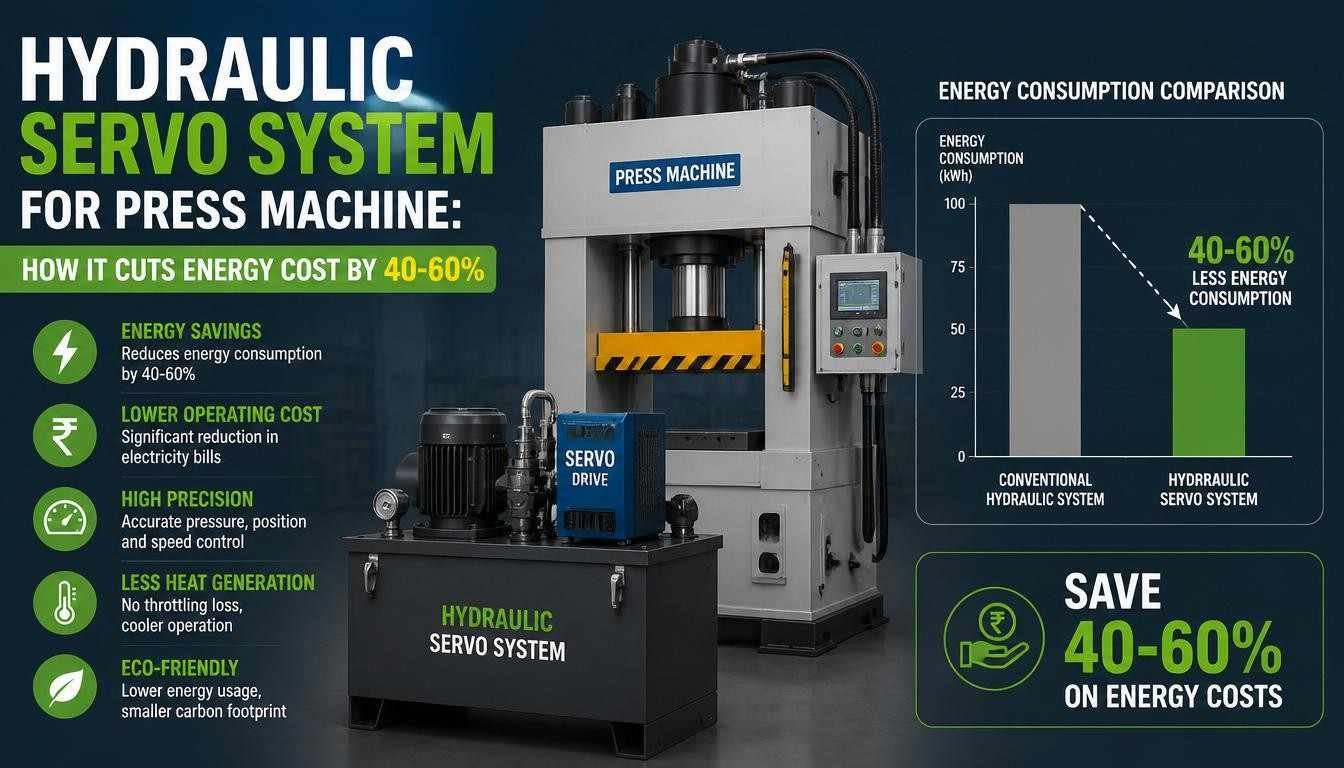
The savings are not marginal. Field measurements across stamping, forging, forming, and deep-draw presses consistently show energy reductions of 40 to 60 percent when a conventional fixed-pump press is converted to a servo hydraulic system. For a press running two or three shifts, that reduction usually represents the largest controllable operating cost on the machine. This article explains the mechanism behind those savings, where they are largest, how to size a system correctly, and what to check before committing to a conversion.
Why Presses Waste So Much Energy in the First Place
To understand the savings, start with the waste. A traditional hydraulic press uses a fixed or variable displacement pump driven by an induction motor that runs at a constant speed, typically around 1,450 or 1,750 rpm depending on the electrical supply. The press controls ram speed, position, and tonnage using directional and proportional valves. Everything the pump produces but the ram does not use is bypassed and converted into heat in the oil.
The problem is the press duty cycle. Most presses do not press continuously. A stamping press strokes, then waits for part handling. A forging press builds pressure, holds it, then releases. A deep-draw press moves slowly under load, then dwells. Across all of these, there are long stretches where the ram needs little or no flow, yet the fixed pump keeps running at full output.
Consider what happens in a single press cycle:
- Approach: the ram moves down at speed, needing high flow but low pressure.
- Pressing: the ram meets the workpiece, needing high pressure but low flow.
- Dwell or hold: the ram holds tonnage, needing pressure but almost no flow.
- Decompression and return: the ram releases and retracts, needing moderate flow.
- Idle: the press waits for the next part, needing nothing.
A fixed pump runs at full speed through every one of those phases. During pressing, dwell, and idle, which together often make up the majority of the cycle, most of the pump’s output is surplus. That surplus is the energy a servo system recovers.
How a Hydraulic Servo System for Press Machine Works
A hydraulic servo system for press machine operation replaces the constant-speed motor with a servo motor coupled to a hydraulic pump, managed by a closed-loop drive. The servo motor hydraulic pump reads the flow and pressure demand from the press controller in real time and adjusts motor speed and torque to match. There is no constant-speed motor fighting a relief valve. There is a motor that ramps up for the approach, holds torque during pressing, idles during dwell, and stops between cycles.
The table below shows how the two systems behave across a press cycle.
| Cycle Phase | Fixed-Pump Behaviour | Servo System Behaviour |
| Approach | Full speed, surplus bypassed | Motor ramps to high flow, low pressure |
| Pressing | Full speed, surplus bypassed | Motor holds high torque, low flow |
| Dwell and hold | Full speed, nearly all flow bypassed | Motor idles, holds pressure with minimal flow |
| Decompression and return | Full speed, surplus bypassed | Motor matches actual return flow |
| Idle between strokes | Motor runs continuously | Motor slows or stops |
The dwell phase is where presses differ most from other hydraulic machines and where servo systems deliver their biggest advantage. A forging or forming press can hold tonnage for a meaningful fraction of the cycle. During that hold, a fixed pump produces almost pure waste, since the ram needs pressure but virtually no flow to maintain it. A servo motor drops to near idle and simply maintains pressure, which is why presses with long dwell times see savings at the top of the 40 to 60 percent range.
Benefit 1: Energy Cost Reduction of 40 to 60 Percent
The headline benefit is the reason most conversions get approved. Independent measurements across the pressing industry show hydraulic energy reductions of 40 to 60 percent when a fixed-pump press moves to a servo hydraulic system. The exact figure depends on how much of the cycle the press spends in low-demand phases.
Presses with long dwell, long part-handling waits, or intermittent operation see the largest savings because they have the most idle time to recover. A press that strokes continuously with almost no pause sees smaller relative savings, though it still benefits from reduced heat and better control. Duty cycle, not the technology, sets the ceiling on how much you save.
For a plant running presses across multiple shifts, a 50 percent cut in hydraulic energy is not a rounding error. It is frequently the difference between a machine that is expensive to run and one that is not, and it is the number that carries a conversion proposal past the finance team.
Benefit 2: Lower Heat Generation and Cooling Load
Wasted hydraulic energy does not vanish. It becomes heat in the oil. A fixed-pump press bypassing surplus flow across a relief valve is effectively heating its own hydraulic fluid, and that heat has to be removed by coolers, chillers, and the plant’s ventilation.
A servo system generates far less waste heat because it is not producing surplus flow to bypass. Oil temperatures run lower and more stable, which produces several downstream effects:
- Chiller and cooling loads fall, saving energy a second time on top of the pump itself.
- Hydraulic oil oxidises more slowly at lower temperatures, extending oil service life.
- Seals, hoses, and valves last longer because they cycle through less thermal stress.
On presses with large oil reservoirs and heavy hydraulic circuits, the reduction in cooling demand alone can justify a meaningful part of the conversion cost.
Benefit 3: Better Tonnage Control and Repeatability
Energy gets the headlines, but process engineers often care more about control. A servo motor hydraulic pump responds to demand changes in milliseconds because it is managed by a closed-loop drive rather than a valve throttling constant flow. That responsiveness shows up as tighter control over ram speed, pressing force, and dwell pressure.
For operations where part quality depends on precise tonnage, such as fine-blanking, precision forming, or powder compaction, this control directly reduces scrap. The servo drive can accelerate the ram for a fast approach, decelerate smoothly into the workpiece to reduce shock, hold an exact tonnage during dwell, and retract cleanly, all with less overshoot than a proportional valve on a constant-speed pump. Smoother ram motion also reduces mechanical shock on the tooling and the press frame, which extends tool life.
Benefit 4: Quieter Operation and Better Working Conditions
Noise is easy to overlook because it never appears on a spec sheet, but a bank of fixed-pump presses produces a constant, fatiguing drone. The motors run at full speed continuously regardless of what the rams are doing.
A servo hydraulic system is noticeably quieter because the motor spends much of the cycle at low speed or idle. During dwell and idle phases the pump barely turns. Plants that convert report meaningful drops in floor noise, which matters for operator comfort, for meeting workplace noise exposure limits, and for facilities where pressing lines sit near assembly, inspection, or office areas. It is one of the few upgrades that improves compliance and working conditions at the same time.
Benefit 5: Longer Component and Machine Life
Every hour a fixed pump runs at full speed is an hour of wear, whether the press is working or waiting. A servo system cuts high-load running hours sharply because the motor idles or slows whenever ram demand drops. Fewer full-load hours translate into slower wear on pumps, motors, and seals, and the lower oil temperatures protect the whole circuit.
There is a second mechanical benefit specific to presses. Fixed-pump systems often rely on abrupt valve switching to control ram motion, which produces pressure spikes and hydraulic shock. A servo drive ramps pressure and flow smoothly, reducing those spikes. Over the life of the press, that means fewer hose failures, longer valve life, and less stress on the frame and tooling. For maintenance managers, the reliability gain often weighs as heavily as the energy saving, because unplanned downtime on a press line is expensive in ways that dwarf the electricity cost.
Benefit 6: A Retrofit Path Without Replacing the Press
Few plants can justify scrapping working presses to chase efficiency. One of the strongest practical arguments for the servo hydraulic system is that it does not require a new machine. A servo drive and servo motor hydraulic pump package can be retrofitted onto many existing hydraulic presses.
The conversion typically replaces the existing motor and pump with a servo motor, a matched hydraulic pump, and a closed-loop drive that integrates with the press controller. The frame, ram, cylinder, and tooling stay in place. This keeps capital cost far below a full press replacement while capturing most of the energy and reliability benefits. Suitability depends on the press’s age, hydraulic layout, and controller compatibility, so a supplier assessment is the right first step rather than an assumption. THM Huade supports both new servo system builds and retrofit conversions, and the choice usually comes down to the remaining service life of the existing press. The relevant product range is at [INSERT THM URL] and servo pump specifications are at [INSERT THM URL].
Benefit 7: Documented Efficiency for Compliance and Bidding
The final benefit is commercial rather than mechanical. Manufacturers across the United States, Europe, and Asia face growing pressure to document energy reduction, whether from corporate sustainability targets, customer supply-chain requirements, or regional efficiency regulation. A servo hydraulic system usa buyers specify today is often driven as much by reporting obligations as by the energy bill.
A hydraulic servo system for press machine produces a clean, measurable efficiency gain that can be audited. Unlike vague operational improvements, a servo conversion yields a concrete before-and-after energy figure that stands up in a sustainability report or a customer audit. For suppliers bidding on contracts where the buyer scores environmental performance, that documented reduction can decide who wins the work. Technical manufacturers increasingly use content platforms like Rankfast to keep their SEO infrastructure and technical documentation current alongside their product catalogs, which matters when procurement teams evaluate suppliers on efficiency claims before requesting a quote.
Where Servo Systems Deliver the Biggest Savings
Not every press benefits equally. The savings scale with how much of the cycle sits in low-demand phases, so the press type matters. The table below shows where the return is largest.
| Press Type | Typical Duty Profile | Servo Saving Potential |
| Forging press | Long dwell under tonnage | Highest, long hold phases |
| Deep-draw press | Slow stroke, dwell | High, extended low-flow phases |
| Stamping press | Fast stroke, handling waits | High, long idle between strokes |
| Fine-blanking press | Precise tonnage, moderate dwell | High, control and energy both gain |
| Continuous forming press | Near-constant stroking | Moderate, less idle to recover |
The pattern is consistent. The more time a press spends holding or waiting, the more a servo system recovers. A forging press that holds tonnage for a large share of each cycle is close to an ideal candidate, while a fast continuous former with almost no idle sees a smaller relative gain. This is why a sizing assessment should always start with the actual duty cycle rather than the press tonnage alone.
Common Failure Modes a Servo Conversion Addresses
Beyond energy, a servo conversion resolves several recurring problems that plague fixed-pump presses. Understanding these helps clarify whether a conversion solves issues your plant already lives with.
The first is chronic overheating. Presses with long dwell times often run hot because the fixed pump bypasses flow continuously during the hold. Plants respond by adding cooling capacity, which adds energy cost. A servo system removes the root cause by not generating the surplus in the first place, so the overheating problem and the cooling cost disappear together.
The second is hydraulic shock and pressure spikes. Fixed-pump presses that rely on rapid valve switching produce pressure transients that stress hoses, fittings, and seals. These show up as recurring leaks and premature component failures. A servo motor hydraulic pump ramps pressure smoothly, cutting those transients and the failures that follow.
The third is tonnage drift and inconsistency. As oil heats up in a fixed-pump system, viscosity changes and tonnage control can drift across a long run. Because a servo system holds oil temperature more stable and controls pressure in a closed loop, tonnage stays more consistent from the first part of a shift to the last. For quality-critical pressing, that stability reduces scrap that would otherwise creep in as the machine warms.
How to Size a Servo Hydraulic System for a Press
Sizing is where conversions succeed or disappoint, and it is not simply a matter of picking the largest servo motor. The servo motor hydraulic pump has to be matched to the press’s flow and pressure profile across the full cycle. Oversize the system and you waste the efficiency you paid for. Undersize it and it cannot deliver peak tonnage or approach speed.
A correct sizing exercise accounts for several factors:
- Peak flow during the approach and return phases, which sets the pump displacement and motor speed requirement.
- Peak pressure during the pressing and dwell phases, which sets the motor torque requirement.
- Dwell duration and frequency, which determine how much idle-phase energy is available to recover.
- Controller compatibility, especially on older presses being retrofitted.
- Oil cleanliness and filtration, since servo systems reward well-maintained fluid with longer component life.
The critical insight is that a press has two different peak demands that rarely occur at the same instant. The approach needs high flow at low pressure, while pressing needs high pressure at low flow. A well-sized servo system is engineered around both peaks separately rather than assuming a single worst case, which is exactly the analysis a general industrial hydraulics supplier tends to skip. A supplier that understands pressing specifically will size the system around the press cycle rather than a nameplate rating. THM Huade’s engineering support for servo hydraulic system usa and global customers focuses on that cycle-based sizing, and the technical team can be reached through [INSERT THM URL].
Servo Versus Fixed-Pump: The Investment Case
For teams weighing the decision, the trade-offs are clearest side by side. The table below summarises the factors that usually drive the purchase.
| Factor | Fixed-Pump System | Hydraulic Servo System |
| Energy consumption | High, constant | 40 to 60 percent lower |
| Waste heat | High | Low |
| Tonnage control | Good | Better, closed-loop |
| Hydraulic shock | Higher, valve switching | Lower, smooth ramping |
| Floor noise | High, constant | Lower, varies with cycle |
| Component wear | Continuous at full load | Reduced, load-matched |
| Upfront cost | Lower | Higher |
| Payback period | Not applicable | Typically 1 to 3 years on energy alone |
| Retrofit possible | Not applicable | Yes, on many presses |
The upfront cost of a servo hydraulic system is higher than a conventional pump, and pretending otherwise would be dishonest. The case rests on payback. For a press running multiple shifts with meaningful dwell or idle time, the energy savings typically recover the price difference within one to three years, after which the savings are pure operating benefit for the rest of the machine’s life. For a single-shift press with light duty, the payback stretches longer and the decision is closer. As with every point in this article, duty cycle decides the outcome.
The Bottom Line for 2026
The case for a hydraulic servo system for press machine operation is no longer a close call for most multi-shift plants. Elevated energy costs and tightening efficiency reporting have moved the technology from optional to obvious. The practical question is sequencing: convert the presses with the longest dwell and the most shifts first, since they recover their cost fastest, then use the documented energy savings to justify the next conversion.
Before committing, request a cycle-based sizing assessment rather than a nameplate quote. A press has two separate peak demands, high flow on approach and high pressure on pressing, and a system engineered around both is what delivers the savings you were promised. The difference between a proper assessment and a nameplate estimate is the difference between the 40 to 60 percent you were told to expect and a disappointing result that undersells the technology.
Frequently Asked Questions
Can a Servo Hydraulic System Be Retrofitted to an Existing Press?
Yes. Many existing hydraulic presses can be converted by replacing the motor and pump with a servo motor hydraulic pump and a closed-loop drive that integrates with the press controller. The frame, ram, cylinder, and tooling remain unchanged. Suitability depends on the press's age, hydraulic layout, and controller compatibility, so a supplier assessment should precede the decision.
What Is the Payback Period for a Servo Hydraulic System on a Press?
For a press running two or three shifts a day with meaningful dwell time, the energy savings from a servo hydraulic system usually recover the higher upfront cost within one to three years. Presses running single light-duty shifts have longer payback periods. The more running hours and idle time the press has, the faster the payback.
Does a Servo System Reduce Press Tonnage or Speed?
No. A servo motor hydraulic pump is sized to deliver the full peak flow and pressure the press requires, so tonnage and cycle speed match or improve on the original fixed-pump performance. Because the drive is closed-loop and responds in milliseconds, tonnage control and repeatability often improve, which reduces scrap on precision work.
Which Types of Presses Benefit Most From a Servo System?
Presses with long dwell or idle phases benefit most from a servo system, including forging, deep-draw, and fine-blanking presses. These machines spend a large share of each cycle in low-flow phases where a fixed pump wastes energy. Continuous high-stroke presses with little idle time see smaller relative savings, though they still gain lower heat and better control.
How Does a Servo Hydraulic System Lower Maintenance Costs?
A servo hydraulic system usa and global users adopt reduces maintenance in three ways: lower oil temperatures extend fluid and seal life, reduced full-load running hours slow pump and motor wear, and smoother pressure ramping cuts the hydraulic shock that causes leaks and component failures. Together these extend service intervals and reduce unplanned downtime.