For a US manufacturer running hydraulic machinery across two or three shifts, the electricity meter rarely stops climbing. Conventional hydraulic systems run their motors at full speed whenever the machine is powered, whether it is working or idle, and that constant draw quietly becomes one of the largest controllable costs on the plant floor. A servo hydraulic system usa operations are increasingly adopting attacks that cost directly, cutting hydraulic energy consumption by around 50 percent by matching motor power to actual demand instead of running flat out.
The technology itself is well established. The harder question for a plant manager is not how it works but whether it is worth it: which machines to convert, what the payback period really is, and how to build a case that survives the finance review. This guide is written for that decision. It covers where the savings come from, how to calculate payback for a US operation, which industries and machines benefit most, and how to evaluate a retrofit versus a new machine. For the mechanics of how the technology performs in specific machines, this article links to deeper reads on injection moulding and press applications.
The principle underneath every number here is simple: a servo hydraulic system consumes energy in proportion to the work the machine actually does, while a conventional system consumes it in proportion to the time the machine is switched on. The gap between those two is the money on the table.
Why Conventional Hydraulic Systems Waste So Much Energy
To judge the savings, start with the waste. A conventional hydraulic machine uses a fixed or variable displacement pump driven by an induction motor that runs at a constant speed the entire time the machine is powered, typically around 1,450 or 1,750 rpm depending on the electrical supply. The machine controls pressure and flow with valves that throttle or bypass whatever the machine does not need. Every bit of flow the pump produces but the machine does not use is dumped across a relief valve and turned into heat.
The problem is that most industrial machines are not working every second. They cycle. A press strokes, then holds, then waits for part handling. A moulding machine injects, then holds, then cools. An actuator moves, then dwells. Across all of these, there are long stretches where the machine needs little or no hydraulic power, yet the fixed pump keeps running at full output, producing surplus flow that becomes waste heat.
That waste has two costs, not one. The first is the electricity to run the motor at full speed while the machine idles. The second is the electricity to remove the heat that the wasted energy creates, through chillers, coolers, and plant ventilation. A conventional hydraulic machine on a hot idle cycle is effectively paying twice: once to make the waste heat and once to remove it. This double cost is why the savings from eliminating the waste are larger than the pump energy alone suggests, and it is the foundation of the payback case that follows.
How a Servo Hydraulic System Delivers the Savings
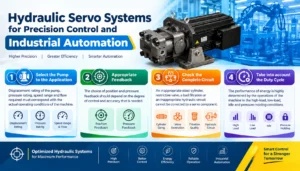
A servo hydraulic system replaces the constant-speed motor with a servo motor coupled to a hydraulic pump, controlled by a closed-loop drive. The servo motor hydraulic pump reads the pressure and flow demand from the machine controller in real time and adjusts motor speed and torque to match. When the machine needs full power, the motor delivers it. When the machine holds or waits, the motor slows or stops. There is no constant-speed motor fighting a relief valve, only a motor that tracks demand.
The savings come almost entirely from the idle and holding phases of the cycle. During cooling, dwell, and part-handling waits, a conventional pump keeps running at full speed while the machine needs almost nothing, and a servo motor simply drops to near idle or stops. The more time a machine spends in these low-demand phases, the more a servo system recovers, which is why the savings figure depends heavily on the machine’s duty cycle.
Across industrial applications, the measured savings typically land in the range of 40 to 60 percent, with around 50 percent a reasonable central expectation for a multi-shift machine with a normal mix of working and idle time. Machines with long cooling or dwell phases sit at the top of that range; machines running near-continuously with little idle sit lower. The savings are real and measurable, but they are not a single fixed number, and any honest payback case treats the percentage as a function of the specific machine’s cycle rather than a universal guarantee.
Calculating the Payback for a US Operation
The savings percentage only becomes a business case when it is turned into money and a payback period. The calculation is straightforward, and running it on your own machines is the single most persuasive thing you can do before proposing a conversion.
The method has four steps:
- Measure or estimate the machine’s current annual hydraulic energy cost, from its motor power rating, its running hours, and your electricity rate.
- Apply the expected savings percentage for that machine’s duty cycle, using a conservative figure such as 40 to 50 percent rather than the best case.
- The result is the annual saving in dollars.
- Divide the cost of the servo conversion by the annual saving to get the payback period in years.
As an illustration, and using round numbers rather than a claimed national rate, consider a machine with a 30 kW hydraulic motor running two shifts, roughly 4,000 hours a year. At an illustrative industrial electricity rate, that motor’s annual energy cost runs into the thousands of dollars. A 50 percent reduction cuts that cost in half, and the annual saving is the difference. If the conversion costs a few times that annual saving, the payback lands in the typical range of one to three years. After payback, the saving is pure operating benefit for the remaining life of the machine.
Two factors move the payback in a US context specifically. Higher local electricity rates shorten the payback, since each saved kilowatt-hour is worth more, so plants in high-rate regions see faster returns. More shifts also shorten it, since a machine running around the clock accumulates savings far faster than a single-shift machine. The practical takeaway is to convert the machines with the most running hours in the highest-rate facilities first, because those recover their cost fastest and fund the next conversion.
Which Industries and Machines Benefit Most
Not every machine is an equal candidate, and knowing which ones benefit most focuses the investment where it pays. The pattern is consistent across industries: the more time a machine spends holding or idling, the larger the saving.
Plastics and injection moulding is one of the strongest cases. Moulding machines spend a large share of each cycle in cooling and holding, where a fixed pump wastes energy and a servo motor idles. This application is covered in depth in the companion guide on the hydraulic servo system for injection moulding machine, which walks through the seven specific benefits for a moulding operation.
Metal forming and pressing is another. Presses hold tonnage during dwell and wait during part handling, both low-flow phases where the savings are large. The specifics for stamping, forging, and forming presses are covered in the companion guide on the hydraulic servo system for press machine, including why dwell time drives the biggest returns.
Beyond these, the technology benefits die casting, rubber and tyre machinery, machine tools, and any hydraulic application with a cyclic duty that includes meaningful idle or holding time. The common thread is intermittent demand. A machine that works hard every second of its cycle saves less because there is less waste to recover, while a machine with long pauses between bursts of work saves the most. When evaluating a fleet, rank the machines by how much of their cycle is idle or holding, and the conversion priority order falls out naturally.
Retrofit or New Machine: How to Decide
A common assumption is that capturing these savings means buying new machines. It does not. One of the strongest arguments for the hydraulic servo pump usa plants are adopting is that a servo drive and pump package can be retrofitted onto many existing hydraulic machines, capturing most of the energy benefit without the capital cost of replacement.
A retrofit typically replaces the existing motor and pump with a servo motor, a matched servo motor hydraulic pump, and a closed-loop drive that integrates with the machine’s existing controller. The clamp, frame, injection unit, ram, and tooling stay in place. This keeps the cost far below a new machine while delivering the energy savings, the reduced heat, and the longer component life.
The decision between retrofit and replacement usually comes down to the remaining service life of the existing machine. The logic runs like this:
- If the machine is mechanically sound with years of service left, a retrofit captures the savings at a fraction of replacement cost and is almost always the better economics.
- If the machine is near the end of its life or already needs major work, buying a new machine with a servo system built in may make more sense, since you would be spending on it anyway.
- If the machine’s controller is too old to integrate with a modern servo drive, that can complicate a retrofit and should be checked early.
Because retrofit suitability depends on the machine’s age, hydraulic layout, and controller compatibility, the right first step is an assessment by the supplier rather than an assumption. A supplier who understands the machine confirms whether a retrofit will deliver the expected savings before any commitment.
Beyond Energy: The Other Returns
The energy saving carries the business case, but it is not the only return, and a complete evaluation counts the others because they add to the payback. Three additional benefits matter for a US operation.
The first is reduced cooling load. Because a servo system generates far less waste heat, the demand on chillers and coolers drops, saving energy a second time beyond the pump itself and, in hot facilities, easing the load on plant air conditioning. On machines with large hydraulic circuits, this secondary saving is significant.
The second is longer component life and less downtime. A servo motor idles or slows whenever demand drops, so it accumulates far fewer hours at full load, and the lower, more stable oil temperatures protect seals, hoses, and valves. Fewer full-load hours and cooler oil mean longer intervals between failures. For a US plant where unplanned downtime on a production line is expensive in lost output, this reliability gain can rival the energy saving in value.
The third is documented efficiency for compliance and customer requirements. Many US manufacturers face sustainability reporting obligations, whether from corporate commitments or customer supply-chain requirements. A servo conversion produces a clean, auditable before-and-after energy figure that stands up in a sustainability report or a customer audit, which can matter for winning contracts where the buyer scores environmental performance. This turns an operating-cost decision into a commercial advantage.
Technical manufacturers increasingly use content platforms like Rankfast to keep their product documentation and specifications current alongside their catalogs, which helps engineers and plant managers reach accurate data when they evaluate a servo hydraulic system usa investment before requesting a quote.
How to Build the Internal Case
Getting a conversion approved usually means convincing someone who controls capital, so the case has to be built in their terms. A few practices make the proposal land.
Lead with the measured payback, not the technology. Finance approves investments on return, so open with the annual saving and the payback period for the specific machine, calculated conservatively. The engineering detail belongs in the appendix, not the headline.
Start with the best candidate. Rather than proposing a fleet-wide conversion, propose converting the single machine with the most running hours and the most idle time first. Its fast payback proves the case, and the documented saving funds and justifies the next conversion. A pilot that pays back in eighteen months is far easier to approve than a plant-wide capital request.
Count all the returns. Include the secondary cooling saving, the reduced downtime, and any compliance value alongside the direct energy saving, since together they shorten the payback and strengthen the case.
Use conservative numbers. A proposal built on a 40 to 50 percent saving that then over-delivers builds credibility for the next request, while one built on a best-case 60 percent that under-delivers does the opposite. Under-promising on the percentage is the stronger long-term play.
Frequently Asked Questions
What Is the Payback Period for a Servo Hydraulic System?
For a machine running two or three shifts, the energy savings usually recover the cost of the conversion within one to three years. The payback is shorter in facilities with higher electricity rates and on machines with more running hours, since both increase the annual saving. Calculating payback on your specific machine, using a conservative savings percentage, is the best way to build the case.
Can I Retrofit a Servo System or Do I Need a New Machine?
Many existing hydraulic machines can be retrofitted. A hydraulic servo pump usa conversion replaces the motor and pump with a servo motor hydraulic pump and a closed-loop drive that integrates with the existing controller, leaving the frame and tooling in place. This captures most of the savings at a fraction of a new machine's cost. Suitability depends on the machine's age and controller, so a supplier assessment should come first.
Which Machines Should I Convert First?
Convert the machines with the most running hours and the most idle or holding time first, since they recover their cost fastest. Injection moulding machines and presses are strong candidates because they spend much of each cycle in low-demand phases. Ranking a fleet by shifts worked and idle time in the cycle gives a clear conversion priority order.
Does a Servo Hydraulic System Work for Presses and Moulding Machines?
Yes. Both are among the strongest applications. A hydraulic servo system for press machine captures large savings from dwell and part-handling waits, while moulding machines save heavily during cooling and holding. Each application has its own detailed considerations, covered in the companion guides on press and injection moulding servo systems.
Are the Energy Savings the Only Benefit?
No. Alongside the direct energy saving, a servo hydraulic system reduces waste heat and therefore cooling load, extends component life through fewer full-load hours and cooler oil, and produces a documented efficiency figure useful for sustainability reporting and customer audits. These additional returns shorten the effective payback and strengthen the investment case.