Selecting the right hydraulic motor is essential for heavy-duty machinery that operates under demanding loads. In industries such as mining, construction, marine, material handling, and industrial manufacturing, equipment often requires high torque at relatively low operating speeds. Choosing the wrong motor can reduce efficiency, increase maintenance requirements, and shorten the life of the hydraulic system.
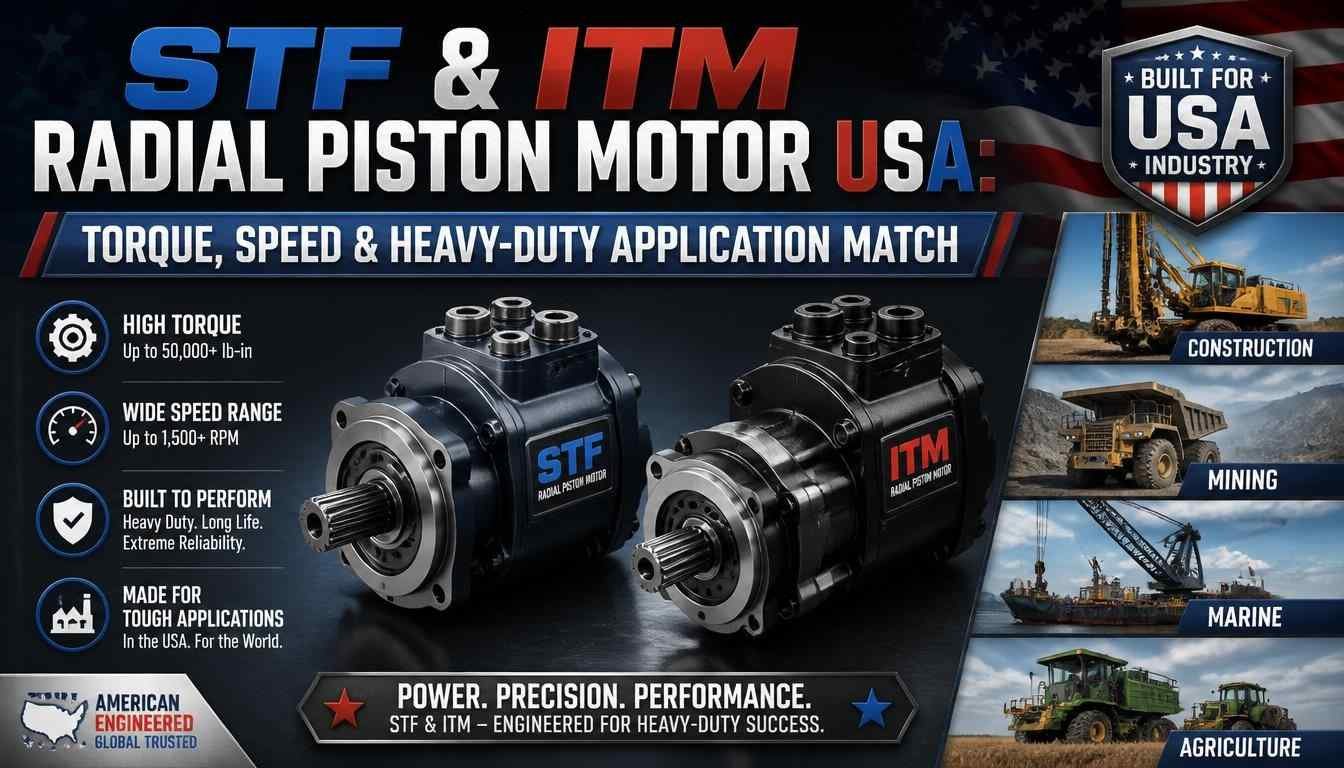
The STF ITM radial piston motor USA is designed to meet these requirements by delivering consistent torque, smooth operation, and dependable performance in applications where conventional hydraulic motors may struggle. Its radial piston design allows it to generate high output torque even at low rotational speeds, making it suitable for equipment that must move heavy loads with precision.
For engineers evaluating hydraulic motors USA, understanding how radial piston motors differ from other hydraulic motor technologies is an important part of the selection process. This guide explains the working principle, technical features, performance characteristics, application suitability, and key considerations when selecting a radial piston motor for industrial hydraulic systems.
What Is the STF ITM Radial Piston Motor?
Before selecting a hydraulic motor, it helps to understand how its internal design influences performance.
The STF ITM radial piston motor USA is a hydraulic motor that converts hydraulic pressure into rotational mechanical power using multiple pistons arranged radially around a central shaft. As pressurised hydraulic fluid enters the motor, the pistons move outward against a cam ring, creating rotational motion that drives the output shaft.
Unlike gear motors or vane motors, radial piston motors are specifically designed to produce high torque at low speeds while maintaining smooth and controlled operation. Their construction allows them to operate efficiently under heavy loads without requiring high rotational speeds.
This makes them particularly valuable in applications where controlled movement and sustained torque are more important than maximum speed.
Typical characteristics include:
- High starting torque
- Low-speed operation
- Excellent volumetric efficiency
- Smooth torque delivery
- High mechanical efficiency
- Compact yet robust construction
- Reliable performance under heavy loads
- Long service life with proper maintenance
These characteristics make the motor suitable for demanding industrial environments where equipment is expected to operate continuously.
How a Radial Piston Motor Works
Understanding the operating principle helps engineers determine whether this type of hydraulic motor is suitable for their equipment.
Inside the motor, several pistons are positioned around the drive shaft. Hydraulic fluid enters pressure chambers, forcing the pistons outward against a fixed cam ring.
As the pistons move, they generate rotational force on the shaft. The continuous sequence of piston movement produces smooth rotational motion while maintaining high torque output throughout the operating cycle.
The basic operating process is as follows:
- Hydraulic pump supplies pressurised fluid.
- Hydraulic oil enters the motor housing.
- Pressure acts on the radial pistons.
- Pistons push against the cam profile.
- The cam converts linear piston movement into rotary motion.
- The output shaft rotates.
- Hydraulic oil exits through the return port.
- The cycle repeats continuously during operation.
Because multiple pistons share the load, torque delivery remains stable even under changing operating conditions.
Why Choose a Radial Piston Motor?
Not every hydraulic application requires a radial piston motor. However, when equipment must deliver high torque while operating at relatively low speeds, this design offers several advantages over other hydraulic motor technologies.
Compared with gear or vane motors, a radial piston motor generally provides:
- Higher starting torque
- Improved low-speed stability
- Better efficiency under heavy loads
- Smooth rotation with reduced speed fluctuation
- Lower internal leakage
- Longer operating life in demanding applications
- Excellent control during precision movement
- Higher load-carrying capability
These advantages explain why radial piston motors are widely used in heavy industrial equipment across multiple sectors.
Technical Specifications of the STF ITM Radial Piston Motor
Engineers should always compare technical specifications alongside application requirements before selecting a hydraulic motor.
While specifications vary depending on the selected model, the STF ITM radial piston motor family generally includes the following characteristics.
| Specification | Typical Configuration |
| Motor Type | Radial piston hydraulic motor |
| Operating Principle | Hydraulic pressure to rotary motion |
| Torque Output | High torque at low speed |
| Speed Range | Low to medium rotational speeds |
| Rotation | Bi-directional depending on configuration |
| Mounting | Standard industrial mounting options |
| Hydraulic Medium | Mineral hydraulic oil and compatible fluids |
| Cooling | Hydraulic fluid circulation |
| Operating Environment | Heavy-duty industrial applications |
Individual models may offer different:
- Displacement options
- Output torque ratings
- Shaft configurations
- Mounting arrangements
- Port sizes
- Pressure ratings
- Speed capabilities
Matching these specifications to the application helps achieve reliable long-term performance.
High Torque Performance Explained
One of the biggest advantages of the STF ITM radial piston motor USA is its ability to produce high torque without relying on high rotational speed.
Torque represents the rotational force available to drive heavy loads. Many industrial machines require strong starting torque to move equipment from a stationary position before maintaining controlled movement throughout operation.
Examples include:
- Winches lifting heavy loads
- Conveyor drives
- Drilling equipment
- Mining machinery
- Heavy-duty rotating platforms
- Material handling equipment
The radial piston mechanism distributes hydraulic force across multiple pistons, allowing the motor to generate substantial torque while maintaining stable operation.
This makes it an excellent choice when precise movement is more important than maximum rotational speed.
Common Industrial Applications
The STF ITM radial piston motor is used in a wide range of industries where hydraulic systems must deliver reliable power under demanding operating conditions.
Typical applications include:
- Mining equipment
- Tunnel boring machines
- Marine deck machinery
- Construction equipment
- Industrial winches
- Steel manufacturing
- Material handling systems
- Agricultural machinery
- Forestry equipment
- Offshore hydraulic systems
- Recycling machinery
- Heavy-duty conveyor systems
In these applications, the motor provides dependable rotational power while handling variable loads throughout the operating cycle.
STF ITM Radial Piston Motor vs Other Hydraulic Motor Types
When selecting a hydraulic motor, engineers often compare radial piston motors with other commonly used designs.
| Feature | Radial Piston Motor | Gear Motor | Vane Motor |
| Starting Torque | Excellent | Moderate | Moderate |
| Low-Speed Performance | Excellent | Limited | Good |
| Heavy Load Capability | Excellent | Moderate | Moderate |
| Efficiency | High | Moderate | Moderate |
| Precision Control | Excellent | Limited | Good |
| Service Life | Long with proper maintenance | Moderate | Moderate |
While each motor type has its own strengths, radial piston motors are generally preferred where high torque, smooth control, and reliable low-speed operation are the primary requirements.
How to Select the Right STF ITM Radial Piston Motor
Selecting the correct hydraulic motor involves more than choosing the required torque. Engineers should evaluate the complete hydraulic system, operating conditions, and performance requirements to ensure long-term reliability.
The following factors should be reviewed before specifying a STF ITM radial piston motor USA.
Required Output Torque
Begin by calculating the torque needed to drive the application under both normal and peak operating conditions.
The selected motor should provide sufficient torque without operating continuously at its maximum capacity. Maintaining an appropriate operating margin can improve reliability and reduce wear.
Operating Speed
Radial piston motors are particularly effective in applications that require controlled movement at low rotational speeds.
If the equipment demands frequent starts, stops, or variable-speed operation, selecting a motor with the correct displacement helps maintain smooth performance.
Hydraulic System Pressure
The available system pressure directly influences motor output.
Confirm that the motor’s pressure rating is compatible with the hydraulic circuit while allowing an adequate safety margin for peak operating conditions.
Motor Displacement
Motor displacement determines the relationship between hydraulic flow, speed, and torque.
Higher displacement generally provides greater torque at lower speeds, while lower displacement allows higher rotational speeds with reduced torque output.
Shaft Configuration
Choose a shaft design that matches the driven equipment.
Common options include:
- Keyed shafts
- Splined shafts
- Flanged connections
- Special application shaft configurations
Selecting the correct shaft helps ensure efficient power transmission while reducing mechanical stress.
Mounting Arrangement
Verify that the motor mounting configuration matches the existing equipment or machine design.
Proper mounting alignment helps minimise vibration and extends bearing life.
Installation Best Practices
Correct installation plays an important role in achieving reliable motor performance.
Before commissioning the STF ITM radial piston motor USA, inspect both the hydraulic system and the mechanical drive components.
Recommended installation practices include:
- Clean all hydraulic connections before installation.
- Flush contaminated hydraulic circuits.
- Replace worn seals and damaged hoses.
- Align the motor accurately with the driven equipment.
- Tighten mounting fasteners according to manufacturer specifications.
- Verify hydraulic port connections.
- Check oil level before startup.
- Remove trapped air from the hydraulic system.
- Perform initial testing at reduced load.
- Monitor pressure and temperature during commissioning.
Taking these precautions helps reduce the likelihood of premature wear and improves overall system reliability.
Hydraulic Fluid Requirements
The performance of any hydraulic motor depends heavily on hydraulic fluid quality.
Clean hydraulic oil reduces internal wear while helping maintain efficiency throughout the motor’s operating life.
Maintenance teams should regularly monitor:
- Oil cleanliness
- Fluid viscosity
- Operating temperature
- Water contamination
- Air entrainment
- Filter condition
- Oil oxidation
Maintaining clean hydraulic fluid protects not only the motor but also pumps, valves, cylinders, and other hydraulic components throughout the system.
Routine Maintenance Recommendations
Although radial piston motors are designed for demanding applications, regular maintenance remains essential.
Preventive maintenance helps identify developing issues before they result in costly downtime.
Recommended maintenance activities include:
- Inspect hydraulic hoses for leaks.
- Monitor operating pressure.
- Check system temperature.
- Replace hydraulic filters at scheduled intervals.
- Analyse hydraulic oil condition.
- Inspect shaft seals.
- Listen for unusual operating noise.
- Verify mounting bolt tightness.
- Monitor motor case drain flow where applicable.
- Record performance trends during scheduled inspections.
A structured maintenance programme helps extend equipment life while improving system reliability.
Common Troubleshooting Issues
Even well-maintained hydraulic systems may occasionally experience operational issues.
The table below outlines common symptoms, possible causes, and recommended inspection points.
| Problem | Possible Cause | Recommended Check |
| Reduced output torque | Low system pressure | Inspect hydraulic pump performance |
| Slow motor speed | Insufficient hydraulic flow | Verify pump capacity and flow settings |
| Excessive operating temperature | Contaminated hydraulic oil | Check oil quality and cooling system |
| External oil leakage | Damaged seals | Inspect seals and hydraulic fittings |
| Unusual vibration | Shaft misalignment | Check coupling and mounting alignment |
| Increased operating noise | Air entering hydraulic system | Inspect suction line and bleed trapped air |
Many apparent motor faults originate elsewhere in the hydraulic circuit. Before replacing the motor, engineers should inspect pumps, filters, hoses, valves, and control settings to identify the root cause.
Benefits of Using STF ITM Radial Piston Motors in Heavy-Duty Applications
Heavy-duty industrial equipment places continuous demands on hydraulic components. A motor must deliver reliable performance under varying loads while maintaining efficiency over extended operating periods.
The STF ITM radial piston motor USA offers several advantages that support these requirements.
Key benefits include:
- High starting torque for demanding loads
- Smooth low-speed operation
- Stable performance under changing load conditions
- High mechanical efficiency
- Reliable continuous-duty capability
- Robust construction for industrial environments
- Reduced internal leakage
- Long service life with proper maintenance
- Compatibility with a wide range of hydraulic systems
These characteristics make radial piston motors suitable for applications where precise motion and dependable torque are essential.
Why Engineers Across the USA Choose Radial Piston Motors
Demand for reliable hydraulic motors USA continues to grow as industries invest in equipment capable of handling higher loads with greater efficiency.
Engineers working in mining, construction, marine operations, steel production, agriculture, and material handling frequently specify radial piston motors because they provide dependable torque without requiring excessive operating speeds.
For equipment manufacturers and maintenance teams, selecting the correct motor can improve machine productivity while reducing maintenance interruptions.
Many industrial manufacturers also invest in detailed online technical resources to help engineers compare products before purchase. Technical marketing specialists such as RankFast support this effort by improving the visibility of engineering documentation, product specifications, and application guides, making it easier for procurement teams to access reliable technical information.
Conclusion
The STF ITM radial piston motor USA is designed to meet the demands of heavy-duty hydraulic applications where high torque, low-speed operation, and dependable performance are essential. Its radial piston construction delivers smooth rotational power while maintaining excellent efficiency under varying loads, making it suitable for equipment used in mining, construction, marine operations, manufacturing, and material handling.
For engineers comparing hydraulic motors USA, selecting the right motor involves more than reviewing torque figures. Hydraulic pressure, flow rate, displacement, shaft configuration, mounting arrangement, and maintenance requirements all influence long-term performance. Evaluating these factors together helps ensure the motor integrates effectively with the hydraulic system and supports reliable operation throughout its service life.
Whether you are replacing an existing hydraulic motor, designing new equipment, or upgrading machinery for improved performance, the STF ITM radial piston motor offers a dependable solution for applications requiring a high torque hydraulic motor with precise low-speed control.
If you need assistance selecting the appropriate model for your equipment, contact the THM Huade team with your hydraulic system specifications. Their technical specialists can recommend a configuration that matches your performance requirements and application needs.