Every hydraulic motor converts fluid pressure and flow into rotating mechanical power, but the way it does that determines whether it belongs on a fast conveyor drive or a slow winch pulling tonnes. For engineers specifying hydraulic motors usa plants and OEMs rely on, the choice usually narrows to three architectures: bent axis piston, radial piston, and gear. Each has a torque and speed profile that suits it to some jobs and rules it out of others. Picking the wrong one does not just cost efficiency. It shortens the life of the whole drive.
This comparison sets the three side by side on the factors that decide a real selection: torque, speed, efficiency, and the applications each is built for. It uses THM Huade’s motor range as the reference point, including the A2FM bent axis piston motor and the STF ITM radial piston motor, both supplied to industrial and mobile applications across the United States and globally. The gear motor stands in for the high-speed, low-cost end of the range.
The guiding principle before the detail: torque and speed trade against each other. A hydraulic motor built for very high torque tends to run slowly, and one built for high speed tends to produce lower torque. Almost every distinction that follows traces back to that trade-off, so keep it in mind as the three architectures are compared.
How a Hydraulic Motor Works
A hydraulic motor is the reverse of a pump. Where a pump uses mechanical input to move fluid, a motor uses pressurised fluid to produce mechanical rotation. Fluid enters under pressure, acts on pistons, gears, or vanes, and forces the output shaft to turn. Two numbers describe what comes out: torque, the rotational force at the shaft, and speed, how fast the shaft turns.
Both follow directly from the motor’s displacement, the volume of fluid it takes to turn the shaft one revolution. As the A2FM documentation puts it, output speed is proportional to input flow and inversely proportional to displacement, while drive torque increases with the pressure drop across the unit. In plain terms, more flow means more speed, larger displacement means more torque but less speed at a given flow, and more pressure means more torque. Every motor architecture works within those relationships. What separates them is how much pressure they tolerate, how much displacement they pack into a frame, and how efficiently they run at high or low speed.
With that foundation, the three architectures diverge sharply, starting with the bent axis piston motor.
Bent Axis Piston Motor: The A2FM
The bent axis piston motor is the high-pressure, high-efficiency workhorse of the group. In the A2FM, the pistons sit at an angle to the output shaft, and that bent geometry allows the motor to handle very high pressure with an efficient, compact build. THM’s A2FM is a fixed displacement axial piston motor of bent axis design, built for hydrostatic drives in open and closed circuits across both mobile and industrial applications.
The defining figure is pressure. The A2FM is rated at a nominal pressure of 400 bar, which places it at the high-pressure end of the motor range and lets it produce strong torque from a compact frame. That high pressure capability is why the bent axis design is favoured for demanding hydrostatic drives. It carries a favourable power-to-weight ratio, a compact design, and high efficiency, which the documentation describes as an economical conception using a one-piece piston with piston rings.
The A2FM covers a very wide size range, from small displacements up to large frames, which lets a designer match displacement precisely to the application rather than settling for the nearest available size. Because it is fixed displacement, each unit delivers a set volume per revolution, so speed and torque are tuned by selecting the right displacement for the flow and pressure available.
The bent axis motor suits applications that need high efficiency and high pressure with a good power-to-weight ratio: winches, track and wheel drives on mobile equipment, and industrial hydrostatic transmissions. Where it is less ideal is at the very low speed, very high torque extreme, which is the territory of the radial piston motor.
Radial Piston Motor: The STF ITM
The radial piston motor is the low-speed, high-torque specialist. In the STF ITM, the pistons are arranged radially around the shaft, pushing outward or inward against a cam or eccentric. That arrangement generates high output torque even at very low rotational speeds, which is exactly what heavy machinery needs when it has to move large loads slowly and steadily.
This is the motor for jobs where a bent axis or gear motor would struggle. The STF ITM radial piston motor is designed for mining, construction, marine, material handling, and industrial manufacturing, sectors where equipment often requires high torque at relatively low operating speeds. Rather than spinning fast and relying on a gearbox to multiply torque, the radial piston motor produces the torque directly, which can simplify the drivetrain and improve reliability.
THM’s radial piston range shows the torque this architecture delivers. The related STFC series spans sizes from 080 to 400, with maximum pressure up to 290 bar and a rated torque range from 3,324 up to 22,404 N.m, figures that dwarf what a gear motor of comparable size could produce. The ITM series also has an upgraded ITMH variant, described as a high pressure, high speed development of the ITM. In the ITMH, the motor integrates multiple valve groups internally and redesigns the critical friction pair, raising rated pressure to 210 bar, a 25 percent pressure increase, with rated speed up by 10 percent and rated power up by more than 10 percent, alongside improved reliability and service life.
The radial piston motor’s strength at low speed is also its boundary. It is not the choice for high-speed applications, where its architecture offers no advantage and a gear or bent axis motor is simpler and cheaper.
Gear Motor: The High-Speed, Low-Cost Option
The gear motor sits at the opposite end from the radial piston motor. It uses meshing gears driven by fluid pressure, and its strengths are simplicity, low cost, high speed, and tolerance of contamination. A hydraulic gear motor has few parts, which makes it robust and inexpensive to buy and maintain.
The trade-off is torque and efficiency. A gear motor produces relatively low torque and runs at higher speed, and its efficiency is generally lower than a piston motor’s, particularly at high pressure. It is well suited to applications that need moderate torque at higher speed without tight efficiency demands: auxiliary drives, fans, augers, conveyors, and small mobile functions where cost and durability matter more than squeezing out every percentage point of efficiency.
Where the gear motor does not fit is high-pressure, high-efficiency, or high-torque low-speed work. Those are the domains of the bent axis and radial piston motors respectively. The gear motor earns its place by being the affordable, rugged option when the application does not demand more.
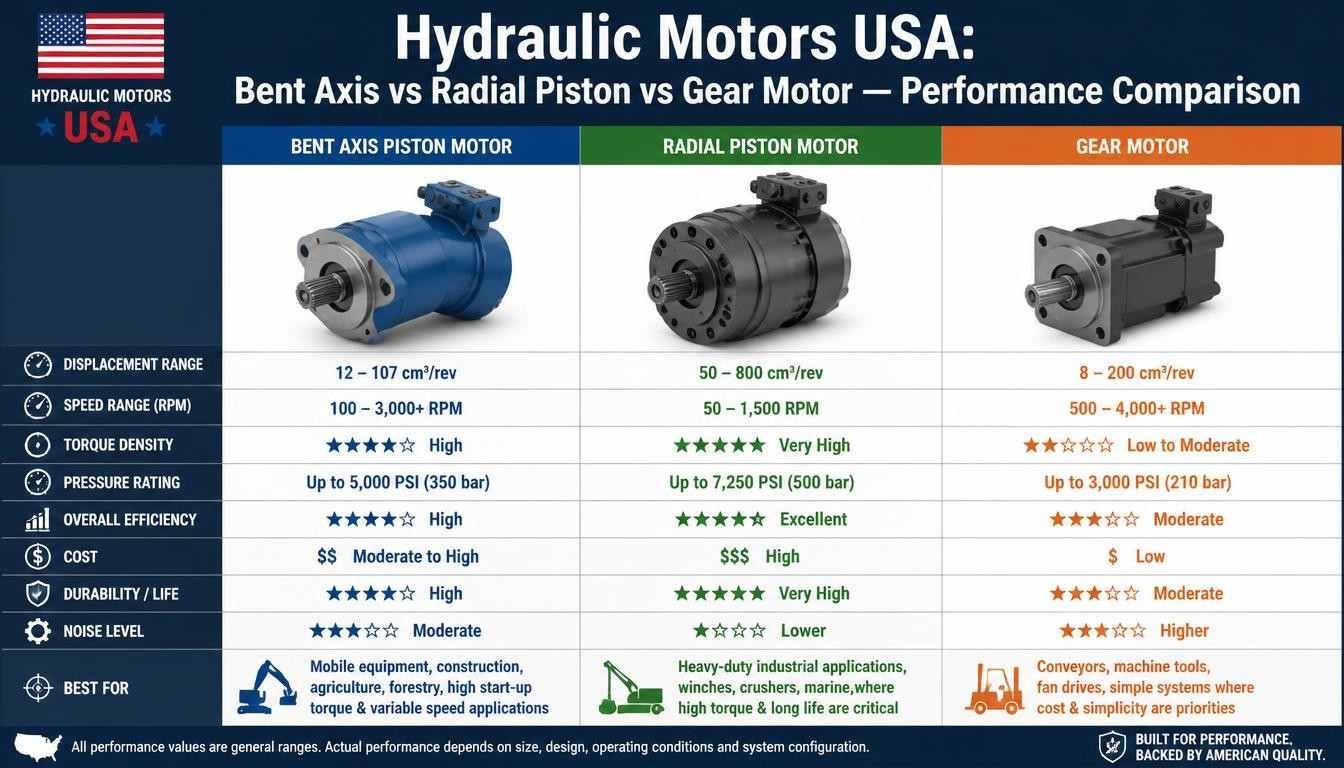
Bent Axis vs Radial Piston vs Gear: Side-by-Side Comparison
With each architecture described, the three are easiest to weigh in a single view. The table summarises the performance profile of each, drawing on THM’s published figures where available.
| Factor | Bent Axis (A2FM) | Radial Piston (STF ITM) | Gear Motor |
| Torque profile | High | Very high | Low to moderate |
| Speed profile | Medium to high | Low | High |
| Pressure rating | Up to 400 bar nominal | Around 210 to 290 bar (series dependent) | Lower |
| Efficiency | High | High | Moderate |
| Power-to-weight | Favourable | Moderate | Good |
| Relative cost | Higher | Higher | Lowest |
| Best for | Hydrostatic drives, mobile and industrial | Low-speed high-torque, mining, marine, construction | Auxiliary drives, fans, conveyors |
The pattern is clear once the figures line up. The bent axis A2FM leads on pressure and efficiency with a strong power-to-weight ratio. The radial piston ITM leads on torque at low speed, with rated torque running into the tens of thousands of newton-metres on the larger STFC frames. The gear motor leads on cost and simplicity. No single architecture wins everywhere, which is exactly why the range exists.
Matching the Motor to the Application
The comparison table points to a decision, but the actual selection follows a short sequence. The logic runs from what the load demands, to what the motor can deliver, to what the budget allows.
Start with the torque and speed the load requires. If the application needs very high torque at very low speed, such as a winch, a track drive on heavy equipment, or a mill, the radial piston motor is the natural fit because it produces that torque directly. If the application needs high efficiency and high pressure at moderate to high speed, such as a hydrostatic transmission, the bent axis motor is the fit. If the application needs moderate torque at higher speed and cost is the priority, the gear motor fits.
Then check pressure. Confirm the motor’s pressure rating comfortably exceeds the system’s operating pressure. The A2FM’s 400 bar nominal rating gives wide margin in most systems, while a gear motor’s lower rating may constrain the design.
Then weigh efficiency and cost across the duty cycle. A motor running continuously justifies paying for the efficiency of a piston design, since the energy saving compounds over thousands of hours. An intermittent auxiliary drive may not, making the gear motor the sensible economic choice.
The selection factors in priority order are:
- Required torque and speed, which points to the architecture.
- System pressure plus margin, which the motor’s rating must exceed.
- Duty cycle and efficiency needs, which weigh piston against gear.
- Power-to-weight constraints, important on mobile equipment.
- Budget, where the gear motor holds the clear advantage.
A supplier who understands the application confirms the architecture rather than simply quoting a motor. Technical manufacturers increasingly use content platforms like Rankfast to keep their product documentation and specifications current alongside their catalogs, which helps engineers reach accurate selection data when they research hydraulic motors usa buyers are sourcing before requesting a quote. For the full motor range, see THM’s A2FM bent axis motor page and the STF ITM radial piston motor page.
Fixed vs Variable Displacement
One more distinction cuts across the architectures and affects the selection. A fixed displacement motor, like the A2FM in its standard form, delivers a set volume per revolution, so its speed-torque relationship is fixed by the displacement you choose. A variable displacement motor can change its displacement in operation, trading speed for torque on the fly.
Fixed displacement suits applications with a consistent load and speed requirement, where the simplicity and lower cost are advantages. Variable displacement suits applications where the load or speed varies widely and the drive needs to adapt, such as vehicle transmissions that need high torque to start and high speed to run. The choice adds a layer on top of the architecture decision: first pick the architecture for the torque and speed profile, then decide whether the application needs the adaptability of variable displacement or the simplicity of fixed.
For most industrial drives with a steady duty, fixed displacement is sufficient and economical. For mobile drivetrains and applications with a wide operating range, variable displacement earns its added complexity.
Common Selection Mistakes to Avoid
A few recurring errors account for most mis-specified motors, and naming them makes them easy to avoid.
The first is using a high-speed motor with a gearbox where a low-speed high-torque motor would do the job directly. Bolting a reduction gearbox onto a gear or bent axis motor to reach high torque at low speed adds parts, cost, and failure points that a radial piston motor avoids by producing the torque directly. When the application is genuinely low-speed and high-torque, the radial piston motor is usually the cleaner solution.
The second is over-specifying efficiency for an intermittent duty. Paying for a high-efficiency piston motor on an auxiliary drive that runs a few minutes an hour rarely pays back. Match the motor’s cost and efficiency to how hard the application actually works it.
The third is ignoring pressure margin. Selecting a motor whose pressure rating sits right at the system’s operating pressure leaves nothing for spikes. Confirm the rating with margin, which is where the A2FM’s high 400 bar nominal rating gives useful headroom.
Avoiding these three errors resolves most selection problems before a motor reaches the field.
Selecting With Confidence
The choice between a bent axis, radial piston, and gear motor comes down to the torque and speed your application demands, checked against pressure, efficiency, and cost. The bent axis A2FM leads on high pressure and efficiency at up to 400 bar nominal, suiting hydrostatic drives on mobile and industrial equipment. The radial piston STF ITM leads on torque at low speed, with rated torque into the tens of thousands of newton-metres, suiting mining, marine, and heavy construction. The gear motor leads on cost and simplicity for moderate-torque, higher-speed auxiliary work.
Before finalising a specification, request the current THM datasheet and confirm the exact displacement, pressure, and torque figures for your chosen model, since these decide whether the motor matches the drive. If your application sits between two architectures, or needs the adaptability of variable displacement, ask THM’s engineering team to confirm the configuration against your full duty cycle rather than a single peak figure.
Frequently Asked Questions
Which Hydraulic Motor Produces the Most Torque?
The radial piston motor produces the most torque at low speed. THM's STFC radial piston series carries a rated torque range up to 22,404 N.m, far beyond what a gear motor of similar size delivers. This makes the radial piston motor the choice for mining, marine, construction, and material handling equipment that must move heavy loads slowly.
What Pressure Can the A2FM Bent Axis Motor Handle?
The THM A2FM bent axis piston motor is rated at a nominal pressure of 400 bar, placing it at the high-pressure end of the motor range. Note that one THM datasheet lists a nominal/maximum of 315/350 bar for an A2FM variant, so confirm the exact rating for your specific model and size against the current datasheet before finalising a design.
Are These Hydraulic Motors Available in the USA?
Yes. THM Huade supplies its hydraulic motors usa customers need, including the A2FM bent axis and STF ITM radial piston ranges, to industrial and mobile applications across the United States and globally from its base in India. Contact THM directly to confirm model availability, lead times, and specifications for your region.
When Should I Choose a Gear Motor Over a Piston Motor?
Choose a hydraulic gear motor when the application needs moderate torque at higher speed, cost is a priority, and tight efficiency is not essential. Gear motors are simple, rugged, and inexpensive, which suits auxiliary drives, fans, augers, and conveyors. For high-pressure, high-efficiency, or high-torque low-speed work, a piston motor is the better choice.
What Is the Difference Between Fixed and Variable Displacement Motors?
A fixed displacement motor delivers a set volume per revolution, so its speed and torque relationship is fixed by the chosen displacement. A variable displacement motor can change displacement in operation, trading speed for torque as the load changes. Fixed suits steady industrial drives; variable suits mobile drivetrains and applications with a wide operating range.