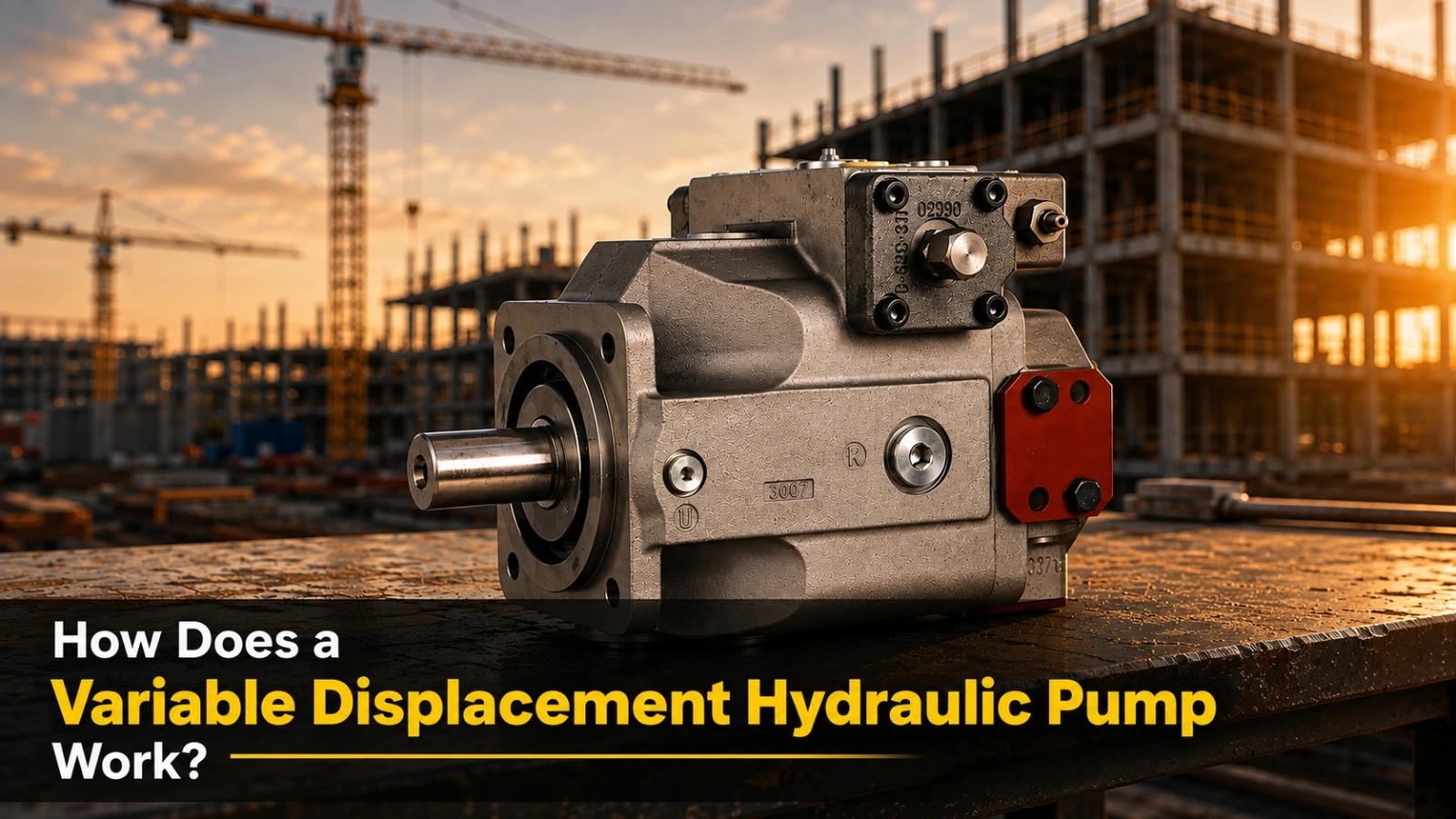
An axial piston pump with variable stroke provides hydraulic systems with the feature that a fixed-displacement pump lacks: the capability to control fluid flow based on changing machine requirements. It is able to adjust its displacement to regulate flow, pressure, speed, and power consumption rather than flowing the same volume of oil at any given time. This renders it an effective option in the current industrial equipment where output and efficiency are important.
Manufacturers are also modernizing hydraulic systems in India to enhance productivity at a low cost on both energy and maintenance. Knowing the operation of variable displacement pumps aids engineers in selecting appropriate pumps to be used on presses, injection molding machines, mobile equipment and other stressful uses.
What is a Variable Displacement Hydraulic Pump?
A variable displacement hydraulic pump varies the hydraulic fluid it discharges when it is operating.
In simple terms:
Fixed displacement: almost constant flow/revolution
Variable displacement: flow per revolution which can be varied.
The pump varies its displacement on the basis of the requirements of the system. This enables the hydraulic system to only supply the flow that it requires rather than producing the maximum flow constantly.
Any type of displacement pump may be designed as a variable displacement, although axial piston technology is particularly prevalent in industrial high-pressure applications.
Variable Displacement Pump Working Principle
The variable displacement pump principle of working relies on the alteration of the stroke of the elements that pump.
A common axial piston engine involves a number of pistons that travel within a rotating cylinder block. A swash plate is used to regulate the piston stroke.
Step 1: The Drive Shaft Rotates
The shaft of the pump is rotated by the electric motor or other prime mover.
Step 2: Pistons Move
As the cylinder block rotates, the pistons move back and forth.
Step 3: Hydraulic oil is added
Through the suction phase, the hydraulic fluid is pulled into the pumping chambers by the pistons.
Step 4: Oil Pressurized.
It consists of pushing the fluid out of the outlet by the pistons, creating hydraulic pressure.
Step 5: Displacement Changes
The control mechanism adjusts the piston stroke by adjusting the swash plate angle.
The greater the stroke, the greater the flow and the lesser the stroke, the lesser the flow.
This minor modification endows a variable flow hydraulic pump with the adaptability needed by modern machinery.
What is the Reason of using a Variable Axial Piston Pump?
When demand of hydraulic varies throughout a machine cycle, a variable axial piston pump is beneficial.
To illustrate, a press might demand high flow but the cylinder travels rapidly and less flow when the cylinder gets to the high-force pressing stage.
The pump is able to vary its output, rather than operating at maximum flow over the cycle.
Key advantages include:
- Better energy efficiency
- Adjustable flow
- High pressure capability
- Precise machine control
- Reduced heat generation
- Lower energy waste
- Appropriate to challenging service cycles
That is why the technology of variable displacement has gained significance in the sophisticated hydraulic systems.
Variable Displacement Piston Pump vs Fixed Displacement Pump
The major distinction is the manner in which both pumps handle flow.
| Feature | Variable Displacement Piston Pump | Fixed Displacement Pump |
| Flow control | Adjustable | Mostly constant |
| Energy efficiency | Generally higher when demand varies | Depends on system design |
| Pressure capability | High | Varies by pump type |
| Control flexibility | Excellent | More limited |
| Application | Variable-load systems | Constant-flow systems |
Even a fixed pump can be very efficient in the appropriate use. The most appropriate option is based on the needs of the machines.
Where Are Variable Displacement Pumps Used?
The variable displacement pump applications cover a wide range of industries.
1. Injection Molding Machines
These pumps are capable of varying the flow at various positions of injection and mold movement.
2. Hydraulic Presses
During approach, pressing and return cycles, presses may require varying flow rates.
3. Machine Tools
The clamping and actuation of CNC machines and other industrial machines use controlled hydraulic flow.
4. Construction Equipment
Mobile machines such as excavators often have varying hydraulic requirements.
5. Material Handling
Adjustable flow and pressure control is an advantage of lifting and positioning equipment.
6. Industrial Automation
When hydraulic requirement varies during production cycles, automated machinery can employ variable pumps.
These are only a few of the large axial piston pump uses in the contemporary industry.
Applications of open Circuit Piston Pumps
The hydraulic fluid is pumped out of a reservoir by an open circuit piston pump and pumped back into the same tank after an actuator is finished with its work.
This arrangement is typical of:
- Industrial presses
- Injection molding equipment
- Machine tools
- Hydraulic power units
- Manufacturing machinery
Open-circuit systems may be tailored to an efficient pressure system and flow control, as well as tolerating a rigorous industrial duty cycle.
High-Pressure Industrial Applications
A high pressure variable displacement pump is suitable to serve challenging hydraulic needs where both pressure and regulated flow are significant.
Typical requirements include:
- High force
- Continuous operation
- Fast machine cycles
- Variable load conditions
- Accurate actuator control
In these applications, the engineers need to look at pressure rating, displacement range, speed, type of control and compatibility with hydraulic fluid before choosing a pump.
Variable Axial Piston Pump Models
Various pump sizes can be selected based on the desired displacement, pressure, flow and pump application. Common models include:
A4VSO Series:
- A4VSO40
- A4VSO71
- A4VSO125
- A4VSO180
- A4VSO250
- A4VSO355
- A4VSO500
A10VSO Series:
- A10VSO18
- A10VSO28
- A10VSO45
- A10VSO71
- A10VSO100
- A10VSO140
How Variable Pumps Improve Energy Efficiency
A significant factor that manufacturers consider using an energy efficient hydraulic pump is that unnecessary hydraulic power generation would be minimized.
In the event that more flow is generated by a fixed pump than the machine needs, the overflow can be discharged by a valve or control circuit. That is capable of producing heat and waste energy.
A demand that decreases can be supplied by a variable pump which can cut its displacement.
This can help:
- Reduce throttling losses
- Lower heat generation
- Reduce cooling requirements
- Enhance the efficiency of the system as a whole.
- Lower operating costs
Real savings are based on machine design, control policy, duty cycle and operating conditions.
Important Factors When Selecting a Variable Pump
Maximum pressure should not be the only consideration in choosing a pump.
1. Required Flow
Determine the actuator and machine cycle flow that is needed.
2. Operating Pressure
Check continuous and peak pressure requirements.
3. Pump Speed
Ensure that the pump can support the desired motor speed.
4. Control Type
You should consider whether your system requires pressure compensation, load sensing or some other system control process.
5. Duty Cycle
The constant running of the industries needs a pump that is expected to perform with the anticipated work load.
6. Fluid and Filtration
Maintained hydraulic oil and good filtration are used to cover internal parts.
7. Installation Conditions
Take into consideration temperature, space, noise and maintenance access.
Maintenance Tips for Long Pump Life
Even a premium hydraulic pump of industrial machines has to be properly maintained.
Important tips:
- Maintain hydraulic oil.
- Change filters as per maintenance schedule.
- Measure pressure and temperature.
- Check for unusual noise or vibration.
- Inspect fittings and connections for leaks.
- Keep the suggested quantity of oil.
- Early investigate performance changes.
Wearing inside piston pumps can be caused by poor filtration and contaminated oil.
Selection of a Pump to fit Industrial Machinery
In the case of an industrial variable displacement pump, engineers must consider the pump as matching the entire hydraulic circuit, and not to select the pump alone.
Consider the:
- Hydraulic cylinder size
- Motor power
- Required flow
- Maximum pressure
- Operating cycle
- Control requirements
- Available cooling capacity
An appropriate matched pump has the capability to enhance the response of the machine and the needless operating loss.
Conclusion
A variable axial piston pump can be a big difference where a hydraulic machine requires varying flow rates at varying speeds of operation. It allows engineers to have more control of pressure, speed, power usage and machine behavior by controlling displacement, rather than providing the maximum flow at all times.
To the Indian manufacturers that are interested in automation and efficient production, when choosing the correct pump the correct pump should be chosen based on the machine cycle it is going to operate in and not just the highest pressure or flow rating. Proper sizing, clean hydraulic oil and frequent maintenance are also key factors to long-term reliability.
Need a reliable answer to your hydraulic project? THM Huade provides the high-performance hydraulic pump technologies in the industrial sector under heavy demand.
Call and receive professional help of THM Huade to choose the proper variable axial piston pump to use in your machine.
Frequently Asked Questions
Q. How does a variable displacement hydraulic pump work?
It varies its internal movement in a bid to modulate hydraulic fluid movement. Swash plate varies the stroke of the piston in the axial piston designs and in this way the pump can produce more or less output.
Q. What is the main advantage of a variable displacement pump?
Its greatest benefit is a variable flow. The pump is able to match output to machine demand and this can enhance control and less consumption of the unnecessary energy.
Q. Where are variable axial piston pumps used?
They are usually applied with injection molding apparatus, hydraulic presses, machine tools, construction equipment, material handling apparatus, industrial automation.
Q. Is a variable displacement pump more efficient than a fixed pump?
It may be more effective when hydraulic requirements vary due to being able to turn down when the full flow is not needed. The effectiveness is a factor of overall system design.
Q. What causes a variable piston pump to lose performance?
Factors that can cause common include contaminated oil, inadequate lubrication, improper pressure settings, excessive wear, cavitation and improper maintenance.