Hydraulic systems rely on pumps and motors working together to convert mechanical energy into hydraulic power and vice versa. While these components often share similar internal designs, they perform entirely different functions within a hydraulic circuit. Understanding those differences is essential when selecting equipment for industrial or mobile applications.
Among the most widely used bent-axis hydraulic components are the A2FO bent axis piston pump USA and the A2FM bent axis piston motor USA. Both are designed for high-pressure operation, excellent mechanical efficiency, and reliable performance in demanding environments. However, choosing the wrong component can lead to poor system performance, increased operating costs, and compatibility issues.
Whether you’re replacing an existing unit, designing a new hydraulic system, or comparing pump and motor options, understanding how these components differ will help you make a more informed purchasing decision.
This guide explains the working principles, technical specifications, key differences, applications, sizing considerations, and maintenance requirements of A2FO pumps and A2FM motors to help buyers in the USA choose the right solution.
What Is an A2FO Bent Axis Piston Pump?
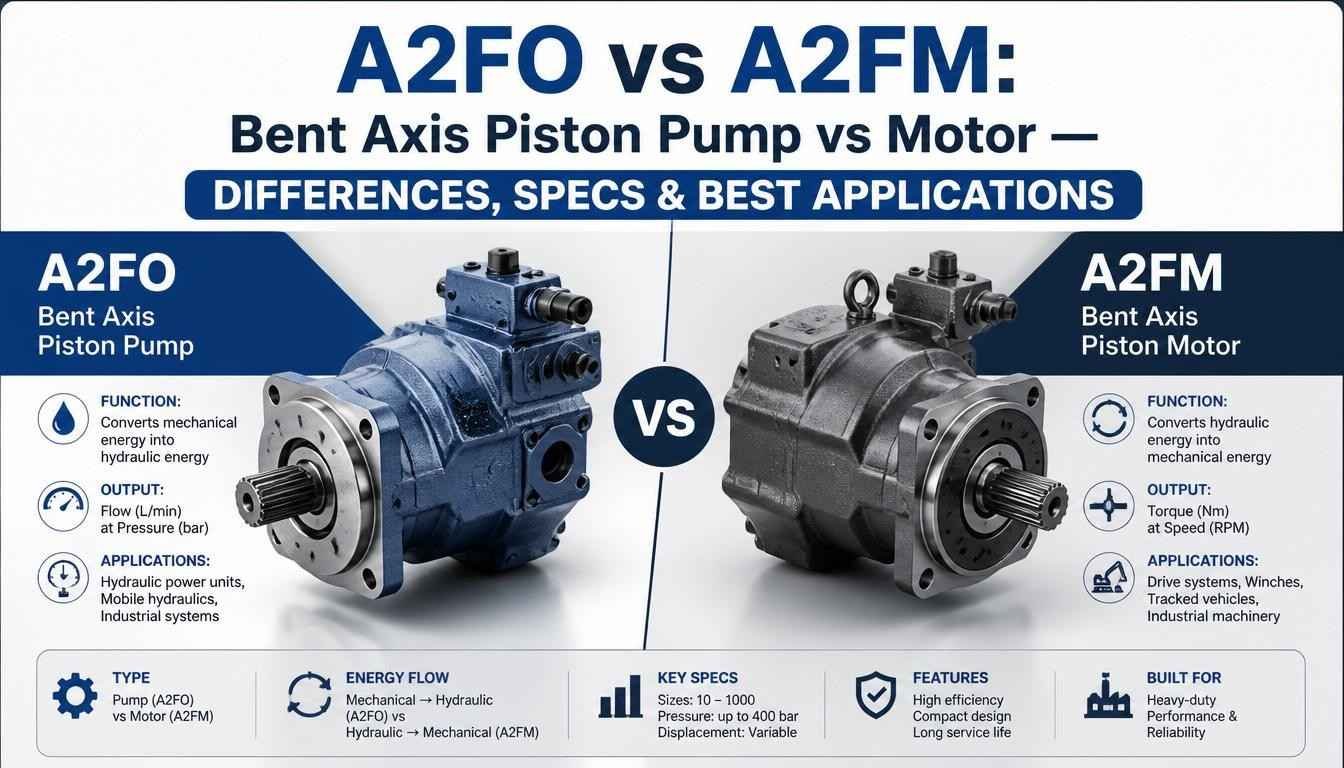
The A2FO bent axis piston pump USA is a fixed displacement axial piston pump designed using a bent-axis configuration. It converts mechanical energy supplied by an electric motor or diesel engine into hydraulic energy by generating fluid flow under pressure.
Unlike variable displacement pumps, the A2FO delivers a fixed volume of hydraulic fluid during every shaft revolution. This makes it suitable for hydraulic systems where constant flow is required.
Its bent-axis design positions the cylinder block at an angle to the drive shaft, allowing the pistons to operate efficiently with high mechanical efficiency and reduced internal friction.
The bent axis piston pump is commonly used in:
- Construction equipment
- Industrial machinery
- Agricultural equipment
- Mining machinery
- Marine hydraulic systems
- Material handling equipment
- Hydraulic power units
Its simple design, compact dimensions, and ability to operate at high pressures make it a popular choice for demanding hydraulic applications.
What Is an A2FM Bent Axis Piston Motor?
The A2FM bent axis piston motor USA shares a similar internal construction but performs the opposite function.
Instead of generating hydraulic flow, the motor converts hydraulic energy into rotary mechanical motion.
Pressurised hydraulic fluid enters the motor, causing the pistons to act on the bent-axis mechanism and rotate the output shaft. This mechanical output powers wheels, winches, conveyors, drilling equipment, and other hydraulic-driven machinery.
A2FM motors are widely used because they offer:
- High starting torque
- Excellent mechanical efficiency
- Compact installation
- Reliable continuous operation
- High-speed capability
They are commonly found in both industrial and mobile hydraulic systems where dependable rotary motion is required.
How Bent Axis Technology Works
Both A2FO pumps and A2FM motors use the same bent-axis operating principle.
The cylinder block is positioned at an angle to the drive shaft rather than being parallel, as seen in swash plate designs.
During operation:
- The pistons move within the rotating cylinder block.
- Their angled arrangement creates reciprocating motion.
- In a pump, this motion draws in hydraulic oil before forcing it into the system.
- In a motor, pressurised hydraulic oil drives the pistons, producing rotational output at the shaft.
This bent-axis arrangement provides several advantages:
- High volumetric efficiency
- Reduced internal friction
- Excellent starting characteristics
- High-speed operation
- Reliable performance under heavy loads
Because of these characteristics, bent-axis technology remains widely used in demanding hydraulic applications.
A2FO Pump vs A2FM Motor: Key Differences
Although these components look similar, they serve different purposes within a hydraulic system.
| Feature | A2FO Bent Axis Pump | A2FM Bent Axis Motor |
| Primary Function | Converts mechanical energy into hydraulic energy | Converts hydraulic energy into mechanical energy |
| Hydraulic Circuit Role | Supplies hydraulic flow | Produces rotary motion |
| Displacement | Fixed | Fixed |
| Energy Conversion | Mechanical → Hydraulic | Hydraulic → Mechanical |
| Typical Applications | Hydraulic power units, mobile machinery | Wheel drives, winches, conveyors, cranes |
| Output | Hydraulic flow | Mechanical torque and rotation |
Selecting the correct component depends entirely on whether your system requires hydraulic power generation or hydraulic-driven motion.
Typical Technical Specifications
Although specifications vary between manufacturers and model sizes, A2FO pumps and A2FM motors typically operate within similar performance ranges.
| Specification | Typical Range |
| Design | Bent-axis axial piston |
| Displacement Range | Approximately 10–250 cc/rev |
| Continuous Operating Pressure | Up to 350 bar |
| Peak Pressure | Up to 400 bar |
| Rotation | Bi-directional (model dependent) |
| Mounting | SAE flange |
| Shaft Options | Splined, keyed |
| Hydraulic Fluid | Mineral hydraulic oil and compatible fluids |
Always confirm the exact specifications for the selected model before installation.
Advantages of Bent Axis Hydraulic Components
Bent-axis designs continue to be used across many industries because they combine efficiency with durability.
Key benefits include:
High Mechanical Efficiency
The bent-axis configuration reduces internal friction, allowing more input power to be converted into useful hydraulic or mechanical output.
High Operating Pressure
Both A2FO pumps and A2FM motors are suitable for demanding hydraulic systems operating at high pressures.
Compact Design
Their high power density allows more hydraulic performance within a relatively small installation space.
Reliable Continuous Operation
When properly maintained, bent-axis hydraulic units provide dependable performance in heavy-duty industrial and mobile applications.
Long Service Life
Good lubrication, efficient internal geometry, and robust construction contribute to extended operating life.
How to Choose Between an A2FO Pump and an A2FM Motor
Although the A2FO pump and A2FM motor share a similar bent-axis design, they perform different functions within a hydraulic system. Selecting the correct component depends on the role it will play in the hydraulic circuit.
Choose an A2FO bent axis piston pump USA when your system needs to generate hydraulic flow from mechanical power.
Choose an A2FM bent axis piston motor USA when hydraulic pressure is already available and needs to be converted into rotary mechanical motion.
The table below provides a quick comparison.
| If You Need To… | Recommended Component |
| Generate hydraulic flow | A2FO Pump |
| Drive wheels or tracks | A2FM Motor |
| Power a hydraulic power unit | A2FO Pump |
| Rotate conveyors or winches | A2FM Motor |
| Supply oil to hydraulic cylinders | A2FO Pump |
| Produce hydraulic-driven rotary motion | A2FM Motor |
Understanding this distinction helps avoid costly specification errors during equipment selection.
How to Size a Bent Axis Piston Pump or Motor
Correct sizing is essential for achieving efficient hydraulic performance. An oversized unit can waste energy, while an undersized one may reduce machine productivity.
When selecting either a bent axis piston pump or motor, consider the following factors:
- Required flow rate
- Operating pressure
- Shaft speed
- Required torque (for motors)
- Duty cycle
- Hydraulic circuit design
Pump Sizing
Pump flow can be estimated using the following equation:
Flow (L/min) = Displacement (cc/rev) × Speed (RPM) ÷ 1000
Example:
Required flow = 150 L/min
Drive speed = 1500 RPM
Required displacement:
150 × 1000 ÷ 1500 = 100 cc/rev
Selecting a displacement close to this value helps achieve the desired hydraulic flow.
Motor Sizing
Motor selection focuses on torque and speed rather than flow alone.
Key considerations include:
- Required output torque
- Desired rotational speed
- Available hydraulic pressure
- System efficiency
Matching these values ensures smooth machine operation without overloading the hydraulic system.
Common Industrial Applications
Both A2FO pumps and A2FM motors are used across a wide range of industries in the USA due to their ability to operate under demanding conditions.
Construction Equipment
Typical applications include:
- Excavators
- Loaders
- Cranes
- Pavers
- Drilling rigs
Pumps generate hydraulic power, while motors drive tracks, wheels, and rotating attachments.
Mining Machinery
Bent-axis hydraulic components are commonly used for:
- Underground vehicles
- Crushers
- Conveyor drives
- Hydraulic drills
- Material handling equipment
Their high-pressure capability makes them suitable for heavy-duty mining operations.
Agriculture
Modern agricultural equipment relies on hydraulic systems for:
- Tractors
- Harvesters
- Sprayers
- Forestry equipment
Reliable hydraulic performance helps improve productivity across changing operating conditions.
Marine Applications
Marine hydraulic systems often use bent-axis pumps and motors for:
- Deck cranes
- Winches
- Steering systems
- Anchor handling equipment
Their compact design and high efficiency make them well suited to space-constrained installations.
Industrial Manufacturing
Factories use these hydraulic components in:
- Hydraulic power units
- Press systems
- Conveyor drives
- Automated production equipment
- Material handling systems
Their ability to operate continuously under high loads supports demanding manufacturing environments.
Maintenance Best Practices
Routine maintenance helps maximise equipment life and minimise unexpected downtime.
Maintain Hydraulic Oil Cleanliness
Contaminated hydraulic oil accelerates wear on pistons, bearings, and valve plates.
Replace filters according to the maintenance schedule and monitor oil cleanliness regularly.
Inspect Hydraulic Fluid
Regularly check hydraulic oil for:
- Contamination
- Water ingress
- Oxidation
- Changes in viscosity
Replacing degraded fluid helps maintain pump and motor efficiency.
Monitor Operating Temperature
High operating temperatures can shorten component life.
If excessive heat develops, inspect:
- Cooling systems
- Hydraulic filters
- Relief valve settings
- Oil viscosity
- System pressure
Check for Leaks
Inspect:
- Shaft seals
- Hydraulic hoses
- Flanges
- Port connections
Repairing leaks promptly helps maintain system pressure and reduces contamination risks.
Listen for Unusual Noise
Abnormal operating sounds may indicate:
- Cavitation
- Bearing wear
- Air entering the hydraulic circuit
- Low oil levels
- Internal component damage
Early diagnosis can prevent expensive repairs and unplanned downtime.
Buying Considerations in the USA
When comparing suppliers of hydraulic pumps USA and hydraulic motors USA, consider more than the purchase price.
A reliable supplier should provide:
- Consistent product quality
- Technical support
- Spare parts availability
- Product documentation
- Warranty coverage
- After-sales service
- Reliable delivery times
Also confirm that the selected component matches your system’s mounting configuration, shaft type, displacement, pressure rating, and hydraulic circuit requirements before placing an order.
Manufacturers that provide detailed technical documentation and responsive customer support often help reduce installation issues and simplify long-term maintenance.
Why Bent Axis Hydraulic Components Remain a Reliable Choice
The A2FO bent axis piston pump USA and A2FM bent axis piston motor USA continue to be trusted across industries because they combine compact construction, high-pressure capability, and excellent mechanical efficiency.
While the A2FO pump is designed to generate hydraulic flow, the A2FM motor converts hydraulic energy into rotary motion, making each component essential for different stages of a hydraulic system. Understanding these functional differences helps engineers and buyers select the right equipment for their specific application.
Whether you’re sourcing hydraulic pumps USA for industrial machinery or hydraulic motors USA for mobile equipment, selecting the correct displacement, operating pressure, and mounting configuration will improve system efficiency, reduce maintenance requirements, and support reliable long-term performance.
Frequently Asked Questions
Are A2FO pumps and A2FM motors interchangeable?
No. Although they share a similar bent-axis design, they perform different functions within a hydraulic system and cannot be used interchangeably.
What industries commonly use bent-axis piston pumps and motors?
They are widely used in construction, mining, agriculture, marine, material handling, forestry, and industrial manufacturing applications where high-pressure hydraulic performance is required.
What pressure can A2FO and A2FM units handle?
Most bent-axis piston pumps and motors operate continuously at pressures up to approximately 350 bar, with peak pressures reaching around 400 bar, depending on the manufacturer and model.
How do I choose the correct bent-axis hydraulic component?
Selection depends on whether your application requires hydraulic flow generation or rotary mechanical output. You should also consider displacement, operating pressure, shaft configuration, mounting dimensions, and system requirements.
What maintenance is required for bent-axis piston pumps and motors?
Routine maintenance includes monitoring hydraulic oil quality, replacing filters, inspecting seals and fittings, checking operating temperatures, and maintaining proper system cleanliness to maximise service life and minimise downtime.