One of the important components of a modern hydraulic system is a proportional flow control valve where precision, versatility and smooth control are needed. In contrast to conventional on/off valves, proportional valves enable the flow and pressure to be adjusted precisely depending on electrical input signals. This renders them necessary in the industrial fields, which require constant performance and accuracy.
Since automation, heavy machinery, etc. The industrial proportional valves are highly applicable to enhance efficiency, decrease energy usage, and enhance system control. With the development of technology, the need to have electro hydraulic proportional valve solutions on different industries is ever increasing.
What Makes Proportional Valves So Important?
Proportional valves are made to offer variable control and not fixed output. This enables systems to work well and respond appropriately to the changing environment.
Key Benefits:
- Constant and flow control of flow and pressure.
- Improved system efficiency
- Reduced energy consumption
- Increased precision in operations.
- Longer equipment life
The principle of proportional valve working is to adjust the spool position based on an electrical signal, to achieve accurate control of the hydraulic flow.
How Proportional Valves Work in Real Applications
An electrical signal is sent to a hydraulic proportional valve by a controller. The flow rate or pressure is controlled by this signal changing the valve opening.
Working Process:
- The valve is provided with electrical signal.
- Position of the spool is varied proportionally.
- Flow or pressure is regulated accurately.
- Feedback assures uniformity in performance.
Due to this, proportional control valves are best suited in the event of smooth and precise motion.
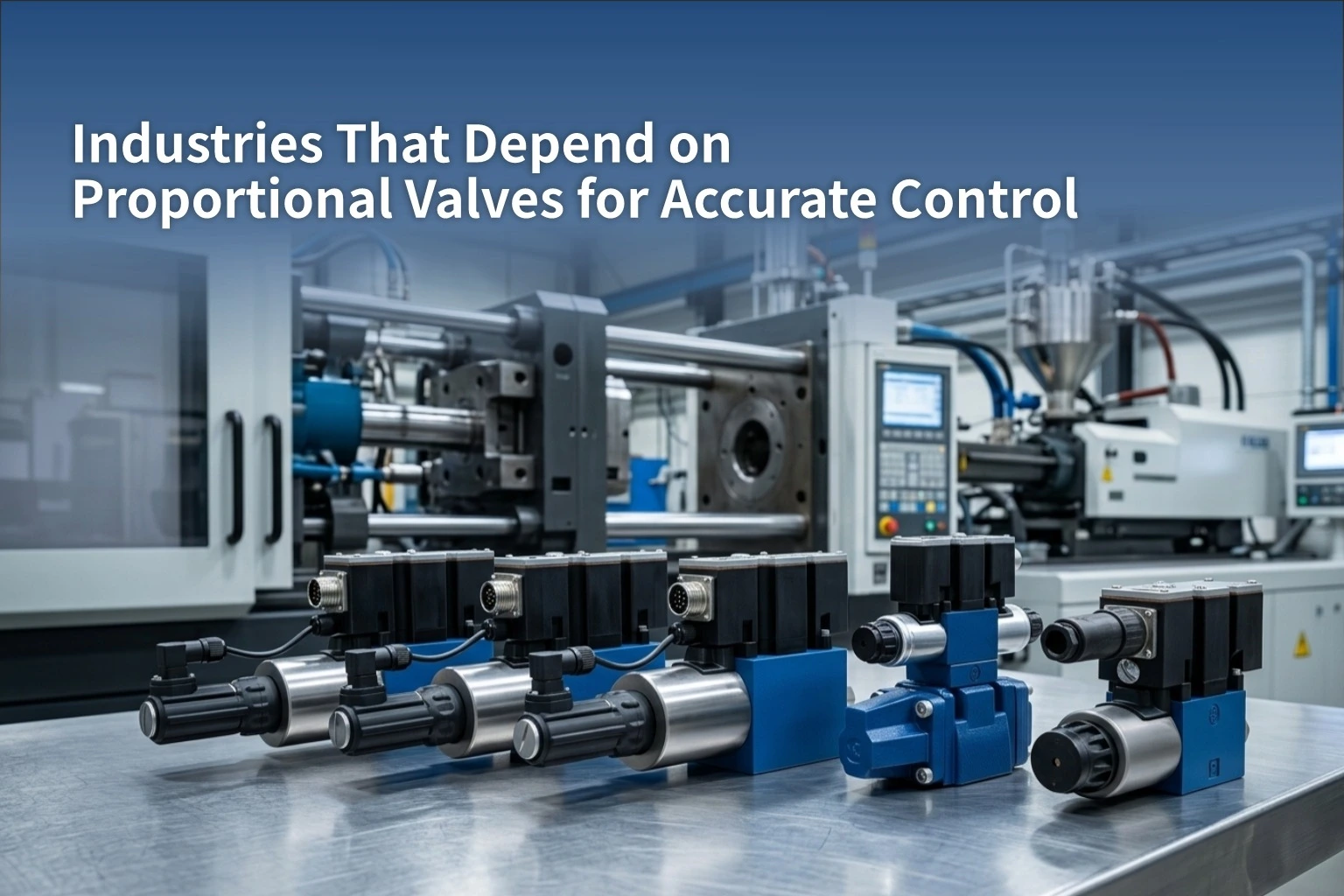
Industries That Rely on Proportional Valves
Numerous industries require the use of proportional valves because of their accuracy and regulation.
1. Manufacturing Industry
Precision and repeatability are important in manufacturing.
- Applications
- CNC machines
- Injection molding machines
- Assembly lines
- Press machines
Proportional pressure control valve maintains the same force and speed throughout production.
2. Construction and Heavy Equipment.
The heavy machinery should be moved within a controlled movement under different loads.
Uses:
- Excavators and loaders
- Lifting equipment and cranes.
- Hydraulic arms
A hydraulic proportional valve assists in the smooth operation and accurate control in harsh conditions.
3. Automotive Industry
In automotive manufacturing, automation and precision play an important role.
Applications:
- Robotic welding systems
- Painting systems
- Testing equipment
Proportional valves used in industries contribute to the production of constant results and increase the quality of production.
4. Aerospace Industry
There is no room to compromise on some minor mistakes in the field of aerospace.
Applications:
- Flight control systems
- Testing equipment
- Hydraulic actuators
A proportional valve that is electro hydraulic in nature provides an accurate and reliable system in critical systems.
5. Plastic and Injection Molding Industry
High quality plastic components require precision control in their production.
Applications:
- Injection molding machines
- Blow molding systems
- Extrusion machines
A proportional flow control valve is used to maintain a steady flow and pressure to enhance the quality of the products.
Why Accuracy Matters in Industrial Systems
The accuracy directly influences productivity and quality.
Importance of Precision:
- Reduces material waste
- Improves product consistency
- Enhances machine efficiency
- Minimizes operational errors
Due to these benefits, proportional control valves are extensively employed in contemporary automation systems.
Guidelines to Selecting the appropriate Proportional Valve
The right valve choice is relevant to the system performance.
Important Tips:
1. Understand Application Needs
There are various types of valves that are needed in different applications.
2. Check Flow and Pressure Requirements.
Make sure that the valve is capable of dealing with system requirements.
3. Consider Control Type
Select flow or pressure control valves.
4. Evaluate System Compatibility
The valve must be easily integrated with the existing systems.
5. Concentrate on Quality and Reliability.
Select reliable manufacturers to perform in the long run.
Common Challenges and How to Avoid Them
Even sophisticated systems may have a problem unless they are well maintained.
Common Problems:
- Incorrect valve selection
- Poor calibration
- Contaminated hydraulic fluid
- Electrical signal issues
Prevention Tips:
- Regular maintenance
- Proper system setup
- Clean hydraulic oil
- Periodic inspection
Such measures guarantee a smooth running of industrial proportional valves.
Conclusion
A Proportional flow control valve is not merely a part but a very important part in the attainment of accuracy and efficiency in the present-day industrial systems. These valves can be used in manufacturing to aerospace to allow easy control, high performance, and dependability.
With industries becoming more and more automated and technologically advanced, proportional valves will continue to gain importance. The selection of appropriate valve and its proper maintenance guarantees long-term success and the best functioning of the system.
THM Huade offers proportional valve technologies that are industry leaders to achieve trusted and high performance solutions.
Upgrade your system to have the latest proportional valve solutions and enjoy better control and efficiency. Call now.
FAQ’s
Q1. What is the difference between proportional valves and servo valves?
Proportional valves provide smooth flow and pressure control, but servo valves have extremely fine control and quick response for fine-tuning applications.
Q2. Where are proportional valves used in the manufacturing industry?
Proportional valves are used in CNC machining, injection molding, assembly and presses for precise and gentle speed and pressure control.
Q3. Can proportional valves be used in construction equipment?
Yes, they are commonly used in loaders, excavators and cranes for accurate control of the hydraulics for different loads.
Q4. How do proportional valves control pressure and flow?
The electrical current controls the opening of the valve to enable the control of flow and pressure.
5. How do proportional valves control pressure and flow?
Considerations include flow rate, pressure, response speed, compatibility and use.