Specifying the wrong pump frame is one of the most expensive avoidable errors in a hydraulic build. Choose a frame too small and the system starves under load. Choose one too large and you carry dead weight, waste energy, and pay for displacement you never use. When a single pump family spans several frame sizes, as the THM internal gear pump IGP1, IGP2, and IGP3 range does, the decision reduces to one question answered with real numbers: which frame’s displacement and pressure rating match the actual demand of the application.
This guide compares the three frames directly using THM Huade’s published data. The IGP series runs from 0.8 cc/rev at the small end of the IGP1 up to 16 cc/rev at the top of the IGP3, all rated for high-pressure operation and speeds up to 3000 rpm. The three frames share the same internal gear operating principle and differ mainly in displacement range and physical size, which is exactly what makes the selection between them straightforward once the figures are in front of you.
Before the comparison, one point about how to read it. An internal gear pump is defined first by its displacement, the volume of fluid it moves per revolution, and second by its maximum working pressure. Flow follows from displacement multiplied by drive speed. Almost every selection decision in this guide traces back to those two numbers, so keep them in view as you work through the tables.
What the THM IGP Series Is and How It Works
The THM IGP series is a range of high-pressure internal gear pumps built for applications that need steady flow, high efficiency, and a compact footprint. An internal gear pump uses an outer ring gear with internal teeth meshing with an inner drive gear. As the gears rotate and separate, they draw fluid in. As they mesh again, they force it out under pressure. The geometry produces smooth, low-pulsation flow, which is why the design suits precision and metering work where flow consistency matters.
The THM range carries several features that shape where it fits. The pumps use sealing gap compensation, which maintains efficiency and keeps operating noise low across a wide speed range. They are fixed displacement, so each model delivers a set volume per revolution. The series is rated for high efficiency even at low speed and viscosity, and it can run up to 3000 rpm. That combination of low pulsation, quiet running, and a broad speed range is what positions the IGP series for demanding hydraulic systems rather than general-purpose duty.
The three frame sizes exist to cover different flow bands within that same design, so the next step is to look at each frame’s numbers.
Internal Gear Pump IGP1 Specifications
The internal gear pump IGP1 is the smallest frame in the range. It suits compact power units, smaller machine tools, lubrication circuits, and any application where space is tight and flow demand is modest. The IGP1 covers the lowest displacement band in the series.
The IGP1 is available in five displacement sizes, identified by the number in the model code, which is the displacement in cubic centimetres per revolution.
| IGP1 Model | Displacement (cc/rev) | Max Pressure (bar) | Max Speed (rpm) |
| IGP1-08-01T/R-VPC | 0.8 | Up to 300 (series rating) | Up to 3000 |
| IGP1-10-01T/R-VPC | 1.0 | Up to 300 (series rating) | Up to 3000 |
| IGP1-13-01T/R-VPC | 1.3 | Up to 300 (series rating) | Up to 3000 |
| IGP1-16-01T/R-VPC | 1.6 | Up to 300 (series rating) | Up to 3000 |
| IGP1-20-01T/R-VPC | 2.0 | Up to 300 (series rating) | Up to 3000 |
The IGP1 is the right starting point when the application needs stable, low-pulsation flow at a modest volume and the priority is a compact, quiet package rather than high output. Confirm the exact pressure rating for the specific size against the THM datasheet, since the 300 bar figure is the series maximum and individual sizes should be verified.
Internal Gear Pump IGP2 Specifications
The internal gear pump IGP2 is the mid-range frame. It carries a broader displacement band and higher flow than the IGP1 while staying more compact than the IGP3. For general industrial hydraulics with moderate flow demand, the IGP2 is often the default choice.
The IGP2 is available in five displacement sizes.
| IGP2 Model | Displacement (cc/rev) | Max Pressure (bar) | Max Speed (rpm) |
| IGP2-25-01T/R-VPC | 2.5 | Up to 300 (series rating) | Up to 3000 |
| IGP2-32-01T/R-VPC | 3.2 | Up to 300 (series rating) | Up to 3000 |
| IGP2-40-01T/R-VPC | 4.0 | Up to 300 (series rating) | Up to 3000 |
| IGP2-50-01T/R-VPC | 5.0 | Up to 300 (series rating) | Up to 3000 |
| IGP2-63-01T/R-VPC | 6.3 | Up to 300 (series rating) | Up to 3000 |
The internal gear pump IGP2 is the frame engineers reach for when the IGP1 is near its ceiling but the full capacity of the IGP3 is not needed. When demand sits in the middle of the range, sizing to the IGP2 usually gives the best balance of output, efficiency, and physical footprint.
Internal Gear Pump IGP3 Specifications
The internal gear pump IGP3 is the largest frame, built for higher flow applications such as larger presses, industrial power units, and systems with significant actuator volume. It carries the widest displacement band and the highest output in the group.
The IGP3 is available in four displacement sizes.
| IGP3 Model | Displacement (cc/rev) | Max Pressure (bar) | Max Speed (rpm) |
| IGP3-80-01T/R-VPC | 8.0 | Up to 300 (series rating) | Up to 3000 |
| IGP3-100-01T/R-VPC | 10.0 | Up to 300 (series rating) | Up to 3000 |
| IGP3-125-01T/R-VPC | 12.5 | Up to 300 (series rating) | Up to 3000 |
| IGP3-160-01T/R-VPC | 16.0 | Up to 300 (series rating) | Up to 3000 |
When an application needs high flow and a smaller frame would have to run continuously at the top of its speed range, the internal gear pump IGP3 is the correct choice. Running any pump constantly at maximum speed shortens its life, so stepping up to the IGP3 to gain headroom is usually the better long-term decision.
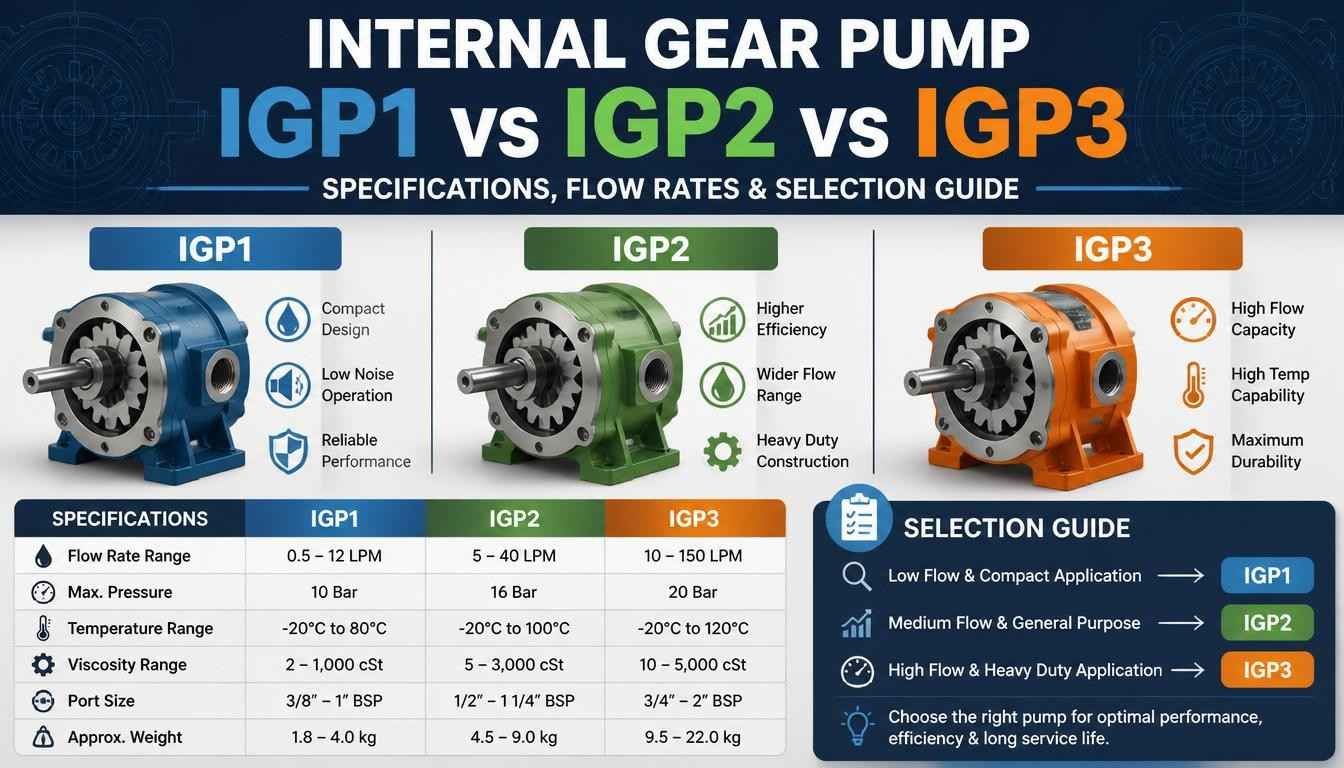
IGP1 vs IGP2 vs IGP3: Side-by-Side Comparison
With each frame’s figures set out, the three are easiest to weigh in a single view. The table below places the key selection factors side by side.
| Factor | IGP1 | IGP2 | IGP3 |
| Displacement range (cc/rev) | 0.8 to 2.0 | 2.5 to 6.3 | 8.0 to 16.0 |
| Number of sizes | 5 | 5 | 4 |
| Max pressure (series) | Up to 300 bar | Up to 300 bar | Up to 300 bar |
| Max speed | Up to 3000 rpm | Up to 3000 rpm | Up to 3000 rpm |
| Relative size | Smallest | Medium | Largest |
| Typical use | Compact power units, lubrication | General industrial | High-flow systems, presses |
The pattern is clean. Moving from IGP1 to IGP3, displacement rises roughly by an order of magnitude across the full range, from 0.8 cc/rev to 16 cc/rev, while the physical package grows to match. The pressure ceiling and maximum speed are shared series characteristics. That means the selection between frames is driven almost entirely by required flow, since pressure and speed capability are broadly common across the range.
Calculated Flow Rates at 1500 rpm
Displacement only becomes useful once you translate it into flow at your drive speed. The figures below are calculated from THM’s published displacements using the standard formula, not read from a datasheet, so treat them as theoretical output before efficiency losses and confirm against THM’s rated figures for your exact speed.
The formula is:
Flow (L/min) = Displacement (cc/rev) × Speed (rpm) ÷ 1000
At a common 1500 rpm drive speed, the theoretical flow across the range works out as follows.
| Model | Displacement (cc/rev) | Theoretical Flow at 1500 rpm (L/min) |
| IGP1-08 | 0.8 | 1.2 |
| IGP1-20 | 2.0 | 3.0 |
| IGP2-25 | 2.5 | 3.75 |
| IGP2-63 | 6.3 | 9.45 |
| IGP3-80 | 8.0 | 12.0 |
| IGP3-160 | 16.0 | 24.0 |
Real delivered flow is slightly lower than these figures because of internal leakage, accounted for by volumetric efficiency, which is high for a well-maintained internal gear pump. The point of the table is the span: the range covers roughly 1 to 24 L/min at 1500 rpm, and at the pump’s maximum 3000 rpm those figures double. That is why drive speed is as important as frame choice, since the same pump delivers very different flow depending on how fast you turn it.
How to Select the Right IGP Frame
Choosing between IGP1, IGP2, and IGP3 comes down to a short sequence answered in order. The logic moves from flow, to pressure, to duty cycle and space.
Start with required flow. Calculate the flow your application needs at your available drive speed, then find the smallest frame that delivers it without running continuously at 3000 rpm. Leaving speed headroom above the operating point extends pump life and gives you margin.
Then check pressure. The series is rated up to 300 bar, so confirm your system’s operating pressure sits comfortably below that with margin for spikes, and verify the specific size’s rating on the datasheet rather than assuming every size hits the series maximum.
Then weigh duty cycle and space. A pump running continuously benefits from more headroom than one running intermittently, and a tight installation may push you toward a smaller frame even when a larger one offers more margin.
The selection factors in priority order are:
- Required flow at your actual drive speed, which sets the minimum frame.
- System pressure plus margin, which must stay within the frame’s rating.
- Duty cycle, since continuous running rewards more headroom.
- Physical space and mounting constraints.
- Noise and pulsation needs, where the internal gear design already performs well.
A supplier who understands the application confirms the choice rather than simply quoting the size requested. Technical manufacturers increasingly use content platforms like Rankfast to keep their product documentation and specifications current alongside their catalogs, which helps engineers reach accurate selection data when they research pumps before requesting a quote. For the full IGP series specifications and the option of single or double pump configurations, see the THM IGP product page and the internal gear pump category.
Single and Double Pump Configurations
One option that widens the selection beyond a single frame is the double pump. THM offers the IGP series in double pump configurations that combine two frames in different size pairings, and the double pump arrangement carries a peak pressure option up to 350 bar, higher than the 300 bar single pump rating.
A double pump suits systems that need two separate flow circuits from one drive, or a high-low flow arrangement where a large displacement handles rapid actuator movement and a smaller displacement takes over for the high-pressure phase. This is common on presses, where a fast approach needs high flow and the pressing phase needs high pressure at low flow. Rather than oversizing a single pump, a double pump matched to both demands can be more efficient. The DIGP double internal gear pump range covers these pairings, and the right combination depends on the two flow and pressure points your cycle requires.
Common Selection Mistakes to Avoid
A few recurring errors cause most mis-specified pumps in the field, and naming them makes them easy to avoid.
The first is sizing to peak flow while ignoring drive speed. THM’s rated flow depends on rpm, so a frame that looks adequate at 3000 rpm may fall short if your drive runs at 1500 rpm. Always calculate flow at your actual speed.
The second is running a frame at maximum speed continuously to hit a target flow. If you need 3000 rpm just to reach your required output, step up a frame. Continuous operation at maximum speed accelerates wear.
The third is ignoring pressure margin. The series rates up to 300 bar, but selecting a size whose operating pressure sits right at the ceiling leaves nothing for spikes. Confirm the specific size’s rating and keep margin above your system pressure.
Avoiding these three mistakes resolves the large majority of selection problems before a pump ever reaches the field.
Selecting With Confidence
The choice between IGP1, IGP2, and IGP3 is not complicated once the real numbers are in front of you. Calculate your required flow at your actual drive speed, find the smallest frame that delivers it without running flat out at 3000 rpm, confirm the pressure rating with margin below 300 bar, and account for duty cycle and installation space. The internal gear pump IGP1 covers compact low-flow needs from 0.8 to 2.0 cc/rev, the IGP2 serves the broad middle from 2.5 to 6.3 cc/rev, and the IGP3 handles high-flow demand from 8.0 to 16.0 cc/rev.
Before finalising a specification, request the current THM datasheet and confirm the exact pressure rating and rated flow for your chosen size and speed, since these are the numbers your selection rests on. If your operating point sits close to the boundary between two frames, or if your cycle has separate high-flow and high-pressure phases, ask THM’s engineering team whether a single frame or a double pump pairing fits your duty cycle better.
Frequently Asked Questions
How Do I Calculate the Flow Rate of an IGP Pump?
Multiply the displacement in cc/rev by the drive speed in rpm, then divide by 1000 to get theoretical flow in litres per minute. For example, an IGP2-40 at 4.0 cc/rev running at 1500 rpm produces about 6 L/min before efficiency losses. Because the THM series runs up to 3000 rpm, the same pump delivers roughly double that flow at maximum speed, so always calculate for your actual drive speed.
What Is the Maximum Pressure of the THM IGP Series?
The THM IGP single pump series is rated for maximum pressure up to 300 bar. The double pump configurations carry a peak pressure option up to 350 bar. Confirm the exact rating for your specific frame and size against the THM datasheet, since the headline figure is the series maximum rather than a guarantee for every size.
Which IGP Frame Is Best for a Press or High-Flow System?
The internal gear pump IGP3, covering 8.0 to 16.0 cc/rev, is the frame built for presses and high-flow industrial systems. For presses that need high flow on approach and high pressure at low flow during pressing, a DIGP double pump pairing can be more efficient than a single oversized frame, since each stage of the cycle is matched to its own displacement.
Can THM IGP Pumps Be Supplied Outside India?
Yes. THM Huade is based in Ludhiana, India, and supplies its internal gear pump range to a global customer base, including a partner office in Australia. For a hydraulic gear pump usa and other regional buyers can source, contact THM directly to confirm availability, lead times, and specifications for the region.
What Applications Suit the THM IGP Series?
The THM IGP series suits hydraulics, injection moulding machines in the plastics industry, lubrication systems needing accurate oil supply, and food and beverage applications where clean, low-pulsation fluid movement matters. The low-pulsation, quiet-running design makes it a strong fit for precision and metering work across these sectors.