In the automation of the modern world, an industrial servo motor is used when machines require high precision and control in movement, speed, and performance. A servo motor is unlike a typical motor that may primarily concentrate on constant rotation, but it is a component of a feedback control mechanism. It is able to react to the dynamic machine demands and assist in managing position, speed and torque with high precision. Servo technology is applicable in CNC machines, robotics, packaging, plastic machinery and other automated production systems.
In the automation of the modern world, an industrial servo motor is used when machines require high precision and control in movement, speed, and performance. A servo motor is unlike a typical motor that may primarily concentrate on constant rotation, but it is a component of a feedback control mechanism. It is able to react to the dynamic machine demands and assist in managing position, speed and torque with high precision. Servo technology is applicable in CNC machines, robotics, packaging, plastic machinery and other automated production systems.
What is a Servo Motor?
A servo motor is meant to move under control and not a continuous rotation. It has a common operation with a servo drive, feedback device, and controller. The feedback mechanism measures the real movement of the motor and feeds back the information to the control system. When the actual position or speed is not equal to the needed value the controller can make adjustments.
One of the primary reasons that servo motors are applied in precision machinery is this closed-loop operation. The system can also react to the changes in the load and movement requirements in the process of operation instead of letting the motor run without constant feedback.
What is the Working Principle of a Servo motor?
A controller sends a movement command to the servo drive and the working process begins. This command is translated into electrical output needed by the motor by the drive. The motor moves and is monitored by an encoder or other feedback device to track the position and speed.
The controller sends the feedback information back to the controller where the system compares the actual movement and the desired movement. In case of a difference, the motor response can be modified by the controller and drive. This is an ongoing procedure that assists in attaining precise positioning and steady movement.
Due to this reason, a servo motor is frequently chosen when a machine requires repeatability in movement as opposed to merely turning at a constant speed.
Why Are Servo Motors Important in Industrial Automation?
Contemporary production devices usually make various movements in a brief time. A machine can be required to accelerate rapidly, come to a certain position, switch speed, and repeat this thousands of times.
The characteristics of servo motors are much better adapted to such environments since they can give controlled speed and torque whilst retaining accuracy of positioning. Automated equipment can also respond fast to the frequent changes in motion, which is possible due to their fast response.
Controlled servo motion can be of special value in applications where the precision of production is directly related to the quality of the product. It is able to support repeatable machine cycles and to minimize undesirable movement in positioning.
Precision and Motion Control
One of the largest benefits of servo technology is precision. The control system constantly receives feedback on the movement of the motor by an encoder that enables the system to correct it as it operates.
This is critical in CNC machining, robotics and automated assembly among others where a small error in positioning can have a significant effect on the final output. With a well-designed servo system, movement can be more precise than most traditional motor systems.
The degree of accuracy however depends on the entire system. The choice of motor, encoder resolution, servo drive settings, mechanical transmission, machine structure, and controller performance have an impact on the final outcome.
Servo Motor Selection for Industrial Machines
When choosing a servo motor, an individual should start by looking at the requirements of the machine. To take the correct decision, motor power is not sufficient to furnish information. The load must be considered, the speed demanded, the torque, acceleration, the positioning accuracy and the operating cycle.
As an illustration, a machine that accelerates a heavy load may have a high peak torque during acceleration. Another application can be slower but with sustained torque over a longer time.
The size of the servo motor should hence be based on the constant and peak operating conditions. The load and motor inertia are also significant since a high variation between the two may influence the dynamic response of the system.
Mechanical setup is also to be checked. Gearboxes, belts, screws, couplings and other transmission elements affect the torque and speed to final load. The right size of the motor must fit comfortably in the real operating range of the machine and not just be chosen as a result of a simple rating of power.
Understanding Servo Motor Torque
Torque is the rotating force generated by the motor. The torque needed may vary during a machine cycle in automation equipment.
Necessary torque in acceleration can be more than that needed in steady operation because the motor is required to overcome the inertia of the load. Other factors that may increase the torque requirement are external forces, friction, mechanical losses and transmission efficiency.
In the case of machine equipment with high demands, a high torque servo motor might be needed to attain the required acceleration and movement. Instead of considering one specific specification, engineers ought to consider both rated torque and peak torque.
Proper choice of torque also prevents the case of the motor running at full capacity with a constant load. An appropriate operating margin will be able to sustain more stable performance and minimize the stress-inducing unnecessity in the system.
Modern Automation AC Servo Motors
AC servo motors are commonly found in modern industrial automation since they can offer controlled speed, torque, position when combined with a suitable servo drive and feedback system.
They are used in a variety of machinery that needs repetitive and precise movement. They can be used to move controlled axis by CNC equipment, and to provide synchronized feeding, cutting and positioning by packaging machines.
Robotics, printing machines, textile machines, plastic machine tools and automated assembly systems can also be supported using the same technology. The precise specification of the motor used depends on the load and motion profile of the respective machine.
Induction Motor vs Servo Motor
Induction motors and servo motors are used in different ways in industrial equipment.
Applications Pumps Fans Compressors Conveyors An induction motor is typically utilized in applications where continuous rotation is the main requirement like pumps, fans, compressors and conveyors. A servo motor will be more suitable when high accuracy, quick speed adjustment, regulated torque or where rapid acceleration and deceleration is the requirement.
It is not merely a disparity of which motor is stronger. The right decision will be determined by what the machine should do. A basic constant-speed application can be implemented with a servo system because it is not that complex, whereas a traditional motor can be used because the positioning precision is often very important thus restricting the performance of the machine.
Energy saving in Servo Systems
Energy efficiency has emerged as a critical factor to manufacturers who intend to cut down the cost of operation. Servo systems have the ability to vary the motor output in response to the movement and load demands instead of running at a constant level.
This may be especially valuable in machines that are controlled by a variable speed with repetitive positioning, high acceleration or deceleration. The motor output can be decreased in times of low demand by the system.
Real-world energy use is a function of a variety of factors, such as design of the machine, load profile, efficiency of the motor, design of the drive, operating cycle, and control strategy. Servo technology should thus be tested as an integrated machine and not on the basis of motor.
Connecting the Servo Motor to the Servo drive
The servo drive and the servo motor must be a matched system. It may cause compatibility or performance issues to choose a motor and then decide on the drive as a different decision.
The motor should have electrical and feedback needs that should be supported by the drive. Before installation, rated voltage, current, peak current, power rating, type of feedback, communication method, speed range, and control mode are to be checked.
The control and mechanical requirements are also important. The drive should be in a position to provide the necessary response in the acceleration, deceleration, positioning and altering loads.
An appropriately matched servo motor drive system can offer a smoother operation and predictable machine operation.
Common Industrial Applications
The servo motors find applications in various industries where precision and repeatability of movement is necessary. One of the key applications is CNC machining since the machine axes frequently require precision positioning and coordinated movement.
Servo technology is also used in robot equipment to provide movement control on multiple axes. In packaging machines, servo systems can coordinate feeding, sealing, cutting and positioning tasks.
Servo motors can also be used in plastic processing equipment, printing machines, textile machines, automated assembly lines, material-handling systems and precision manufacturing equipment when their motion needs are critical.
Not the name of the industry but the motion profile of the machine is the important factor. Applications with high frequency of positioning, adjustable speed, high acceleration, and high precision movements are usually good candidates of servo technology.
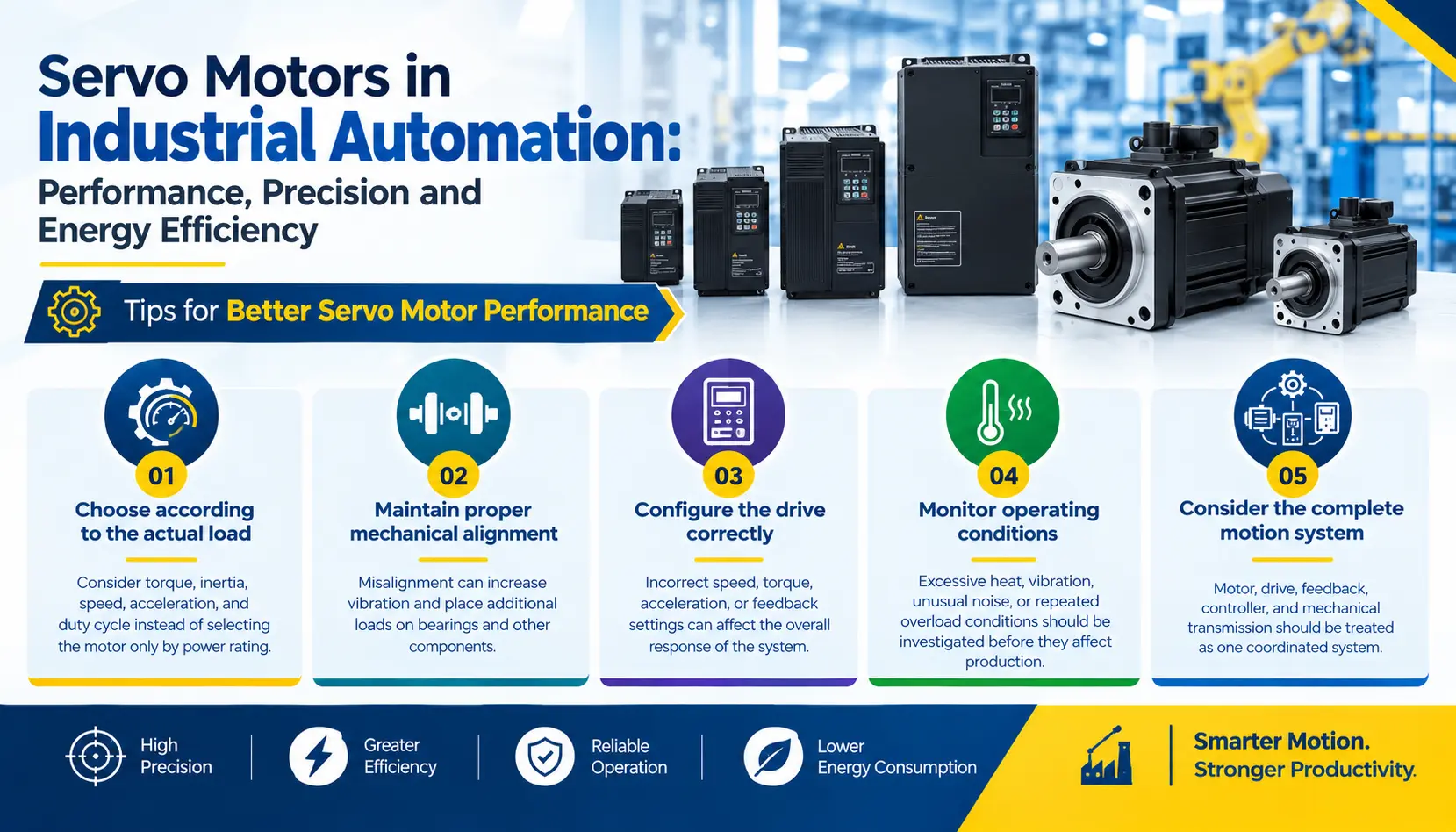
Tips for Better Servo Motor Performance
Select based on the real load: Select the motor not by power rating but by actual load, in terms of torque, inertia, speed, acceleration, and duty cycle.
Keep good mechanical balance: Improper mechanical alignment may contribute to vibration and introduce other loads to bearings and other elements.
Properly set up the drive: The wrong speed, torque, acceleration or feedback settings can influence the general reaction of the system.
Check on operating conditions: Overheating, vibration, abnormal noise and recurring overloaded conditions should be checked before they impact production.
Think of the entire motion system: Motor, drive, feedback, controller, and mechanical transmission are to be considered as a single system.
Important: Sizing a Servo Motor is not Solely about Power.
The biggest mistake is to choose a servo motor with the choice being dependent on the power demand of the machine. The reality is that the motor has to deal with the entire motion profile.
Final selection depends on the load inertia, the required torque, operating speed, acceleration and deceleration, duty cycle, gear ratio, positioning accuracy and mechanical transmission.
Adequate sizing may be used to ensure that the motor is used within a reasonable range and gives the necessary dynamic response instead of being over-sized.
Conclusion
Good automation does not mean to have a machine run faster. It is connected with the possibility to make all movements controlled, repeatable and appropriate to the production process. Servo technology can have a significant impact in this regard.
Ranging between CNC equipment and robotics, as well as packaging and plastic machinery, the appropriate servo system may facilitate the fine-tuning of motion and reaction to the varying conditions of operation. The motor cannot be viewed in isolation of the drive, feedback system, controller and mechanical load.
When you are thinking of a new automation project or need to replace an already used motor, THM Huade will be happy to assist you in discussing the appropriate servo motor options depending on the needs of your machine.
Enquire now with THM Huade for industrial servo motor solutions designed around your application.
Frequently Asked Questions
What is a servo motor used for?
A servo motor is employed in controlled movement where precision in speed, torque, or positioning is needed. Typical uses are CNC machines, robotics, packaging machinery, and automated manufacturing systems.
How do I select the right servo motor?
Begin with the assessment of the load, the torque needed, the operating speed, acceleration rate, the duty cycle of the machine, the positioning precision and the mechanical transmission. The servo drive and feedback system must also be compatible with the motor chosen.
How do I calculate servo motor torque?
The torque of servo motors varies with the load inertia, acceleration, friction, mechanical transmission and external load forces. The motor should be sized in both the continuous torque and peak torque.
What is the difference between a servo motor and an induction motor?
General-purpose continuous rotation may be done with an induction motor, whereas a servo motor is specified to have high-precision motion control with feedback. The correct selection will be based on the speed of the machine, its placement, torque and the control needs.
What are the reasons why servo motors are used in industrial automation?
Among the benefits of the servo motors are accurate positioning, speed control, responsive acceleration and precise torque control. These properties render them to be used in automated machines that require repetitive and synchronized motion.