Fixed displacement piston pumps give a fixed quantity of hydraulic fluid per revolution of the shaft and are used for applications where there is a need for a constant flow and high pressure. The choice of pump for the high priority mobile and industrial equipment can significantly affect pressure stability, efficiency, response time and system life. The bent-axis and axial piston types are especially useful in situations where the hydraulic power must be guaranteed under harsh operating conditions.
Engineers and maintenance personnel can select pumps with ease by understanding the displacement, pressure, and speed requirements, as well as the application. This guide provides a description of the operating principle, important advantages, applications and selection considerations of fixed displacement piston pump technology.
What is a Fixed Displacement Piston Pump?
A hydraulic pump that expels a known quantity of fluid per revolution is called a fixed displacement piston pump.
It is a fixed displacement pump, which means its displacement will not vary when running. The pump thus outputs the flow determined by the displacement and rotation rate.
The basic relationship is:
Flow is approximately proportional to the rotational speed of the pump and its displacement.
The actual output is also dependent on volumetric efficiency and conditions of operation.
Key characteristics include:
- Constant fluid displacement, per revolution
- High-pressure capability
- Strong mechanical construction
- High efficiency for appropriate operating conditions
- Reliable continuous operation
- Ideal for challenging hydraulic systems
- Also comes in bent and straight axes
The displacement isn’t variable, so the pump is effective in hydraulic systems where the flow demand is predictable.
How Does a Bent-Axis Piston Pump Work?
A bent axis piston pump is a type of piston pump that has a group of pistons housed in a rotating cylinder barrel. The cylinder cylinder barrel is at an angle to the drive shaft.
The pistons slide in the pistons’ bores, as the shaft is rotating. This reciprocating or oscillating action is necessary to develop the suction and discharge strokes for moving the hydraulic oil.
The operating cycle can be broken down into four steps:
- Rotation starts – cylinder assembly is driven by the rotation of the drive shaft.
- Pistons move to create suction – The pistons move to suck hydraulic oil into the cylinder chambers.
- Compression takes place – Because of the continued rotation, the pistons compress.
- Fluid is released – Pressurized oil is removed from the pump and put into the hydraulic system.
The bent-axis design provides a highly efficient way of transforming mechanical rotation into hydraulic flow.
Why are Axial Piston Pumps used for High Pressure?
Heavy equipment hydraulic systems frequently demand a great amount of pressure, with a consistent flow.
These can be achieved by an axial piston pump, which has multiple pistons working on the same hydraulic load. The design also makes it easy for manufacturers to produce pumps for high pressure and high speed applications.
It is crucial that the following performance factors are taken into account:
- Operating pressure
- Peak pressure
- Displacement
- Rotational speed
- Volumetric efficiency
- Mechanical efficiency
- Oil viscosity
- Temperature
- System load
If the pump is chosen properly, it will deliver a steady hydraulic power without oversizing.
Fixed vs Variable Displacement Pumps
The difference between Fixed and Variable Displacement pumps.
A very popular question when selection hydraulic equipment is if to decide for fixed or variable displacement.
| Feature | Fixed Displacement | Variable Displacement |
| Displacement | Constant | Adjustable |
| Flow control | Mainly through speed/system control | Can change through pump displacement |
| Construction | Generally simpler | More complex |
| Control requirements | Lower | Higher |
| Suitable applications | Constant-flow requirements | Variable-flow requirements |
| System flexibility | Moderate | High |
A fixed design might be a good option when the machine is needed to flow at a known rate.
If there are highly variable flow requirements throughout the operating cycle of the machine, a variable design might be more suitable.
Major Benefits of Fixed Displacement Piston Pumps
1. High-Pressure Capability
Piston pump technology is commonly employed in hydraulic systems where greater pressure is needed. This renders it ideal for work-intensive industrial and mobile machinery.
2. Consistent Flow
The fixed displacement provides predictable fluid delivery at a given rotational speed.
This may make hydraulic circuit design more straightforward if the application requires relatively constant flows.
3. Efficient Power Transfer
When sizing correctly, the piston pump can be used to efficiently convert mechanical energy into hydraulic energy.
Efficiency depends, however, on operating pressure, speed, temperature, fluid condition and proper system design.
4. Reliable Operation
When correctly installed, lubricated and filtered, piston pump designs are well suited to the demanding working environment of their construction.
This Scheme is Suitable for Mobile Hydraulics
When mobile hydraulic equipment needs hydraulic power, a reliable supply can be achieved with a fixed displacement piston pump.
Common equipment can consist of:
- Construction machinery
- Agricultural equipment
- Material-handling machines
- Mobile hydraulic systems
- Industrial machinery
Fixed Displacement Piston Pump Applications
Correct application is based on pressure, flow, speed, duty cycle and control.
Mobile Hydraulic Equipment
- Compact hydraulic components that are reliable when subject to variable working conditions are frequently needed on mobile machines.
- The piston pump technology may be used for lifting, steering and actuation functions in hydraulics.
Industrial Machinery
- Pumps in industrial hydraulic systems are used to provide pressurized oil to cylinders, motors and valves.
- A fixed-flow system can be effective when the hydraulic circuit’s demand is fairly constant.
Heavy-Duty Hydraulic Systems
- Components for high pressure hydraulic applications must be able to withstand severe loads.
- Heavy duty operations can be performed if a suitable piston pump is used to deliver the hydraulic power.
- Welding, cutting, and grinding equipment are used in welding, cutting, and grinding.
- In special machines, hydraulic power is also utilized for clamping, positioning and actuation.
- When designing a pump, the pump’s pressure, flow and operating cycle must be taken into account.
Hydraulic Pump Displacement: Why It Matters
One of the most critical specs to consider when choosing a pump is displacement.
It is a measure of the volume of fluid that is displaced per full turn.
For instance a higher displacement pump will have a higher flow rate at the same rotational speed as a lower displacement pump.
But “bigger is not necessarily “better.”
An oversized pump can cause to rise:
- Energy consumption
- Heat generation
- System cost
- Relief-valve losses
- Unnecessary flow
Always work out the flow and pressure before choosing the displacement.
The basics are:
- Flow required = Flow of actuator.
- Then, take into account the effectiveness of the pumps and the speed of the machine.
A2FO Model Codes
A2FO10/61R-VBB05, A2FO10/61R-VBB06, A2FO107/61R-VBB05, A2FO12/61R-VBB06, A2FO125/61RVBB05, A2FO16/61R-VBB06, A2FO160/61R-VBB05, A2FO180/61R-VBB05, A2FO200/61R-VBB05, A2FO23/61R-VBB05, A2FO28/61RPBB05, A2FO28/61RVBB05, A2FO32/61L-VAB05, A2FO32/61R-VBB05, A2FO45/61R-VBB05, A2FO56/61R-VBB05, A2FO63/61R-VBB05, A2FO80/61R-VBB05, A2FO90/61R.-VBB05
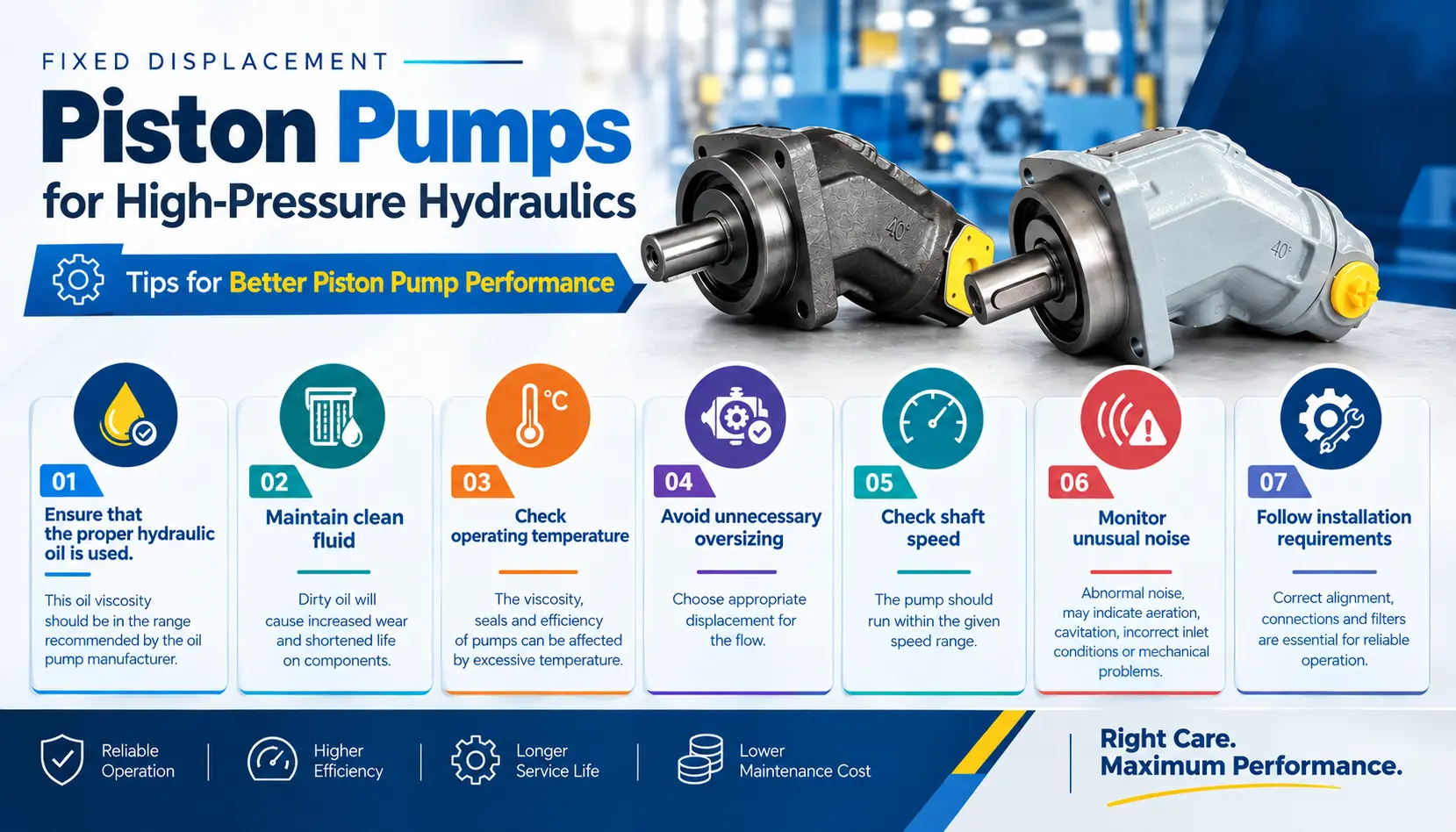
Tips for Better Piston Pump Performance
1. Ensure that the proper hydraulic oil is used
This oil viscosity should be in the range recommended by the oil pump manufacturer.
2. Maintain clean fluid
Dirty oil will cause increased wear and shortened life on components.
3. Check operating temperature
The viscosity, seals and efficiency of pumps can be affected by excessive temperature.
4. Avoid unnecessary oversizing
Choose appropriate displacement for the flow.
5. Check shaft speed
The pump should run within the given speed range.
6. Monitor unusual noise
Abnormal noise may indicate aeration, cavitation, incorrect inlet conditions or mechanical problems.
7. Follow installation requirements
Correct alignment, connections and filters are essential for reliable operation.
Important Factors Before Selecting a Piston Pump
When buying an industrial piston pump, here are some of the specifications to check out first:
- Required flow rate
- Continuous operating pressure
- Maximum pressure
- Pump displacement
- Drive speed
- Hydraulic fluid type
- Fluid viscosity
- Operating temperature
- Installation configuration
- Duty cycle
The amount of power that is available from the moving machine, such as a motor or engine.
In the mobile application, space and weight can also be a factor.
Noise, efficiency, serviceability and continuous operating conditions might be given more attention for stationary equipment.
A2FO Fixed Displacement Bent-Axis Piston Pump
The A2FO range is based on the principle of the fixed-displacement bent-axis piston pump. It is relevant because of the way it is built for applications where reliable hydraulic flow and high pressure operation are important.
It can be used in applications that demand a high level of mobility and hydraulic performance such as mobile, industrial applications where the pump’s displacement and operating conditions match the application requirements.
When considering an A2FO type pump an engineer should compare:
- Displacement
- Operating pressure
- Maximum pressure
- Rotational speed
- Hydraulic fluid
- Installation requirements
- Application duty cycle
This specification-based approach will aid in matching the selected pump to the entire hydraulic system, not just a single parameter.
Need an appropriate fixed-displacement option for your hydraulic application? For all your pump needs and conditions of use, please contact THM Huade. Call today to learn about products and technical advice.
Fixed Displacement Piston Pump vs Gear Pump
Both technologies can be used for hydraulic purposes, but their operating properties are different.
Hydraulic fluid is moved by a gear pump with meshing gears. It is frequently used in simpler hydraulic circuits and applications because of the need for cost-effective hydraulic flow.
A piston pump is a pump consisting of reciprocating pistons that are usually used in high-pressure hydraulic systems.
The final selection will be based on:
- Required pressure
- Required flow
- Efficiency
- Noise
- Duty cycle
- System complexity
- Installation conditions
- Budget
Therefore, to compare the complete requirement of the machine is more beneficial than just selecting the type of pump.
Final Takeaway
The first step to selecting the right hydraulic pump is to consider the machine, not the brand name. When assessing a pump’s performance, you need to consider all of these factors, along with pressure, flow, displacement, speed and the condition and duty cycle of the oil.
A fixed displacement piston pump may be a good choice for applications where a consistent flow rate is required and high pressure hydraulic performance is critical. The bent-axis design, A2FO, is especially significant for challenging mobile and industrial applications in which a pump’s specifications are comparable to the system’s requirements.
According to your application, operating pressure and operating flow, THM Huade can give you product information to help you select the right hydraulic solution. Enquire now to discuss your hydraulic pump requirements.
Frequently Asked Questions
Q. What is a fixed displacement piston pump?
A piston pump that is fixed in place provides a predetermined fluid with each stroke. During operation it cannot be adjusted in its displacement.
It is universally applicable in cases when high-pressure and constant flow is needed.
Q. How does a bent-axis piston pump work?
The pistons of a bent-axis piston pump are attached to a rotating cylinder block at an angle. The pistons alternately push and pull as the block turns to cause the hydraulic fluid to move in and out.
This design is highly efficient and can be used with high loads.
Q. What is the difference between fixed and variable displacement pumps?
A fixed displacement pump is a pump that pumps the same amount of fluid for each revolution. A variable displacement pump is a pump that is able to vary its fluid output based on the needs of the system.
Variable pumps provide a better control of the flow and can be used to minimize the energy use.
Q. Where are axial piston pumps used?
Axial piston pumps are commonly found in high pressure industrial and mobile hydraulic systems. Some of the common uses include injection molding machines, presses, construction equipment, cranes and power units.
They can be applied to high performance and pressure control systems.
Q. Why are piston pumps suitable for high-pressure hydraulic systems?
Piston pumps are developed to deal with high pressure, with efficient fluid delivery. Their strong structure can carry heavy loads and operate under heavy load.
This renders them an excellent option in heavy machinery and high-pressure hydraulic.