Where a hydraulic system requires constant flow, consistent pressure management, and free running, selection of an appropriate pump can have a direct impact on the performance of the machine. An internal gear pump utilizes the regulated motion of meshing gears to convey hydraulic fluid with a regular displacement. The small design, low operating noise and flow characteristics help in making this type of pump design applicable in most industrial hydraulic systems where reliable operation is important.
What is an Internal Gear Pump?
An internal gear pump is a positive-displacement hydraulic pump where one gear is rotating within another. The gear arrangement forms closed spaces that convey hydraulic oil between the inlet and the outlet.
This design is in contrast to a centrifugal pump, which relies primarily on the velocity of the fluid, and is able to pump a known amount of fluid with each stroke. That is why it is applicable where a constant flow and a predictable hydraulic performance is needed.
A high pressure internal gear pump may be used where the pressure requirement of a demanding hydraulic piece of equipment must be met and a smooth and relatively quiet performance is needed.
Internal Gear Pump Working Principle
The principle of the internal gear pump operation is grounded on three basic actions: suction, fluid transfer and discharge.
The teeth are parted on the inward side as the gears turn. This enlarges the volume available and pulls the hydraulic oil into the pump. The oil gets stuck between the teeth of the gears and the pump housing.
The rotating gears then push the trapped oil towards the outlet. The space available decreases and the oil is forced into the pressure line as the gears reenter mesh.
This flow generates a smooth flow with relatively low pulsation. Internal clearances are of importance since excessive clearance may result in more leakages and low volumetric efficiency.
Why High Pressure Internal Gear Pumps Are Used in Hydraulics
Hydraulic machines frequently have variable loads. A pump must then be able to sustain a steady flow, and meet the pressure requirements produced by cylinders, motors, valves, and other hydraulic components.
High-pressure design is chosen when the application needs high pressure capability that is beyond the capability of a normal gear pump to give. The pressure rating in use, speed, displacement, fluid viscosity, and temperature should never be left without verification against specifications by the manufacturer.
This is why choosing a pump cannot be made depending on pressure. Flow requirements and the entire hydraulic circuit must also be taken into account.
Internal Gear Pump Advantages for Industrial Systems
The key benefits of the internal gear pump are the positive-displacement design and compact gear layout.
A properly selected pump can provide:
- Smooth and consistent hydraulic flow
- Minimal pulsation relative to most other positive-displacement designs
- Relatively quiet operation
- Compact installation
- Consistent operation of continuous-duty systems
- Good efficiency in the range of its operation
- Direct connection with hydraulic power units
The fluid operation nature is particularly handy where high pressure variation or noise of the pump may influence machine operation. Internal gear pumps are also known to have an efficient and versatile performance in industrial hydraulics.
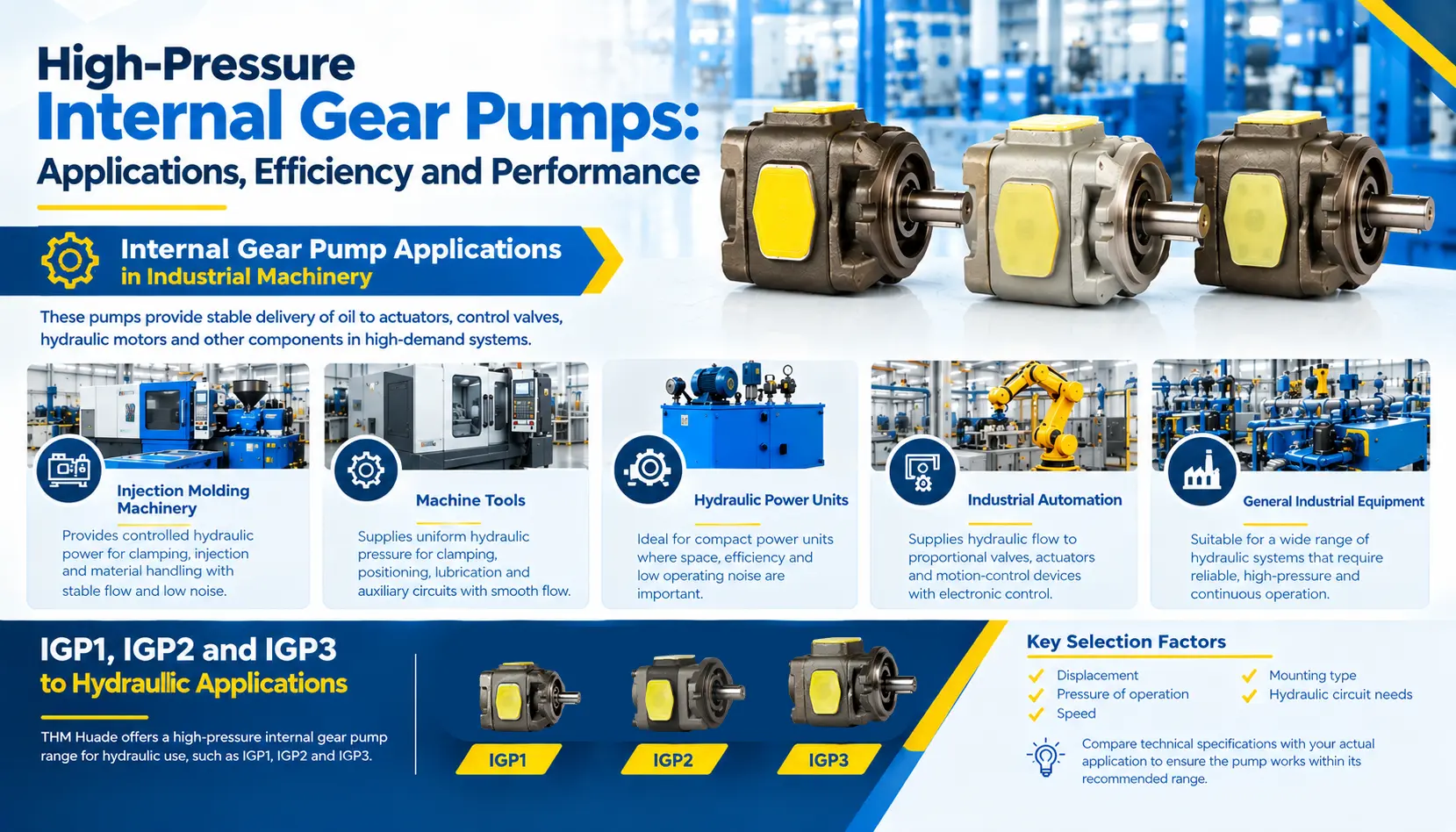
Internal Gear Pump Applications in Industrial Machinery
The variety of internal gear pump applications varies depending on the pressure, displacement, speed and fluid needs of the pump.
These pumps are applicable in hydraulic machinery systems where there is need to have stable delivery of oil to actuators, control valves, hydraulic motors, and other components. They are also able to fit large industrial equipment with long run times and predictable flow.
Typical areas can include:
Injection Molding Machinery
The injection molding equipment requires the use of controlled hydraulic power in the movements of clamping, injection and handling of material. With an appropriately sized pump, stable hydraulic flow can be maintained with operating noise kept at a manageable level.
Machine Tools
Machine tools depend on accurate and repeatable hydraulic functions. A smooth-flow pump may be used to supply uniform hydraulic pressure to clamping, positioning, lubrication and auxiliary circuits.
Hydraulic Power Units
A hydraulic internal gear pump may be incorporated into compact power units where space, efficiency and operating noise are critical factors.
Industrial Automation
Hydraulic power is usually used together with electronic control in automated machinery. An appropriate pump may supply the hydraulic flow needed by proportional valves, actuators and other motion-control devices.
IGP1, IGP2 and IGP3 to Hydraulic Applications
THM Huade provides high-pressure internal gear pump range of hydraulic use, such as IGP1, IGP2, and IGP3 configuration.
These models may be taken into consideration when developing hydraulic systems that need to have reliable positive-displacement flow and high-pressure operation. The right model is to be chosen based on the displacement, pressure of operation, speed, mounting, and the need of the entire hydraulic circuit.
Instead of selecting a pump based on just its model name, engineers ought to compare the technical characteristics with the real machine task. This aids in making sure that the pump operates within its recommended working range.
Fixed Displacement Gear Pump and Flow Control
A common internal gear design is a fixed displacement gear pump, i.e. the theoretical volume per revolution is fixed.
Flow can be then closely connected to the pump displacement and rotational speed. In the case that the system requires a new flow rate, the choice of pump speed or displacement should be taken into account when designing the system.
This feature renders the pump to be applicable in hydraulic circuits in which a predictable delivery of the flow is more significant than a continuously variable pump displacement.
Low Noise Hydraulic Pump for Industrial Equipment
Noise is also a major factor in the current manufacturing world. Unreasonable pump noise may impact on operator comfort, workplace conditions and the overall acoustic performance of machinery.
Internal gear design is able to work smoothly due to its controlled gear engagement and fluid transfer in a continuous manner. This is among the reasons why it can be chosen as a low noise hydraulic pump to use in industrial machinery.
But the pump is not the only source of total system noise. The final noise level can also depend on the motor speed, mounting, pipework, pressure variations, the condition of the fluid, and the structure of the machine.
High Pressure Gear Pump Efficiency
The efficiency of the pump is determined by the degree to which the pump is run under its designed conditions. Performance is affected by fluid viscosity, pressure, speed, temperature, internal leakage and mechanical losses.
A high pressure gear pump should not be chosen on the basis of a high pressure rating, but should be chosen to fit in the hydraulic system.
Proper sizing can be used to minimize the unwarranted energy losses. Stable long-term performance can also be facilitated by keeping hydraulic oil clean and adhering to recommended operating conditions.
IGP High-Pressure Internal Gear Pump Models
THM Huade provides IGP and DIGP to various hydraulic flow and displacement needs. The IGP1 range includes IGP1-08, IGP1-10, IGP1-13, IGP1-16, and IGP1-20, while IGP2 includes IGP2-25, IGP2-32, IGP2-40, IGP2-50, and IGP2-63. The IGP3 range covers **IGP3-80, IGP3-100, IGP3-125, and IGP3-160.
In the case of dual-pump requirements, THM Huade also provides configurations of DIGP-3-3, DIGP21, DIGP22, and DIGP32. Choose the appropriate model based on the necessary flow, pressure, velocity, displacement, and usage conditions.
Tips for Better Pump Performance
- Choose displacement based on desired system flow.
- Check continuous and peak pressure requirements individually.
- Adjust match pump speed to operating range of the manufacturer.
- Fill with the suggested hydraulic fluid and range of viscosity.
- Maintain the hydraulic circuit in clean and good condition.
- Test abnormal noise, heating, vibration, pressure.
- Check connections and seals during regular maintenance.
Match the Pump to the Complete Hydraulic System
The performance of the whole hydraulic circuit depends on the choice of the pump. Prior to specifying an industrial gear pump, it is important to take into account the required flow, working pressure, peak pressure, rotational speed, oil viscosity, temperature, motor power, mounting arrangement and anticipated duty cycle.
Other protection elements such as the relief valve are also very crucial in a positive-displacement system. The pressure may still accumulate when the discharge is confined and thus the hydraulic circuit should be equipped with appropriate pressure protection.
THM Huade offers hydraulic pump systems and solutions to industrial machinery and hydraulic systems. When you are choosing IGP1, IGP2, or IGP3 to use on a new machine or replacement project, call now to describe the use and specifications needed.
Internal Gear Pump for Hydraulic Systems: What to Check
In the case of an internal gear pump to be used in hydraulic systems, one should start the selection process with the requirements of the machine.
The following questions must be asked prior to the completion of the pump:
- What flow rate do you need?
- What is the normal working pressure?
- What is the maximum pressure?
- What is the motor speed to be used?
- Which hydraulic oil and viscosity range are given?
- Is continuous-duty operation required?
- Which mounting and shaft design is required?
The responses to these questions will assist in eliminating the number of pumps to be considered and minimize chances of using the component beyond the recommended operating range.
Key Takeaway
The first step to good hydraulic performance is to select a pump that is appropriate to the actual working conditions of the machine. An internal gear pump may be a feasible option in cases where smooth fixed-displacement flow, compact design, reliable operation, and regulated noise is of concern.
In the case of high pressure industrial systems, there are models like THM Huade which offer alternatives to use based on the needed hydraulic specifications like THM Huade IGP1, IGP2 and IGP3. We should always select the right one with reference to the entire application and not a single specification.
Looking for a suitable High pressure internal gear pump for application in your hydraulic system? Enquire THM Huade today and discuss your requirements and select a pump option that meets the requirements of your machine.
FAQ’s
What is an internal gear pump?
The internal gear pump is a positive displacement pump which operates with the fluid being carried by an inner and outer gear. It allows for smooth and consistent flow and is popular in industrial hydraulic systems.
How does an internal gear pump work?
Fluid comes in between the teeth and body of the gears as it rotates. The fluid is circulated around the housing by the rotating gears and is forced towards the outlet under pressure.
What is the difference between an internal gear pump and a piston pump?
The fluid is pumped by the rotation of gears in an internal gear pump, or by the reciprocating action of pistons in a piston pump. Gear pumps are characterized by smooth low pulsation flow, while piston pumps are commonly used in very high pressure and variable flow applications.
Are internal gear pumps suitable for high-pressure applications?
Yes. High-pressure internal gear pumps are designed to meet the requirements of demanding hydraulic systems that require reliable flow, efficiency and low noise. The appropriate range of pressure will vary based on the type of pump design and application.
What are internal gear pumps used for?
Internal gear pumps are employed in applications that demand continuous and constant hydraulic fluid delivery such as injection molding machines, presses, machine tools, and hydraulic power units and industrial machinery.