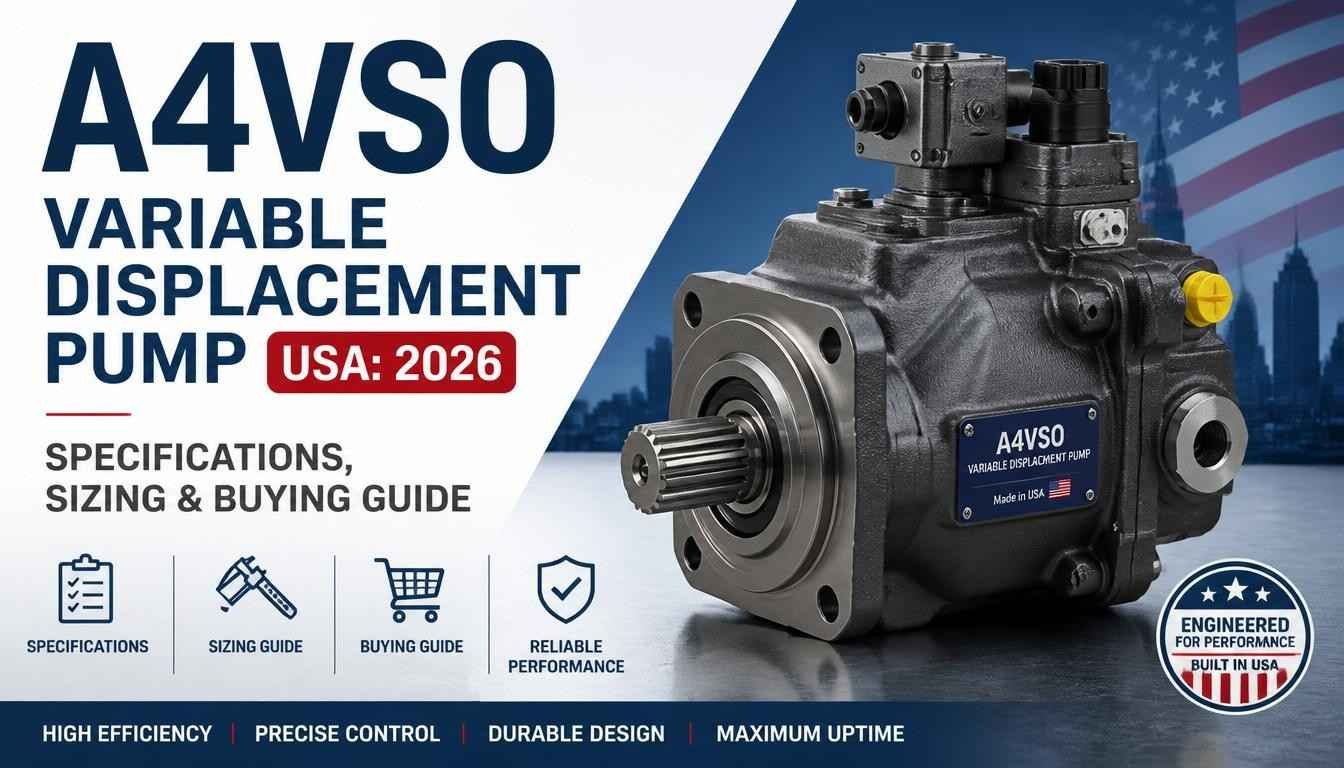
Hydraulic systems used in manufacturing, construction, mining, marine, and industrial automation depend on pumps that deliver consistent pressure while adapting to changing load requirements. Fixed displacement pumps work well in applications with constant flow demands, but many modern hydraulic systems require greater efficiency and precise control. That is where the A4VSO variable displacement pump USA market continues to grow.
The A4VSO series is widely recognised for its variable displacement axial piston design, allowing operators to adjust flow according to system demand instead of running at full capacity all the time. This improves energy efficiency, reduces heat generation, extends component life, and lowers operating costs.
Whether you are replacing an existing Bosch Rexroth A4VSO unit, designing a new hydraulic power pack, or looking for a cost-effective replacement, understanding the pump’s specifications and sizing requirements is essential before making a purchase.
This guide explains everything buyers in the USA should know, including technical specifications, sizing calculations, control options, application suitability, and how to choose the right variable displacement piston pump USA suppliers for long-term reliability.
What Is an A4VSO Variable Displacement Pump?
Unlike fixed displacement pumps that produce the same flow during every revolution, an A4VSO pump adjusts its displacement according to the system’s pressure and flow requirements.
This design enables hydraulic systems to consume only the power they need at any given moment.
The axial piston pump USA market commonly uses A4VSO-style pumps in closed-loop and open-loop hydraulic circuits where efficiency and accurate pressure control are priorities.
The pump operates using several pistons arranged parallel to the drive shaft. As the swash plate angle changes, piston stroke changes accordingly, increasing or decreasing oil flow while maintaining smooth hydraulic performance.
Some of the most common industries using A4VSO pumps include:
- Injection moulding
- Steel processing
- Press machinery
- Marine hydraulic systems
- Mining equipment
- Material handling
- Mobile construction equipment
- Industrial automation
- Hydraulic power units
- Machine tools
Because displacement automatically adjusts to demand, these pumps help minimise energy waste during partial-load operation.
Why Variable Displacement Pumps Are Preferred in Modern Hydraulic Systems
Many industrial facilities in the USA are focused on reducing energy consumption without compromising machine performance.
Variable displacement pumps provide several operational advantages over fixed displacement models.
Better Energy Efficiency
Since output flow changes according to system demand, less energy is wasted circulating unnecessary hydraulic oil.
Lower power consumption often results in measurable reductions in electricity costs over the lifetime of the equipment.
Reduced Heat Generation
Excess flow in fixed displacement systems creates additional heat that must be removed through cooling systems.
Variable displacement operation significantly lowers heat generation, reducing cooling requirements and extending hydraulic oil life.
Longer Component Life
Lower operating temperatures reduce wear on:
- Hydraulic hoses
- Valves
- Cylinders
- Seals
- Bearings
- Hydraulic fluid
This contributes to lower maintenance costs over time.
Improved Machine Performance
A4VSO pumps provide smooth flow regulation, making them suitable for equipment requiring accurate pressure and motion control.
A4VSO Variable Displacement Pump Specifications
Before selecting a pump, it helps to understand the available sizes, operating ranges, and control options.
The table below summarises the typical specifications found across A4VSO-style pumps.
| Specification | Typical Range |
| Pump Type | Axial piston variable displacement |
| Hydraulic Circuit | Open circuit |
| Mounting | SAE flange |
| Rotation | Clockwise or counter-clockwise |
| Displacement Range | Approximately 40–500 cc/rev depending on model |
| Maximum Operating Pressure | Up to 350 bar continuous |
| Peak Pressure | Up to 400 bar |
| Speed Range | Model dependent |
| Fluid Type | Mineral hydraulic oil and compatible fluids |
| Shaft Options | Splined, keyed, SAE |
| Control Types | Pressure, load sensing, power control, electro-hydraulic |
Different manufacturers may offer slight variations, but these specifications represent the general operating range expected from A4VSO-compatible pumps.
Available Displacement Sizes
A4VSO pumps are available in numerous displacement options to suit different flow requirements.
Common models include:
- A4VSO 40
- A4VSO 71
- A4VSO 125
- A4VSO 180
- A4VSO 250
- A4VSO 355
- A4VSO 500
Larger displacement models provide greater flow output while maintaining the same operating principle.
Choosing the correct displacement depends on:
- Required system flow
- Operating pressure
- Prime mover speed
- Duty cycle
- Equipment type
- Future expansion requirements
A properly sized pump improves efficiency while avoiding unnecessary operating costs.
Understanding A4VSO Control Options
Different hydraulic applications require different control strategies.
Selecting the appropriate control option ensures optimal system performance.
Pressure Control
Pressure control automatically reduces displacement once the preset pressure is reached.
Common applications include:
- Hydraulic presses
- Clamping systems
- Power packs
Load Sensing Control
Load sensing adjusts flow according to actuator demand while maintaining pressure margin.
Typical applications include:
- Mobile equipment
- Construction machinery
- Agricultural hydraulics
Constant Power Control
Constant power control limits input power by reducing displacement as system pressure increases.
This helps protect electric motors and diesel engines from overload.
Electro-Hydraulic Control
Electronic proportional controls allow integration with PLC-based automation systems.
These are increasingly used in Industry 4.0 manufacturing environments requiring precise hydraulic control.
How to Size an A4VSO Variable Displacement Pump
Selecting the correct pump size has a direct impact on system efficiency, operating costs, and equipment lifespan. Oversizing a pump increases energy consumption and heat generation, while an undersized pump may struggle to meet flow demands, causing slow actuator movement and reduced productivity.
Before purchasing an A4VSO variable displacement pump USA, evaluate your hydraulic system’s operating conditions rather than choosing a replacement based solely on the existing model number.
The key sizing parameters include:
- Required flow rate (L/min or GPM)
- Maximum operating pressure (bar or psi)
- Motor speed (RPM)
- Hydraulic cylinder or motor requirements
- Duty cycle
- Future system expansion
These factors help determine the appropriate displacement and control option for your application.
Step 1: Determine the Required Flow Rate
Flow rate defines how much hydraulic fluid pump must deliver to achieve the desired machine speed.
For example:
| Application | Typical Flow Requirement |
| Small hydraulic power unit | 20–60 L/min |
| Machine tools | 40–120 L/min |
| Injection moulding machines | 80–250 L/min |
| Steel processing equipment | 150–400 L/min |
| Heavy industrial presses | 250 L/min and above |
Higher flow increases actuator speed, but it also raises power consumption if the system is not properly controlled.
Step 2: Identify the Operating Pressure
Pressure depends on the force required by the hydraulic system rather than the pump itself.
Typical industrial pressure ranges include:
| Application | Typical Pressure |
| General machinery | 140–210 bar |
| Industrial automation | 180–280 bar |
| Hydraulic presses | 280–350 bar |
| Heavy-duty industrial systems | Up to 350 bar continuous |
Selecting a pump with adequate pressure capability provides a safety margin without pushing the equipment to its operating limits.
Step 3: Calculate Pump Displacement
Pump displacement determines the volume of hydraulic fluid delivered during one shaft revolution.
A commonly used sizing formula is:
Pump Flow (L/min) = Displacement (cc/rev) × Speed (RPM) ÷ 1000
For example:
Required flow: 180 L/min
Motor speed: 1800 RPM
Required displacement:
180 × 1000 ÷ 1800 = 100 cc/rev
In this case, a pump with a displacement close to 100 cc/rev would typically be selected, subject to efficiency losses and application-specific requirements.
Step 4: Calculate Power Requirements
Hydraulic power should also be checked before selecting the electric motor or engine.
The basic hydraulic power formula is:
Power (kW) = Pressure (bar) × Flow (L/min) ÷ 600
Example:
- Pressure: 250 bar
- Flow: 180 L/min
Power required:
250 × 180 ÷ 600 = 75 kW
This figure helps ensure the prime mover can supply adequate power under full-load conditions.
Factors That Influence Pump Selection
Even when two pumps have the same displacement, they may not perform equally in every hydraulic system.
Several operational factors should influence your final selection.
Duty Cycle
Equipment operating around the clock requires pumps designed for continuous heavy-duty service.
Applications such as steel mills, manufacturing plants, and process industries typically benefit from pumps with high volumetric efficiency and durable internal components.
Fluid Compatibility
Most A4VSO-style pumps are designed for mineral hydraulic oil.
However, some industrial applications may require compatibility with:
- Fire-resistant hydraulic fluids
- Biodegradable hydraulic oils
- Synthetic hydraulic fluids
Always verify fluid compatibility before installation to avoid premature seal wear or reduced pump life.
Ambient Conditions
USA installations cover a wide range of operating environments, from cold northern states to high-temperature industrial facilities in the south.
Temperature affects:
- Oil viscosity
- Starting torque
- Lubrication performance
- Seal longevity
Where extreme temperatures are expected, hydraulic oil grade and cooling capacity should be considered alongside pump selection.
Noise Requirements
Manufacturing plants increasingly prioritise lower operating noise to improve workplace conditions.
Variable displacement piston pumps generally operate more quietly than many older hydraulic pump designs because they produce only the flow required by the system instead of circulating excess oil continuously.
Common Applications Across the USA
The hydraulic pumps USA market serves a broad range of industries, and A4VSO-style pumps are used wherever efficiency and precise flow control are essential.
Typical applications include:
Manufacturing Equipment
Industrial production lines rely on variable displacement pumps for:
- Press machines
- Plastic injection moulding
- CNC machinery
- Die-casting equipment
- Metal fabrication systems
Construction Equipment
Many mobile hydraulic systems benefit from variable displacement technology due to changing load conditions.
Common examples include:
- Excavators
- Cranes
- Pavers
- Drilling rigs
- Concrete equipment
Marine Hydraulics
Marine systems often use axial piston pumps for:
- Steering systems
- Deck machinery
- Winches
- Hydraulic cranes
- Stabilisation equipment
Mining Operations
Mining equipment demands continuous hydraulic performance under high loads.
Typical applications include:
- Conveyor systems
- Crushers
- Hydraulic drills
- Underground machinery
- Material handling equipment
Renewable Energy
Hydraulic systems supporting wind turbines, hydroelectric installations, and industrial testing equipment increasingly use variable displacement technology to improve energy efficiency and system responsiveness.
Installation Considerations
Correct installation is just as important as selecting the right pump.
Improper installation can reduce efficiency and shorten service life.
Before commissioning an A4VSO-style pump, verify:
- Correct shaft alignment
- Suitable coupling selection
- Proper suction line sizing
- Clean hydraulic oil
- Correct filtration
- Adequate reservoir capacity
- Pressure relief valve settings
- Air removal during start-up
Routine maintenance should include periodic inspection of filters, hydraulic oil condition, seals, hoses, and operating temperatures to help maximise pump lifespan.
A4VSO vs Other Hydraulic Pump Types
Not every hydraulic application requires a variable displacement pump. However, for systems where operating conditions change throughout the day, an A4VSO-style pump often delivers better efficiency and control than fixed displacement alternatives.
The table below compares the most common hydraulic pump types used across industrial applications in the USA.
| Pump Type | Best For | Advantages | Limitations | |
| Fixed Gear Pump | Basic hydraulic systems | Simple design, lower upfront cost | Constant flow, lower efficiency | |
| Vane Pump | Medium-pressure industrial applications | Smooth operation, quieter performance | Limited pressure capability | |
| Fixed Displacement Axial Piston Pump | Constant-load applications | High efficiency, compact design | Flow cannot adjust to demand | |
| Industrial automation, presses, heavy machinery | Adjustable flow, high efficiency, lower energy consumption | Higher initial investment |
Although the purchase price of a variable displacement pump is generally higher, many facilities recover the additional cost through reduced energy usage, lower maintenance requirements, and longer equipment life.
Choosing the Right Rexroth A4VSO Alternative
Many businesses search for a Rexroth A4VSO alternative when replacing worn equipment, reducing procurement costs, or looking for shorter lead times.
A suitable alternative should offer comparable performance rather than simply matching the model number.
When evaluating replacement options, consider the following:
Hydraulic Performance
The replacement pump should match or exceed the original specifications for:
- Maximum operating pressure
- Peak pressure
- Flow capacity
- Volumetric efficiency
- Mechanical efficiency
A mismatch in these parameters can affect system performance and increase energy consumption.
Dimensional Compatibility
Check that the replacement matches the original installation wherever possible.
Key dimensions include:
- Mounting flange
- Shaft type
- Shaft diameter
- Port configuration
- Overall installation space
Selecting a compatible design can minimise installation time and reduce modification costs.
Control Configuration
Modern A4VSO-style pumps are available with several control options.
Ensure the replacement supports the control method already used within your hydraulic system, such as:
- Pressure compensation
- Load sensing
- Constant power control
- Electro-hydraulic proportional control
Changing control systems may require modifications to valves, controllers, or the hydraulic circuit.
Spare Parts Availability
One factor often overlooked during purchasing is long-term serviceability.
Before selecting a supplier, verify the availability of:
- Seal kits
- Bearings
- Pistons
- Valve plates
- Swash plates
- Technical support
Readily available spare parts can significantly reduce downtime during future maintenance.
What to Look for When Buying Hydraulic Pumps in the USA
With many suppliers offering A4VSO-compatible pumps, comparing more than just the purchase price is important.
A lower-cost pump may not deliver the reliability, efficiency, or support needed for demanding industrial applications.
When evaluating suppliers, consider the following:
Product Quality
Look for pumps manufactured using precision machining, high-quality materials, and strict quality control processes.
Consistent manufacturing standards contribute to better efficiency, longer service life, and reliable operation.
Technical Support
Industrial hydraulic systems often require assistance during pump selection, installation, or troubleshooting.
A supplier that offers technical guidance can help ensure the pump is correctly matched to your application.
Lead Times
Unexpected pump failures can bring production to a halt.
Choosing a supplier with reliable inventory and shorter delivery times can help reduce downtime, particularly for critical operations.
Warranty and After-Sales Service
A comprehensive warranty reflects the manufacturer’s confidence in product quality.
Also consider whether the supplier provides:
- Installation guidance
- Maintenance recommendations
- Spare parts support
- Technical documentation
- Repair services
Application Experience
Suppliers with experience across industries such as manufacturing, mining, marine, and construction are often better equipped to recommend the most suitable hydraulic solution.
As technical manufacturers expand their online resources, many also work with specialist digital partners such as Rankfast to keep product information accessible and technically accurate for engineers researching replacement components.
Common Mistakes to Avoid
Selecting the wrong hydraulic pump can lead to higher operating costs, reduced efficiency, and premature component failure.
Avoid these common purchasing mistakes:
Selecting by Model Number Alone
A matching model number does not always guarantee compatibility.
Always confirm:
- Flow requirements
- Pressure ratings
- Shaft configuration
- Mounting dimensions
- Control options
Ignoring Future Capacity
If equipment upgrades are planned, selecting a pump with some additional operating flexibility may reduce future replacement costs.
Overlooking System Efficiency
A larger pump is not always better.
Oversized pumps consume more power, generate additional heat, and increase operating expenses.
Proper sizing delivers better long-term efficiency.
Buying on Price Alone
The lowest purchase price may result in higher lifetime costs due to increased maintenance, reduced efficiency, or shorter service life.
Evaluating total cost of ownership provides a more accurate basis for comparison.
Why A4VSO Pumps Remain a Popular Choice
The continued demand for A4VSO variable displacement pump USA solutions reflects the growing need for efficient and adaptable hydraulic systems across multiple industries.
Their ability to adjust flow according to system demand helps reduce energy consumption, improve machine responsiveness, and extend the lifespan of hydraulic components.
Whether used in manufacturing plants, mobile machinery, marine equipment, or industrial automation, A4VSO-style pumps provide the flexibility required for applications where operating conditions change throughout the working cycle.
For buyers comparing a variable displacement piston pump USA, evaluating technical specifications, sizing calculations, control options, and supplier support will lead to a more informed purchasing decision. Selecting the right pump not only improves hydraulic performance but also reduces maintenance costs and contributes to reliable long-term operation.
Frequently Asked Questions
How do I choose the correct A4VSO pump size?
Pump sizing depends on the required flow rate, operating pressure, motor speed, duty cycle, and application. Calculating these parameters before purchase helps ensure the pump delivers the required performance without wasting energy.
Is an A4VSO pump suitable for high-pressure applications?
Yes. Most A4VSO-style pumps are designed for continuous operating pressures of up to 350 bar, with peak pressures reaching approximately 400 bar, depending on the specific model and manufacturer.
Can I replace a Bosch Rexroth A4VSO pump with an equivalent alternative?
Yes, provided the replacement matches the original pump's displacement, pressure rating, mounting dimensions, shaft configuration, and control type. Verifying these specifications helps ensure compatibility and reliable operation.
Which industries commonly use A4VSO variable displacement pumps?
These pumps are widely used in manufacturing, mining, marine, construction, material handling, industrial automation, machine tools, and hydraulic power units where variable flow and high efficiency are required.
What maintenance is required for an A4VSO pump?
Routine maintenance includes monitoring hydraulic oil condition, replacing filters at recommended intervals, checking seals and hoses for leaks, maintaining proper oil cleanliness, and inspecting operating temperatures. Preventive maintenance helps maximise pump life and reduce unexpected downtime.