In modern automation, precision is not optional; it is essential. A properly configured industrial servo drive plays a critical role in ensuring that hydraulic press systems operate with accuracy, repeatability, and efficiency. Without correct parameter setup, even the most advanced hardware can fail to deliver optimal performance.
Hydraulic presses demand high force, controlled motion, and consistent pressure cycles. Therefore, integrating a servo motor drive allows operators to achieve better control compared to traditional systems. According to industry research published by the International Federation of Robotics, advanced motion control systems can improve production efficiency by up to 30% in automated environments.
Additionally, proper configuration reduces energy consumption and extends equipment lifespan. As a result, businesses benefit from lower maintenance costs and improved system reliability.
What Are the Core Components of a Hydraulic Servo Control System?
Before diving into parameter setup, it is important to understand the architecture of a hydraulic servo control system. Each component must work seamlessly together for optimal results.
A typical system includes:
- Servo motor and feedback encoder
- Industrial servo drive controller
- Hydraulic actuator or cylinder
- Pressure and position sensors
- PLC or motion controller
The servo motor drive acts as the brain of the system, converting control signals into precise motor movements. Meanwhile, sensors provide real-time feedback, ensuring accurate positioning and pressure regulation.
This integration allows for smoother operation, reduced vibration, and improved cycle times. Consequently, industries such as metal forming, automotive manufacturing, and heavy machinery rely heavily on these systems.
How Do You Begin Parameter Setup for an Industrial Servo Drive?
Setting up an industrial servo drive for a hydraulic press requires a structured approach. Skipping steps or making assumptions can lead to instability or inefficiency.
Step 1: Define System Requirements
Start by identifying key performance parameters:
- Load characteristics (weight, inertia, and friction)
- Desired speed and acceleration
- Pressure and force requirements
- Duty cycle and operating environment
These factors determine how the small servo motors and drives will perform under real-world conditions.
Step 2: Motor and Drive Matching
Next, ensure that the motor and drive are properly matched. Incorrect pairing can lead to overheating or insufficient torque.
According to technical guidelines from IEEE, proper motor-drive matching improves efficiency and reduces energy loss in industrial systems.
Which Parameters Are Critical for Hydraulic Press Applications?
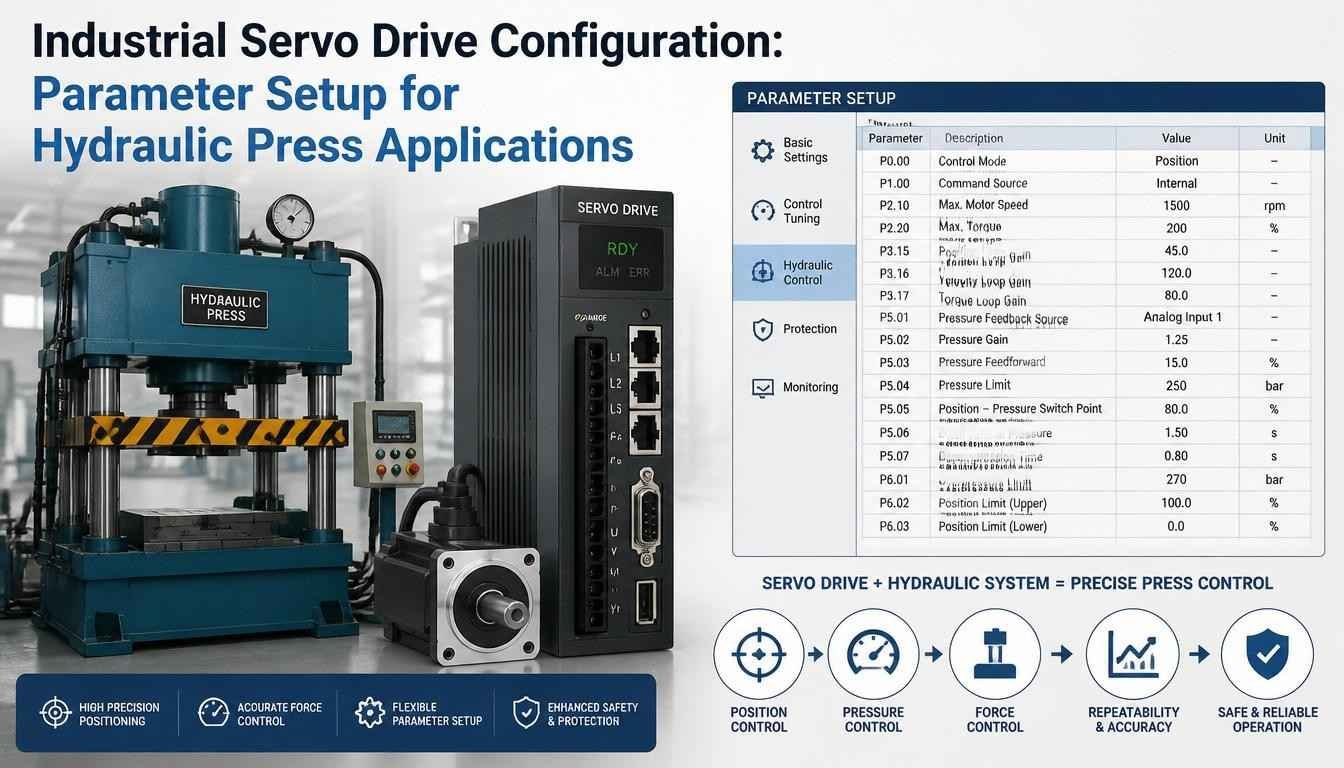
Once the basics are established, the next step is configuring key parameters within the industrial servo drive. These settings directly impact performance and safety.
Torque and Force Limits
Hydraulic presses require high force output. Setting appropriate torque limits ensures that the system delivers sufficient power without damaging components.
Speed and Acceleration Profiles
Smooth motion is essential for precision. Gradual acceleration and deceleration reduce mechanical stress and improve product quality.
Position Control Gains
Fine-tuning proportional, integral, and derivative (PID) gains helps maintain stability. Poor tuning can cause oscillations or delayed responses.
Feedback Calibration
Accurate encoder feedback ensures precise positioning. Calibration errors can result in misalignment or inconsistent pressing force.
Pressure Synchronization
In a hydraulic servo control system, pressure must align with position control. Synchronization ensures consistent force application throughout the cycle.
How Can You Optimize Performance and Efficiency?
After initial configuration, optimization becomes the focus. Even small adjustments can significantly enhance system performance.
Use Auto-Tuning Features
Most modern servo motor drive systems include auto-tuning capabilities. These features analyze system behavior and adjust parameters automatically.
Monitor Real-Time Data
Continuous monitoring helps identify inefficiencies or irregularities. Data-driven adjustments improve long-term performance.
Reduce Energy Consumption
Energy efficiency is a major advantage of servo systems. Studies by the U.S. Department of Energy indicate that servo-driven hydraulic systems can reduce energy usage by up to 50% compared to traditional setups.
Schedule Preventive Maintenance
Regular inspection and servo motor repair ensure that the system remains in peak condition. Preventive maintenance minimizes downtime and extends equipment life.
What Common Mistakes Should You Avoid?
Even experienced engineers can make errors during configuration. Avoiding these pitfalls can save time and resources.
- Incorrect parameter scaling for load conditions
- Ignoring the feedback signal noise
- Over-tuning PID gains, leading to instability
- Neglecting the thermal limits of small servo motors and drives
- Skipping system validation tests
Each of these mistakes can compromise system performance. Therefore, careful planning and testing are essential.
How Do You Validate and Test the System?
Once the configuration is complete, validation ensures that everything works as expected. Testing should simulate real operating conditions.
Perform Load Testing
Apply actual load conditions to verify torque and pressure capabilities. This step confirms that the industrial servo drive can handle operational demands.
Check Response Time
Evaluate how quickly the system reacts to control inputs. Faster response times improve productivity and precision.
Analyze Stability
Observe the system for oscillations or irregular movements. Stability is critical for consistent hydraulic press performance.
Document Results
Maintain detailed records of parameter settings and test outcomes. Documentation simplifies future troubleshooting and upgrades.
Why Is Proper Configuration a Long-Term Investment?
Configuring an industrial servo drive correctly is not just a technical task; it is a strategic investment. A well-optimized system delivers:
- Higher production efficiency
- Reduced energy consumption
- Longer equipment lifespan
- Improved product quality
Moreover, it reduces the need for frequent servo motor repair, saving both time and operational costs.
As industries continue to adopt automation, the demand for precise and reliable motion control systems will only grow. Therefore, mastering servo drive configuration is essential for staying competitive.
Conclusion
Configuring an industrial servo drive for hydraulic press applications is more than a technical requirement. It is a decisive factor in achieving precision, efficiency, and long-term reliability. When parameters such as torque limits, speed profiles, and feedback calibration are carefully tuned, the entire hydraulic servo control system operates with greater stability and control.
Moreover, integrating the right servo motor drive and maintaining it through timely servo motor repair ensures that performance remains consistent even under heavy loads. Whether you are working with large systems or small servo motors and drives, the principles of accurate configuration and continuous optimization remain the same.
Ultimately, a well-configured system reduces downtime, lowers energy consumption, and enhances production quality. By investing time in proper setup and validation, you position your operation for sustained success in today’s demanding industrial environment.
Upgrade your hydraulic systems with precision-engineered solutions from THM Huade. Achieve better efficiency, control, and reliability with advanced industrial servo drive technology. Get in touch today and take your servo motor drive performance to the next level.
FAQs
How does a servo motor drive improve hydraulic press performance?
A servo motor drive enhances control, efficiency, and accuracy. It allows precise force and motion control, reducing energy consumption and improving consistency in hydraulic press operations.
What are small servo motors and drives best suited for?
Small servo motors and drives are ideal for compact systems requiring precise control. They are commonly used in automation, robotics, and light-duty hydraulic applications where space and efficiency matter.
When is a servo motor repair necessary?
Servo motor repair is needed when there are signs of overheating, unusual noise, or performance loss. Regular maintenance helps detect issues early and prevents costly system failures.
What is a hydraulic servo control system?
A hydraulic servo control system combines servo technology with hydraulic components. It enables precise control of pressure, position, and force in heavy-duty applications like presses and industrial machinery.