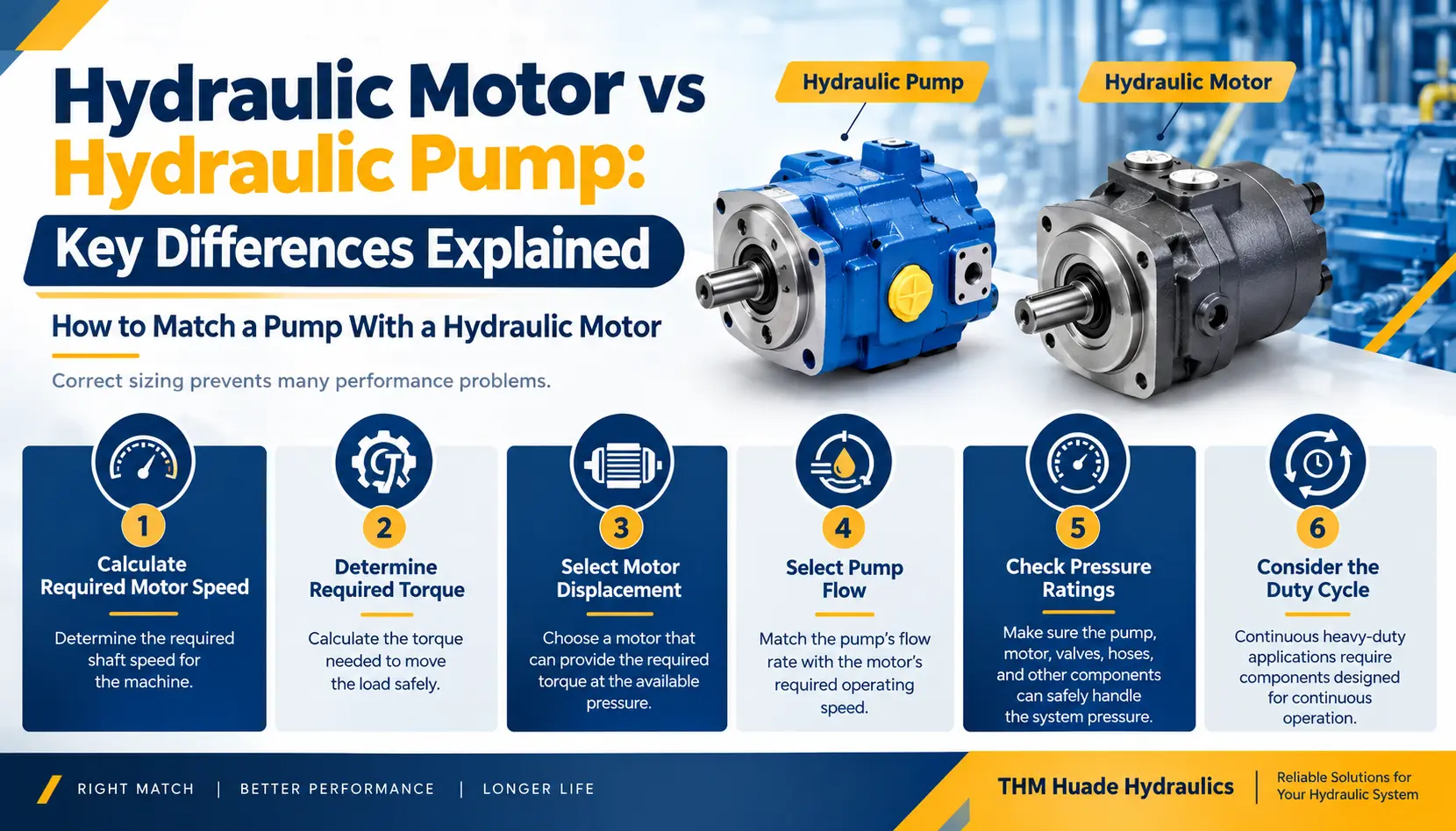
The simplest understanding of the difference between hydraulic motor and hydraulic pump is to consider what they do. A hydraulic pump is used to deliver mechanical energy to hydraulic flow and a hydraulic motor is used to convert hydraulic energy into mechanical energy. They both play a vital role in a hydraulic system, but they have opposing actions.
For engineers, manufacturing and maintenance people in India, selection of the right component can impact the machine speed, torque, efficiency, reliability and operating costs. Let’s make it easy to understand the differences.
Hydraulic Pump: What Does It Do?
A hydraulic pump converts the mechanical energy of an electric motor or engine into hydraulic energy by pumping fluid through the system.
Flow is generated by the pump. Pressure is built up in the system due to the resistance of that flow.
Hydraulic Pump Working Principle
Hydraulic pump working principle is to create lower pressure at the inlet and drive the fluid to the higher-pressure outlet.
In simple terms:
Mechanical energy: Hydraulic energy
A pump is used to circulate fluid to the cylinders, valves and hydraulic motors to do useful work.
Common Hydraulic Pump Types
There are a variety of different hydraulic pump types, such as:
- Gear pumps
- Vane pumps
- Axial piston pumps
- Radial piston pumps
- Fixed displacement pumps
- Variable displacement pumps
The correct pump is determined by the flow, pressure, speed, efficiency and application.
Hydraulic Motor: What Does It Do?
A hydraulic motor is the device that does the other energy conversion. It is fed with high pressure hydraulic fluid and transforms the high-pressure energy of the fluid into rotary mechanical power.
In simple terms:
Tapping into the energy of flowing water. Using water that is moving.
It can be used to power vehicles such as wheels, conveyors, winches, fans, drilling rigs and other machines.
Hydraulic Motor Working Principle
The working principle of hydraulic motor is to use the pressure of fluid to input into the hydraulic motor and exert force against the internal working mechanism. This force causes rotation of the shaft.
The output of the motor is influenced by:
- Hydraulic pressure
- Fluid flow
- Motor displacement
- Load requirements
- Operating speed
The bigger the difference between the motor, the greater the torque at a specific pressure, and the flow is mainly to determine the speed of rotation at a specific pressure.
Hydraulic Motor vs Hydraulic Pump: Main Difference
The most basic difference between a hydraulic motor and a hydraulic pump is how the energy is converted.
| Feature | Hydraulic Pump | Hydraulic Motor |
| Main function | Produces hydraulic flow | Produces rotary motion |
| Energy conversion | Mechanical, hydraulic | Hydraulic, mechanical |
| Main output | Flow and pressure capability | Torque and speed |
| Driven by | Electric motor or engine | Hydraulic fluid |
| Common use | Supplies hydraulic circuit | Drives mechanical load |
While they may appear alike in certain designs, there are differences in their internal components and requirements for operation.
Hydraulic Motor Types
The selection of the appropriate motor is determined based on the desired speed, torque, pressure and duty cycle.
Gear Motors
Gear motors have a simple design and can be used in most industrial applications.
Piston Motors
Piston motors are most suitable for applications with high pressures, high torque and high efficiency.
Vane Motors
Vane motors are smooth rotating and they can be used successfully in applications with consistent performance.
Radial Piston Motors
Such motors can be very powerful at relatively low speeds and are suitable for heavy duty applications.
Hydraulic Pump Types
Gear Pumps
For many low to medium pressure applications, gear pumps are a simple and economical solution.
Vane Pumps
Vane pumps deliver smooth flow and moderate noise level.
Axial Piston Pumps
For high-pressure applications, axial piston pumps are available and may provide variable displacement to improve the flow control.
Radial Piston Pumps
Radial piston pumps are best suited for those applications which need extremely high pressure and force.
Shows how Torque, Flow, and Speed are related
There are three key factors that will help people understand the system: flow, pressure, and torque.
The hydraulic pump flow rate dictates the amount of fluid that a Pump can deliver. Depending on the motor displacement, more high flow can accelerate the hydraulic motor.
The hydraulic motor torque from a motor is primarily dependent on the motor’s pressure and displacement.
This relationship implies the need to do a proper component matching. If the pump is unable to provide enough flow and/or pressure, the motors will not perform as well.
Hydraulic Motor Applications
Hydraulic motors find various applications where machines require high torque, in compact power transmission, or where the motion must be controlled as a rotation.
Hydraulic motors are used in a variety of applications such as:
- Excavators
- Cranes
- Winches
- Conveyors
- Drilling machines
- Construction equipment
- Agricultural machinery
- Material handling systems
A hydraulic motor can be particularly beneficial in situations where the equipment is subject to heavy loads or challenging operating conditions.
Hydraulic Pump Applications
The hydraulic pump is used in almost all the major applications of fluid power.
They include:
- Hydraulic presses
- Injection molding machines
- Machine tools
- Construction equipment
- Industrial power units
- Mobile hydraulic systems
- Material handling equipment
- Agricultural machinery
The motor (or cylinder) does the work and the pump supplies the hydraulic power.
Hydraulic Motor Efficiency vs Hydraulic Pump Efficiency
When operating, both components lose some energy.
There are some mechanical losses, volumetric leakage, pressure, speed, fluid condition and motor design that affect the efficiency of the hydraulic motor.
Similarly, hydraulic pump efficiencies are affected by internal leakage, friction, operating pressure, speed and fluid viscosity.
To enhance overall performance:
- Employing the right-size parts.
- Maintain clean hydraulic oil.
- Maintain operating pressures within specifications.
- Avoid unnecessary throttling.
- Maintain proper filtration.
- Check temperature and leaks.
A hydraulic system design that is properly done can allow for a huge boost in overall system efficiency.
How to Match a Pump with a Hydraulic Motor
Many performance issues can be avoided by correct sizing.
Step 1: Calculate Required Motor Speed
The first step is to determine the required motor speed.
Step 2: Calculate Required Torque
Determine the torque required to shift the load properly.
Step 3: choose Motor Displacement
Choose a motor that can provide the required torque at the available pressure.
Step 4: Select Pump Flow
Adjust the pump’s flow rate to the speed at which the motor must run.
Step 5: Check Pressure Ratings
Ensure that the pump, motor, valves, hoses, etc. are capable of operating at the system pressure.
Step 6: Consider the Duty Cycle
For continuous heavy-duty applications, components must be engineered to operate continuously.
Common Mistakes to Avoid
There are times of hydraulic issues that are caused by incorrect component matching and not just due to poor product quality.
- Installing pump too large for motor size limits.
- Operating a motor at a flow that is lower than its recommended flow.
- Ignoring pressure spikes
- Using contaminated hydraulic oil
- Choosing components without considering duty cycle
- Failure to filter and cool.
Energy loss and wear of components can be avoided if the system is designed properly.
Conclusion
When comparing hydraulic motor vs hydraulic pump, keep in mind one simple concept: the pump provides power for the hydraulic system and the motor converts hydraulic power to rotational movement. They perform in concert, and they address two different aspects of the energy-conversion process.
Choosing the right components not only enhances machine performance, but also reduces manufacturing downtime and expenses, while guaranteeing reliability and efficiency for Indian manufacturers. When selecting a pump and/or motor, always take the entire hydraulic circuit into account and do not merely select one part.
THM Huade can provide you the solutions according to your machine and condition, if you want the reliable hydraulic equipment and application support.
Enquire now THM Huade today for the optimal hydraulic pump and hydraulic motor solution to your needs.
FAQ’s
What is the difference between a hydraulic motor and a hydraulic pump?
A hydraulic pump transforms mechanical energy into hydraulic flow and pressure and a hydraulic motor transforms hydraulic energy into mechanical rotation.
Is it possible to convert a hydraulic motor into a hydraulic pump?
Not all hydraulic pumps are able to function as a motor, but some will if the design and specification of the pump is able to accommodate the reverse function.
What are the main types of hydraulic motors?
Common motors include gear, vane, piston, radial piston and axial piston motors.
What are the main types of hydraulic pumps?
There are four common types of hydraulic pumps: gear, vane, axial piston and radial piston.
What is the difference between a hydraulic motor and a hydraulic pump?
The selection will be determined by the function to be performed. Utilize a pump for hydraulic flow and pressure, and a motor in order to transform hydraulic power to rotary mechanical power.