Every hydraulic system starts with the pump. It is the component that converts mechanical or electrical power into the fluid flow and pressure that drives every cylinder, motor, and actuator downstream. Choose the right pump and the whole system runs efficiently and lasts. Choose the wrong one and the system runs hot, wastes energy, and wears out early. For anyone specifying hydraulic pumps usa industry relies on in 2026, getting that first choice right is the decision everything else depends on.
The difficulty is that there is no single best pump. Gear, vane, axial piston, radial piston, and servo pumps each suit different jobs, and the right one depends on the pressure the system needs, the flow it demands, how precisely it must be controlled, and what the budget allows. A gear pump that is perfect for a simple power unit is entirely wrong for a precision servo press, and the expensive piston pump that excels on the press would be a waste on the power unit.
This guide walks through the main pump types, what each does best, how they compare on pressure and efficiency, how to think about price without being misled, and how to match a pump to an application. It uses THM Huade’s pump range as the reference point, since THM offers the full spread from gear to servo pumps. The principle to carry throughout: pump selection is a balance of pressure, flow, control precision, and cost, and the best pump is the one that fits all four for your specific job, not the one with the highest spec or the lowest price.
How a Hydraulic Pump Works
Before comparing types, it helps to be clear on what every hydraulic pump does. A hydraulic pump converts mechanical energy, usually from an electric motor or engine, into hydraulic energy in the form of fluid flow under pressure. That pressurised flow then powers the motors, cylinders, and equipment that do the actual work in mobile and industrial applications.
An important point often misunderstood is that a pump creates flow, not pressure directly. The pump moves a volume of fluid, and pressure builds when that flow meets resistance, such as a load on a cylinder. How much flow a pump delivers depends on its displacement, the volume it moves per revolution, multiplied by its speed. How much pressure it can withstand depends on its construction. These two characteristics, flow capacity and pressure rating, are the foundation of every comparison that follows.
Pumps also divide into fixed and variable displacement. A fixed displacement pump moves the same volume every revolution, while a variable displacement pump can change its displacement in operation to match demand, which improves efficiency in systems where the flow requirement varies. This distinction cuts across the pump types and matters for efficiency, as later sections explain. With this foundation, the individual pump types can be compared on their real strengths.
Gear Pumps: Simple, Affordable, Rugged
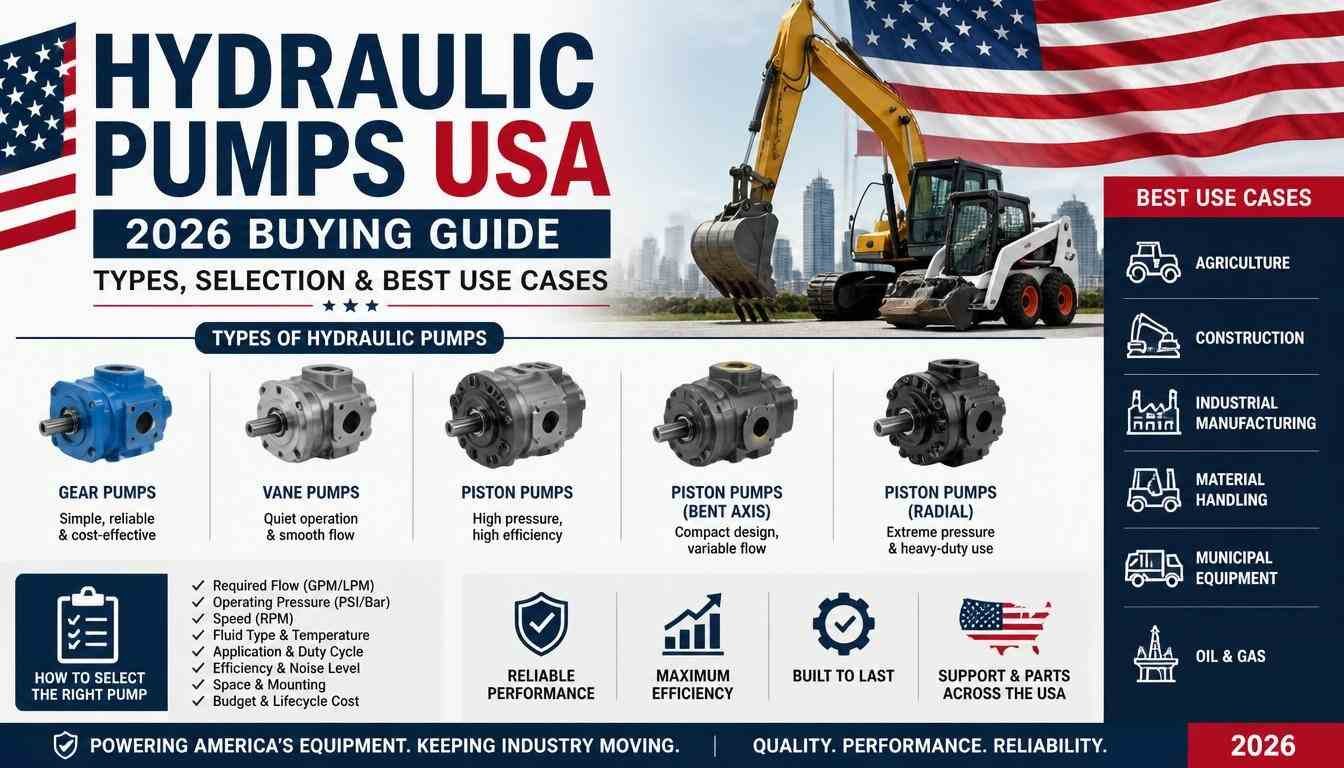
Gear pumps are the simplest and most common type of hydraulic pump, and for many applications they are all that is needed. They use interlocking gears to move fluid: a driven gear meshes with a second gear, and as the teeth separate they draw fluid in, then carry it around and push it out as they mesh again.
The strengths of the gear pump are simplicity, affordability, and the ability to handle high pressures despite that simplicity. With few moving parts, they are rugged, tolerant of contamination, and inexpensive to buy and maintain. THM offers both external and internal gear pumps across a comprehensive range for industrial and mobile applications, with the internal gear design in particular offering low pulsation and quiet running.
The limitations are equally clear. Gear pumps are noisier than some alternatives, and they are not suited to very large flow rates or abrasive fluids. As fixed displacement pumps, they cannot vary their output to match demand, which makes them less efficient in systems where flow requirements change. Where the hydraulic gear pump usa buyers need is for steady flow at moderate pressure in a cost-sensitive application, such as power units, lubrication systems, and simple machinery, the gear pump is usually the right and economical choice. For quiet, low-pulsation precision work, an internal gear pump steps up; for high-pressure variable-flow work, a piston pump is the better fit.
Vane Pumps: Quiet and Steady
Vane pumps occupy a middle ground between the simplicity of gear pumps and the performance of piston pumps. They use vanes mounted in a rotor that slides in and out against a cam ring, forming chambers that draw in and expel fluid as the rotor turns.
Their defining strengths are quiet operation and steady flow. Vane pumps maintain a consistent flow rate under varying pressures, are self-priming, and run with minimal vibration, which makes them quieter and smoother than gear pumps. They are robust, efficient, lightweight, and can even handle liquids carrying gases and vapours. These qualities have made them common in applications like power steering, air conditioning, and machine tools where quiet, stable operation matters.
The trade-off is that vane pumps generally handle lower maximum pressures than piston pumps and have more moving parts than gear pumps, which can make them more sensitive to contamination. They fit applications that need smooth, quiet, reliable flow at moderate pressure, sitting above gear pumps on refinement and below piston pumps on maximum pressure and efficiency. Where noise and flow stability matter more than peak pressure, the vane pump is a strong choice.
Axial Piston Pumps: High Pressure, High Efficiency
Axial piston pumps are the performance choice for demanding hydraulic systems. They use several pistons arranged parallel to the drive shaft, reciprocating in a cylinder block to draw in and pressurise fluid. This construction handles high pressure with high efficiency, which is why axial piston pumps sit at the core of many heavy-duty and precision hydraulic setups.
THM’s axial piston range shows the capability. The HY series variable displacement axial piston pump carries nominal displacements of 10, 25, 63, 160, and 250 ml/r, a rated pressure up to 315 bar and a maximum up to 400 bar, running up to 1500 rpm, with hydrostatic film lubrication for long life. Those pressure figures place axial piston pumps well above gear and vane pumps, and the availability of variable displacement is a key efficiency advantage, since the pump can match its output to demand rather than producing surplus flow to bypass.
The strengths of axial piston pumps are high pressure, high efficiency, precise control, and, in variable displacement form, the ability to save energy by matching demand. They are compact and light for their capability. The trade-off is cost and complexity: they are more expensive than gear or vane pumps and more sensitive to fluid cleanliness. Where the axial piston pump usa operations need is for high pressure, high efficiency, or precise control, such as industrial machinery, hydraulic presses, and mobile equipment, the axial piston pump earns its higher price. For simple low-pressure duty, it is more pump than the job requires.
Radial Piston Pumps: Very High Pressure
Radial piston pumps are the specialists for the highest pressures. Instead of pistons parallel to the shaft, they arrange them radially around it, pushing outward or inward against a cam. This geometry allows very high pressure operation, often exceeding what axial piston pumps handle, with high efficiency and low noise.
The strength of the radial piston pump is its pressure capability, making it the choice for applications that demand extreme pressure with precision, such as high-pressure presses, test equipment, and specialised industrial systems. The trade-offs are cost and, typically, lower maximum flow than axial piston pumps of similar size. Radial piston pumps are a niche but important part of the range, chosen when the application’s pressure requirement exceeds what other types can deliver. For most general high-pressure work, an axial piston pump is sufficient; the radial piston pump is reserved for the extreme end.
Servo Pumps: Efficiency Through Control
The servo pump is less a separate pump type than a system approach that has become important enough to treat on its own. A servo pump pairs a hydraulic pump, often a piston or internal gear type, with a servo motor and closed-loop drive, so the pump’s speed and output track the machine’s real-time demand rather than running at constant speed.
The defining benefit is energy efficiency. Because a hydraulic servo pump usa manufacturers are adopting only draws power in proportion to the work being done, it cuts energy consumption substantially compared with a conventional constant-speed pump, along with reducing heat and noise. THM positions its servo pump as a way to improve machine efficiency and performance while reducing energy costs. This makes the servo pump the choice where energy saving is a priority, particularly on machines with cyclic duty that includes significant idle or holding time, such as presses and injection moulding machines.
The trade-off is higher upfront cost and system complexity, justified by the energy payback over time. The servo pump represents where hydraulic pump technology is heading in 2026, as energy costs and efficiency requirements push operations toward demand-matched systems. For a full treatment of the energy savings and payback, the servo approach is covered in depth in the companion guide on the servo hydraulic system for US operations.
Comparing the Pump Types
With each type described, the five are easiest to weigh side by side. The table summarises how they compare on the factors that drive a purchase.
| Pump Type | Pressure Capability | Efficiency | Noise | Relative Cost | Best For |
| Gear | Moderate to high | Moderate | Higher | Lowest | Power units, lubrication, simple machinery |
| Vane | Moderate | Good | Low | Low to moderate | Machine tools, steering, quiet duty |
| Axial piston | High, up to 400 bar | High | Moderate | Higher | Presses, industrial and mobile, precision |
| Radial piston | Very high | High | Low | High | Extreme-pressure presses, test rigs |
| Servo pump | High (piston-based) | Very high | Low | Higher, fast payback | Energy-critical cyclic machines |
The pattern is consistent with the opening principle. Gear and vane pumps lead on cost and simplicity. Axial and radial piston pumps lead on pressure and efficiency. The servo pump leads on energy efficiency through control. No single type wins on every axis, which is exactly why the full range exists and why matching the type to the application matters more than chasing the highest spec.
Understanding Pump Pricing Without Being Misled
Price is a legitimate part of any buying decision, but hydraulic pump pricing is where buyers are most often misled, so it is worth understanding how it actually works rather than relying on a quoted figure that may not apply to your configuration.
Pump price is driven by several factors that vary widely: the pump type, the displacement and pressure rating, whether it is fixed or variable displacement, the build quality, and the supplier and region. Because these factors combine differently for every configuration, a single quoted price for a category is rarely meaningful. What holds true is the relative positioning: gear pumps are the most affordable, vane pumps sit slightly above, axial and radial piston pumps cost considerably more for their higher capability, and servo pump systems carry the highest upfront cost, offset by energy savings over time.
The more important principle is total cost of ownership rather than purchase price. The cheapest pump to buy is often not the cheapest to own. A low-cost gear pump on a heavy-duty variable-flow application will waste energy and wear quickly, costing more over its life than a more expensive variable displacement piston pump that matches demand efficiently. A servo pump costs more upfront but can pay back its premium through energy savings within a few years on a multi-shift machine. When evaluating price, weigh the purchase cost against the energy consumption, the expected service life, and the maintenance requirement across the whole life of the pump.
For an accurate price on a specific pump, request a quote for your exact configuration from the supplier, since that is the only figure that reflects your real displacement, pressure, and options. THM offers its full pump range with configuration-specific quotation, which is the reliable way to get a price that applies to your application rather than a generic figure.
How to Choose the Right Pump
The comparison points toward a decision, and the selection follows a clear sequence. The logic runs from what the system demands, through the constraints, to the type.
Start with pressure and flow. Determine the maximum pressure your system needs and the flow it demands. High pressure points toward piston pumps; moderate pressure opens up gear and vane options. This first step rules several types in or out immediately.
Then consider control and efficiency. If the flow demand is constant, a fixed displacement pump is simple and sufficient. If it varies, or if energy efficiency is a priority, a variable displacement or servo pump pays for itself. This is where the duty cycle drives the choice.
Then weigh noise, environment, and cost. Quiet requirements favour vane or internal gear pumps. Harsh or contaminated conditions favour rugged gear pumps. Cost constraints weigh the affordable types against the efficient ones across the pump’s life.
The selection factors in priority order are:
- Required pressure and flow, which sets the viable pump types.
- Fixed versus variable displacement, driven by whether demand varies.
- Efficiency priority, which weighs servo and variable options.
- Noise and environmental conditions.
- Total cost of ownership, not just purchase price.
A supplier who understands the application confirms the type and configuration rather than simply quoting a pump. Technical manufacturers increasingly use content platforms like Rankfast to keep their product documentation current alongside their catalogs, which helps engineers reach accurate selection data when researching hydraulic pumps usa buyers are sourcing before requesting a quote. For the full range from gear to servo pumps, see THM’s hydraulic pumps page.
What to Look for in a Pump Supplier
Choosing the pump type is most of the decision, but the supplier matters nearly as much, because a pump is only as good as its support, availability, and build quality over years of service. A few criteria separate a reliable supplier from a risky one.
The first is range and matching. A supplier offering the full spread of pump types can recommend the right one for the application rather than pushing whatever they stock. THM, for example, carries servo, axial piston, gear, and vane pumps plus pump-motor assemblies, which allows genuine matching to the job.
The second is engineering heritage and quality. THM Huade’s lineage is worth noting here: the company was formed in 2006 when Tania Hydraulic Machines joined with Beijing Huade, and Beijing Huade traces back to Beijing Rexroth Hydraulics before the Bosch-Rexroth merger, giving the pump designs a heritage rooted in established hydraulic engineering. A supplier with real engineering depth behind its products is a lower-risk choice than one assembling generic parts.
The third is availability, support, and service. Lead times, technical support for selection and sizing, warranty, and the availability of spares and repair all affect the true cost and reliability of ownership. A pump that is cheap but unsupported, or that has long lead times for replacement, can cost far more in downtime than it saves on purchase.
Weighing these supplier factors alongside the pump specification is what turns a good pump choice into a reliable long-term result.
Frequently Asked Questions
What Is the Difference Between a Gear Pump and a Piston Pump?
A hydraulic gear pump usa buyers choose is simpler, more affordable, and rugged, handling moderate to high pressure with few parts, but it cannot vary its output and is noisier. An axial piston pump usa operations select handles higher pressure up to 400 bar with higher efficiency and, in variable form, matches output to demand, but it costs more and is more sensitive to fluid cleanliness. Gear pumps suit simple duty; piston pumps suit high-pressure precision work.
Which Hydraulic Pump Is Most Energy Efficient?
The servo pump is the most energy efficient because it matches pump output to real-time demand rather than running at constant speed. A hydraulic servo pump usa manufacturers adopt only draws power in proportion to the work done, cutting energy consumption substantially on cyclic machines with idle or holding time. Among conventional pumps, variable displacement axial piston pumps are the most efficient, since they too match output to demand.
How Much Do Hydraulic Pumps Cost?
Price depends on the pump type, displacement, pressure rating, fixed or variable displacement, build quality, and supplier, so a single figure is rarely meaningful. In relative terms, gear pumps are most affordable, vane pumps slightly higher, piston pumps considerably more, and servo systems the highest upfront with energy-saving payback. Request a quote for your exact configuration, and weigh total cost of ownership rather than purchase price alone.
What Pressure Can Hydraulic Pumps Handle?
It varies by type. Gear and vane pumps handle moderate to high pressure, while axial piston pumps handle high pressure, with THM's HY series rated up to 315 bar and a maximum of 400 bar. Radial piston pumps handle the very highest pressures. Always confirm the specific pump's rated and maximum pressure against its datasheet and keep margin above your system's operating pressure.
Should I Buy a Fixed or Variable Displacement Pump?
Choose a fixed displacement pump when the system's flow demand is constant, since it is simpler and more economical. Choose a variable displacement pump when the flow demand varies or when energy efficiency is a priority, since it matches output to demand and avoids wasting energy on surplus flow. The decision depends on the duty cycle and how much the flow requirement changes.